Full-Color Night Vision Goggles Developed by Researchers
▼ Summary
– Human eyes cannot see infrared because infrared photons lack the ~1.6 electron volts needed to trigger vision, leaving over half of the Sun’s radiant energy invisible.
– A Beijing Institute of Technology team, led by Xin Tang and Ge Mu, built a device that converts infrared into full-color images rather than monochrome shades.
– The device pairs mercury telluride colloidal quantum dots, which absorb infrared, with a dual-layer OLED that emits visible color, producing natural-looking images.
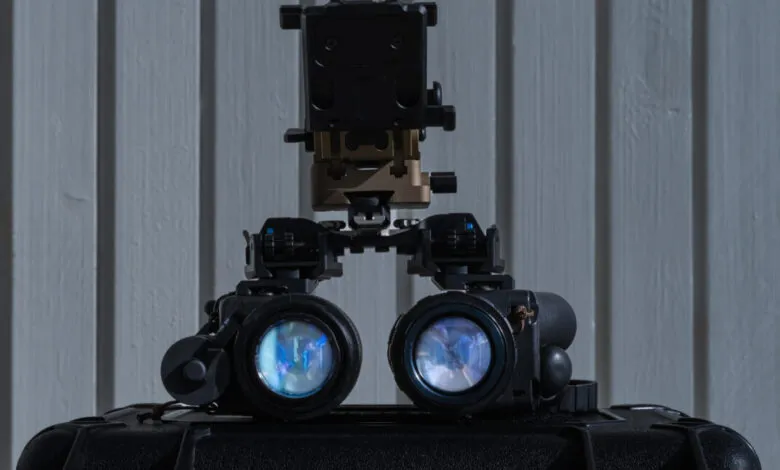
– Standard night-vision goggles translate infrared into brightness only, typically green, which underuses the eye’s superior ability to distinguish hues over brightness levels.
– The new approach assigns different infrared wavelengths to distinct visible colors, offering vision closer to natural sight.
Human sight evolved to capture only a narrow slice of the electromagnetic spectrum. Photons in the infrared range simply lack the energy, about 1.6 electron volts, needed to trigger the molecular shift in our retinal pigments that starts the chain of neural activity behind vision. As a result, more than half of the Sun’s radiant output, along with any object that emits heat rather than light, remains invisible to us. Yet researchers have long sought ways to translate that hidden radiation into something our eyes can process.
A group at the Beijing Institute of Technology, led by Xin Tang and Ge Mu, has now developed a breakthrough approach to infrared imaging. Rather than rendering infrared as a single monochrome glow, the way standard night-vision equipment does, their new device maps different infrared wavelengths onto distinct colors across the visible spectrum. The result is a full-color image that feels far closer to natural sight.
The technology hinges on a clever pairing of materials. Mercury telluride colloidal quantum dots absorb incoming infrared light, while a dual-layer OLED converts that absorbed energy into visible hues. When these layers are stacked with precise internal wiring, infrared radiation entering the device exits as a vivid, ordinary-looking picture.
Traditional night-vision systems rely on infrared photodetectors connected to visible-light LEDs. Those setups make heat visible, but only in terms of brightness: a warmer surface shines a little more intensely, a cooler one dims slightly, and everything appears in the same greenish tone. That approach leaves a lot on the table. Human eyes excel at distinguishing subtle differences in color, far more than they do at catching minor shifts in brightness. A system that only modulates intensity fails to tap into the eye’s most sensitive capabilities.
By assigning distinct colors to different infrared wavelengths, this new design leverages that natural strength. It offers a more intuitive view of the thermal world, one where temperature variations appear as rich tonal differences rather than faint gradations of light. The work opens the door to next-generation goggles and imaging tools that could make the invisible spectrum not just visible, but genuinely comprehensible.
(Source: Ars Technica)