Slab: The First MIDI Controller Made for Serato Studio
▼ Summary
– Serato’s Slab is a new, affordable ($329) MIDI controller designed to integrate with its Serato Studio DAW, aiming to emulate the successful hardware-software pairing of products like Native Instruments’ Maschine and Ableton’s Push.
– The controller’s design is heavily inspired by Maschine, but it is more streamlined and approachable, trading extensive controls and a large screen for simplicity to match its budget-friendly price point.
– While build quality is solid for plastic construction, the pads are decent but not exceptional, and a key limitation is that its advertised aftertouch feature is not supported by Serato Studio software.
– Slab successfully provides intuitive, hands-on control for core Serato Studio functions like sequencing, sampling, and using effects, making the music creation process more tactile and enjoyable compared to using only a mouse and keyboard.
– Its main drawbacks include sometimes cumbersome menu-diving due to multiple modes, limited control over third-party plugins, and it is best suited for existing Serato Studio users rather than as a tool to attract new converts.
For musicians already invested in the Serato ecosystem, the Slab controller offers a dedicated, tactile hardware companion for Serato Studio at an accessible price point. While established giants like Native Instruments’ Maschine and Ableton’s Push set a high bar for deep DAW integration, Serato’s entry aims to bring that hands-on magic to its own streamlined beat-making software. The Slab’s $329 price tag makes it a notably more affordable gateway into this style of integrated music production compared to its feature-packed, and often intimidating, competitors.
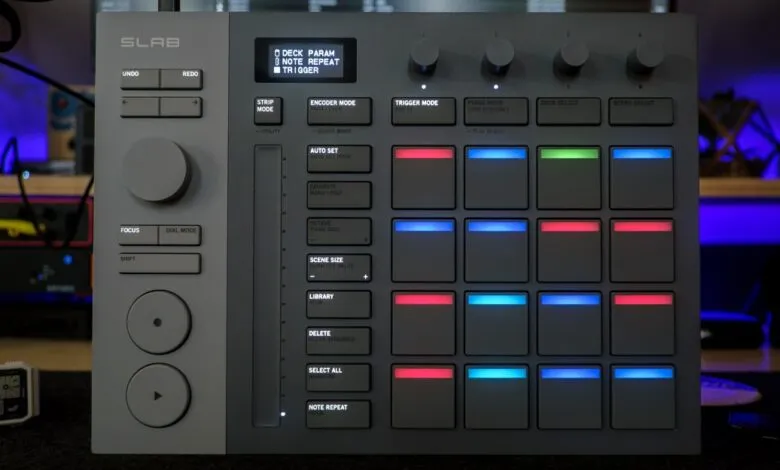
Visually, the Slab shares a strong family resemblance with devices like the Maschine, built around a central grid of sixteen velocity-sensitive pads. Its gray-on-gray design is clean and modern, though the labeling can be tricky to read in some lighting. The construction is entirely plastic, but it avoids feeling flimsy; the encoders offer satisfying resistance, buttons click decisively, and the large central dial has firm, precise detents. Connectivity is strictly utilitarian, with just a single USB-C port for power and data, there’s no built-in audio interface or traditional MIDI ports here.
The core pads are serviceable for finger drumming, though they don’t match the legendary feel of an Akai MPC. A notable omission is the lack of aftertouch support in Serato Studio, which feels like a missed opportunity. However, the RGB pad lighting is a practical standout, allowing for instant visual organization of drum hits and sample chops. The small screen provides basic feedback, but you’ll be relying on your computer monitor for any serious composition, which is standard for controllers in this category.
Where the Slab truly shines is in its seamless integration with Serato Studio. Essential workflows are brilliantly mapped to the hardware. It’s intuitive to sequence drum patterns, play melodic parts, or dive into the powerful stem separation technology borrowed from Serato Sample. Browsing your sound library and loading plugins can be done directly from the unit, reducing mouse dependency. The experience of chopping a drum break and building a beat feels immediate and engaging, transforming the software into a much more tactile and enjoyable instrument. Several performance effects, like a pitched looper and a wah, are also placed at your fingertips for live tweaking.
The controller isn’t without its quirks, however. Navigating its various modes and shift functions can become confusing. Changing parameters like note repeat rate or switching between sample chop modes often lacks clear visual feedback on the hardware itself, forcing you to glance back at the computer screen. While Serato Studio supports third-party VST and AU plugins, the Slab provides only limited control over these external instruments, which may frustrate synth enthusiasts.
Ultimately, the Slab is a focused tool designed for a specific user. It’s not likely to lure producers away from other established platforms. But for existing Serato Studio users who crave a more hands-on, physical interface, the Slab delivers a compelling and fun experience that makes beat-making feel direct and responsive, all without requiring a massive financial investment.
(Source: The Verge)