How to Photograph the Northern Lights in St. Louis This Week
▼ Summary
– Missouri and Illinois residents are experiencing rare northern lights displays this week due to powerful geomagnetic storms.
– Geomagnetic storms occur when solar particles collide with Earth’s magnetic field, creating colorful auroras and potentially disrupting technology.
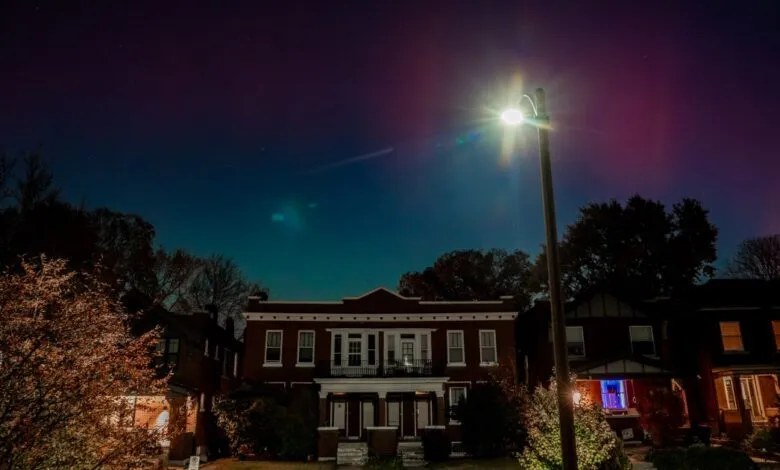
– The auroras appeared as pink and green ribbons Tuesday night, with better visibility in rural areas than cities like St. Louis and Kansas City.
– Another viewing opportunity was expected Wednesday night, though visibility might require ideal conditions away from light pollution.
– Photography tips include using night mode on phones, stabilizing cameras, facing north, and including local landmarks for unique compositions.
Residents of Missouri and Illinois have a remarkable opportunity this week to witness the aurora borealis, also called the northern lights, as intense geomagnetic storms create a celestial display. This phenomenon occurs when charged solar particles interact with Earth’s magnetic field, producing vibrant ribbons of color in the night sky. While these storms generate breathtaking visuals, they can also interfere with satellite signals, GPS navigation, and power systems.
On Tuesday evening, shimmering pink and green hues illuminated the heavens, appearing more vividly in countryside locations than in urban centers like St. Louis or Kansas City. The spectacle results from coronal mass ejections, tremendous expulsions of plasma and magnetic energy from the sun that travel through space toward our planet. Another chance to observe the aurora is anticipated Wednesday night, though visibility may require photographic assistance rather than relying solely on the naked eye. The optimal viewing period typically occurs shortly after sunset.
For those eager to photograph the northern lights in the Midwest, here are practical suggestions for capturing the moment.
Location
Travel away from city centers to reduce interference from artificial lighting. Seek out a dark spot with an unobstructed northern horizon for the clearest perspective on the aurora. Including a recognizable local feature, such as a barn, silo, or tree, in the foreground can lend a distinctive sense of place to your images.
Equipment
You don’t need expensive gear to take impressive photos of the night sky.
Using a smartphone, disable the flash and activate night mode. Stability is crucial; place your phone on a steady tripod, a fence post, or another solid surface. Engaging the timer function minimizes blur caused by pressing the shutter button. Always wipe your lens with a soft cloth to avoid smudges that can degrade image quality. If you have access to one, a wide-angle lens helps encompass more of the expansive sky. Helpful applications like My Aurora Forecast & Alerts can assist in tracking auroral activity and planning your outing.
Settings
For DSLR or mirrorless camera users, experiment with a long exposure, a wide aperture, and a low ISO setting. Finding the right equilibrium among these three factors is essential for recording the subtle light typical of midlatitude auroras. Whenever possible, shoot in RAW format. This preserves more data and allows greater flexibility during post-processing.
Enjoy the Experience
Each auroral display is unique. If your initial shots aren’t perfect, take a moment to breathe and readjust your approach. Remember that the real magic lies in the experience itself, sharing the wonder of a glowing sky with companions or loved ones is just as meaningful as photographing it.
Have you captured a striking image of this week’s northern lights? You can submit your photos to social@stlpr.org for a potential feature on our platforms.
(Source: stlpr npr)