Cyberdeck: The Future of VR Personal Computing
▼ Summary
– William Gibson’s 1984 novel *Neuromancer* conceptualized a “cyberspace deck” for accessing a virtual “matrix,” an idea that now inspires real-world DIY computing projects.
– A modern “cyberdeck” is fundamentally a portable, personal data store, beginning with terabytes of local files accessible across various operating systems and in VR.
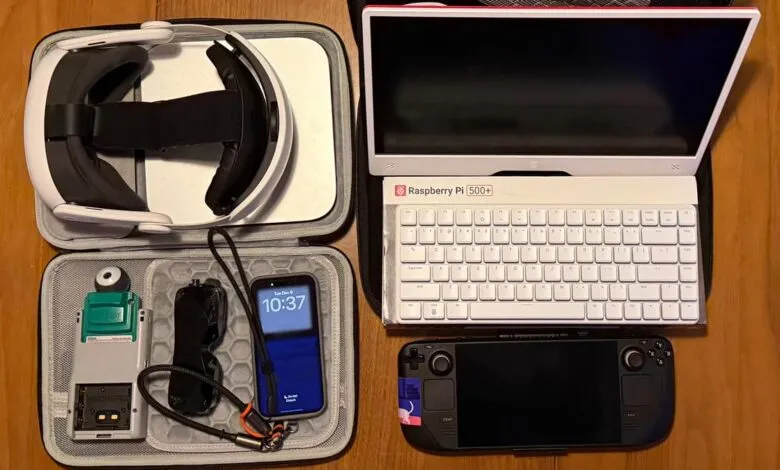
– Current entry-level cyberdeck builds, like a modified Raspberry Pi keyboard computer, prioritize portability and custom data storage but lack seamless VR software integration.
– The ideal future cyberdeck, such as a powerful, upgradeable Framework laptop, would combine high-end portable computing with the ability to fully immerse and interact in VR.
– The article argues that mainstream VR adoption is hindered by the lack of a personal, portable cyberdeck companion to manage and access one’s data seamlessly within virtual environments.
The concept of a personal cyberdeck, once pure science fiction, is edging closer to reality as virtual and spatial computing mature. These portable, powerful devices promise to be the key that unlocks truly personal and persistent data within immersive digital worlds. The idea, popularized by William Gibson’s Neuromancer, describes a custom hardware rig used to project consciousness into cyberspace. Today, enthusiasts are building the first real-world versions, driven by a desire to carry and access vast personal data stores seamlessly in VR.
So, what exactly constitutes a modern cyberdeck? Fundamentally, it begins with personal data. Many of us already carry significant storage in our smartphones. The vision expands this into terabytes of videos, photos, music, and files, all organized in a portable format. This data store becomes the core of a custom system, accessible across various operating systems and, crucially, within virtual reality. The recent advent of standalone headsets with robust computing power has started to unlock this potential, allowing users to wirelessly access local drives and display them as virtual screens, creating a private digital workspace invisible to the physical world.
This collision of personal storage models with immersive technology highlights both possibility and friction. While we can pour our digital lives into portable devices, from affordable thumb drives to high-end laptops, the software to seamlessly access these “decks” in VR often requires creative workarounds. The goal is straightforward: to bring true personal computing, with all one’s own files and preferences, directly into virtual environments.
For those starting out, entry-level decks demonstrate the core principle. A device like the Raspberry Pi 500+, a keyboard with a built-in computer, can be customized with substantial solid-state storage. It runs Linux and, while not powering a VR experience itself, can be accessed within VR as a virtual terminal. The challenge lies in the current need for technical hacks like VNC or capture cards to bridge the gap, pointing to a clear software opportunity. Alternatively, devices like the Steam Deck offer a more user-friendly, console-like form of portable Linux computing, providing another foundation for a personalized hardware and software stack.
Looking forward, the framework for a high-end cyberdeck is clear. Imagine a powerful, upgradeable laptop, like one from Framework, equipped with a top-tier graphics card and ample RAM, dedicated to driving VR. This represents the premium vision: a deck that matches the investment in a high-end headset, fully embracing the cyberspace concept. Whether starting with a simple thumb drive or a complex multi-thousand-dollar system, the computer becomes truly “custom” and “personal” when it houses your organized, searchable, and immediately accessible data library.
This need is particularly acute for cutting-edge hardware. A headset like the Bigscreen Beyond fundamentally requires a companion deck to reach its potential. The core experience is about having your personal storage device, separate from the computer itself, instantly available at your fingertips in VR. True data portability isn’t about waiting for cloud downloads; it’s the decades-old concept of removable storage, granting the freedom to unplug your content and yourself, taking your entire digital world anywhere.
The evolution from MP3 players to smartphones shows how a personal data hub can consume and remake product categories. Spatial computing is triggering a similar shift. In VR, any surface can become a display, and physical devices like phones can be used for input while their screens remain off. You could play a game while feeling physically present in its world, holding a controller that resembles an in-game item. The term “cyberdeck” remains largely conceptual, but its slow adoption might be because we’re missing these companion devices. We interact with VR using abstracted controllers instead of a personalized deck that grounds us with our data and maps our journey.
The future points toward compact pucks or glasses that carry terabytes between headsets, finally providing that seamless bridge to cyberspace. For now, the community builds and prototypes, making fiction tangible one Reddit post and custom rig at a time.
(Source: Upload VR)