Boom Supersonic Secures $300M for Crusoe Data Center Turbines
▼ Summary
– Boom Supersonic will sell a stationary power plant version of its turbine engine, with data center startup Crusoe as its first customer for a $1.25 billion order.
– The profits from selling these Superpower turbines will fund the continued development of Boom’s Overture supersonic aircraft, a strategy compared to SpaceX using Starlink to fund rockets.
– The Superpower turbine shares 80% of its parts with Boom’s airborne Symphony engine and targets 39% efficiency, similar to competitors.
– While the turbine’s base cost is high, the total project cost for customers will be significantly higher as they must provide additional infrastructure like pollution controls.
– Boom plans to scale production to 4 gigawatts worth of turbines by 2030, but faces significant challenges in scaling up manufacturing.
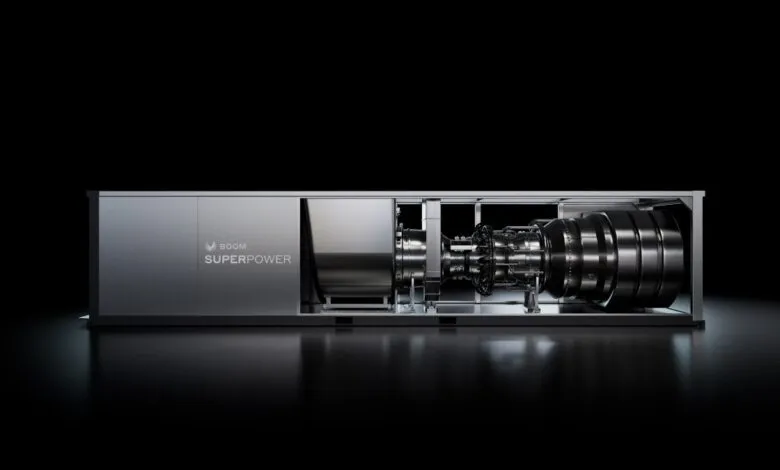
In a strategic move to fund its ambitious aviation goals, Boom Supersonic has secured $300 million in new funding to launch a stationary power turbine business, with data center firm Crusoe as its inaugural customer. The investment round was spearheaded by Darsana Capital Partners and included notable participants such as Altimeter Capital, Ark Invest, and Bessemer Venture Partners. This capital injection is earmarked for commercializing Boom’s new Superpower stationary turbine, a 42-megawatt unit derived from the company’s aircraft engine technology. The venture’s first major deal is a substantial agreement with Crusoe, which has committed to purchasing 29 turbines for $1.25 billion to generate 1.21 gigawatts of power for its data center operations.
Boom’s founder and CEO, Blake Scholl, framed this new business line as a critical funding mechanism for the company’s core project: the Overture supersonic airliner. He drew a direct parallel to SpaceX’s strategy, where the profitable Starlink satellite internet service helps finance rocket development. “I’ve been kind of keeping my eyes open for 10 years for what could be our Starlink,” Scholl remarked, emphasizing that the turbine venture aligns perfectly with the company’s engineering path without being a distraction. Revenue generated from Superpower sales will be funneled directly into the continued research and development of the Overture aircraft.
The technical synergy between Boom’s aviation and energy divisions is significant. The Superpower turbine shares approximately 80% of its parts with the Symphony engine designed for the Overture jet. This commonality allows Boom to leverage its aerospace engineering while entering the energy market. The turbines are slated for delivery beginning in 2027, with manufacturing details for a dedicated factory expected next year. Initially, production will occur at Boom’s existing facilities before scaling up to a larger plant, with ambitious output targets of 1 gigawatt worth of turbines in 2028, scaling to 4 gigawatts by 2030.
For Crusoe, the agreement involves a cost of $1,033 per kilowatt of generating capacity. This price covers the turbine, generator, control systems, and preventative maintenance from Boom. However, it excludes several major expenses that fall to Crusoe, including pollution controls, electrical connections, and site preparation. When these additional costs are factored in, the total project expense likely rises considerably. Analysts suggest that applying standard industry cost percentages could push the final price over $2,000 per kilowatt, placing it in a premium segment of the market.
In terms of performance, the Superpower turbine is targeting 39% efficiency in its initial simple-cycle configuration, which is competitive with similar aeroderivative units on the market. For context, more advanced combined-cycle plants, which recapture exhaust heat, can achieve efficiencies above 60%. Scholl noted that Boom is developing a “field upgrade” kit to eventually convert its simple-cycle turbines to combined-cycle operation, though such a modification would extend installation timelines significantly.
Logistically, the turbines will be delivered in shipping-container-sized modules, a standard practice for aeroderivative units. Data center developers like Crusoe are then responsible for the necessary gas, electrical, and emissions control hookups. On the issue of noise, Scholl stated the plants should be “no louder” than existing comparable turbines, though that benchmark is not insignificant; similar installations have been audible to residents from distances of half a mile or more.
This pivot into the energy sector represents a calculated gamble for Boom Supersonic. Successfully scaling turbine production could create a formidable revenue stream to accelerate the return of commercial supersonic flight. However, the path is fraught with the classic challenges of hardware manufacturing and scaling. The company must navigate the difficult transition from a promising startup to a reliable industrial supplier, a journey where many have faltered. If Boom can execute its plan, it may not only power data centers but also propel the future of high-speed travel forward faster than anticipated.
(Source: TechCrunch)