Saudi Arabia’s Space Economy to Hit $31.6B by 2035
▼ Summary
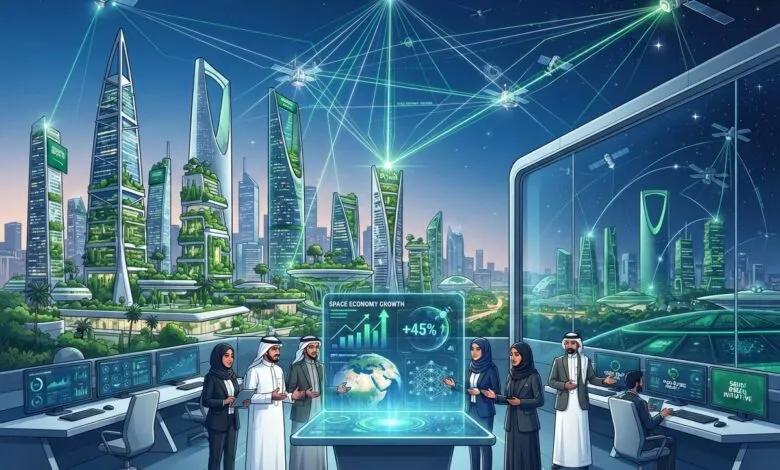
– Saudi Arabia’s space economy is projected to nearly quadruple from $8.7 billion in 2024 to $31.6 billion by 2035, driven by investments in satellite technologies and digital infrastructure.
– The Digital & Space Sustainability Report 2026 highlights the critical role of space-based services in addressing environmental challenges, such as climate monitoring and disaster response.
– The Kingdom boasts a robust digital foundation with 99.6% internet penetration and the highest global ICT Development Index score, supporting its growing digital economy which accounts for 15% of GDP.
– Business adoption of artificial intelligence has surged to 33.1% in 2025, providing a commercial base for adjacent sectors like cloud computing and satellite services.
– Women’s participation in the digital sector reached 35% in 2025, marking a significant increase from 2018 and establishing the highest rate in the Middle East and North Africa region.
Saudi Arabia’s space economy is forecast to surge from $8.7 billion in 2024 to $31.6 billion by 2035, a trajectory driven by aggressive investments in satellite technologies, digital infrastructure, and space-based services. This expansion aligns with the Kingdom’s broader goals of economic diversification and sustainability, as detailed in the Digital & Space Sustainability Report 2026. Published by the Communications, Space and Technology Commission (CST) with support from the International Telecommunication Union (ITU), the report underscores how space assets are becoming central to national development strategies.
The optimistic outlook mirrors findings from the KSA Space Market Report 2025, which estimates a compound annual growth rate of approximately 12% through the end of the decade. This rapid expansion is not occurring in isolation but is deeply intertwined with the Kingdom’s robust digital ecosystem and environmental commitments.
Satellite Technologies Drive Environmental Solutions
A key theme in the new report is the critical role of space technology in addressing climate change and resource management. The data indicates that more than 50% of essential climate variables can now be measured via satellite systems. This capability makes space-based monitoring indispensable for tracking environmental shifts and managing natural resources efficiently.
Potential applications span multiple sectors, including:
- Water management and conservation
- Agricultural optimization
- Desertification monitoring
- Disaster response coordination
As the commercial space sector matures, these Earth observation services are expected to expand significantly, providing both economic value and ecological benefits.
Digital Infrastructure Lays the Groundwork
The foundation for this space-driven growth is Saudi Arabia’s world-class digital infrastructure. By 2025, internet penetration had reached an impressive 99.6%, with fiber-optic networks extending to over 3.9 million homes. Furthermore, the Kingdom achieved a score of 99.2 points on the ITU ICT Development Index 2025, marking it as the highest-rated nation globally in terms of information and communication technology readiness.
These metrics highlight the scale of investment in connectivity, which serves as a vital platform for integrating advanced technologies into the wider economy. The digital economy itself has become a major economic pillar, contributing 15% of GDP in 2024. This amounts to SR459 billion (approximately $122.4 billion), cementing Saudi Arabia’s status as having the largest ICT market in the region.
This extensive commercial base supports adjacent high-tech industries, including artificial intelligence (AI), cloud computing, and satellite services. AI adoption among businesses has accelerated rapidly, rising to 33.1% in 2025, a 20% increase from the previous year according to the General Authority for Statistics.
Inclusivity and Talent Development
The report also highlights significant progress in workforce diversity. Women now account for 35% of participation in Saudi Arabia’s digital sector. This figure represents a dramatic rise from just 7% in 2018 and stands as the highest rate in the Middle East and North Africa (MENA) region. It also surpasses averages recorded in G20 nations and the European Union, reflecting a concerted effort to build a diverse domestic talent pool capable of sustaining technology-led growth.
Strategic Integration of AI and Space
Abdullah Al Swaha, Saudi Minister of Communications and Information Technology, emphasized the strategic vision behind these developments. He stated:
> “The Kingdom is seeking to unlock the potential of AI and digital innovation as tools for sustainable development.”
This perspective frames AI, connectivity, and space infrastructure not as siloed sectors, but as complementary technologies working in tandem. The integration aims to drive economic development, protect the environment, and improve societal outcomes simultaneously.
Alignment with the Saudi Green Initiative
The growth of the space and digital economies is explicitly linked to the Saudi Green Initiative, launched in 2021. Since its inception, more than 85 initiatives have been launched under this banner, with 10 already completed. Key achievements include:
- Rehabilitation of one million hectares of land
- Connection of over 3.6GW of renewable energy to the national grid
- Planting of more than 161 million trees
- Protection of 18.1% of terrestrial areas and 16.1% of marine areas
- Release of 10,000 wild animals into nature reserves and national parks
Why This Matters
The projected quadrupling of the space economy by 2035 signals a shift in how the sector is perceived. It is no longer viewed solely as a niche scientific or defense endeavor but as a core component of the national technology economy. Satellite communications, Earth observation, and data-driven services offer tangible commercial opportunities while reinforcing national infrastructure and sustainability targets.
The success of this strategy hinges on the ability to translate government-led investment into a vibrant commercial ecosystem. By leveraging existing strengths in broadband, high internet penetration, and AI adoption, Saudi Arabia is positioned to add new layers of data, connectivity, and environmental intelligence to its technological landscape.
(Source: ME Tech Watch)