▼ Summary
– Tissium raised €60M to commercialize COAPTIUM CONNECT, the only FDA-cleared sutureless nerve repair system, which uses a light-cured polymer glue instead of stitches.
– The €60M combines a €30M Series D2 round led by an undisclosed US investor and a €30M credit line from the European Investment Bank, tied to commercial and clinical milestones.
– In a 12-patient study, all participants regained full movement and reported no pain a year after digital nerve repair, leading to FDA De Novo authorization in November 2025.
– The company’s biomorphic programmable polymer is a synthetic glue that dissolves over months, avoiding donor tissue and nerve-piercing sutures used by competitors like Axogen.
– Tissium aims to build a US sales force and advance its pipeline, including a hernia repair device, with the funding to transition from development to commercial-stage operations.
Tissium has secured €60M in financing to bring the world’s only FDA-cleared sutureless nerve repair system into U.S. operating rooms. The Paris-based medtech company aims to replace the surgeon’s needle with a dab of light-cured glue, offering a gentler alternative for repairing severed nerves.
For decades, the standard repair for a severed nerve has remained largely unchanged. A surgeon stitches the two frayed ends together under a microscope, hoping the needle doesn’t damage the very tissue it’s meant to mend. Results vary widely. One recent meta-analysis found that only 54% of patients regain meaningful function after such surgery.
Tissium believes it has a better solution. The company has just closed a €60M financing package to push its sutureless system into U. S. operating rooms. Its first product is already on sale there.
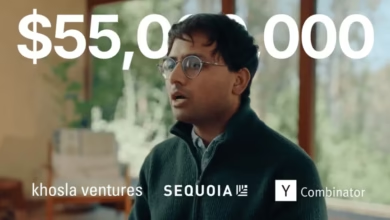
The deal is split into two parts. The first is a €30M Series D2 round, completed at the end of 2025, led by an undisclosed U. S. family-owned investor. New family offices, wealthy individuals, and existing backers also participated. The second part is a credit line of up to €30M from the European Investment Bank, arriving in three tranches of €10M each. Each tranche depends on commercial, clinical, and financing milestones. The mix of dilutive and venture debt allows Tissium to draw the first tranche before the end of June.
The raise brings the company’s total funding to more than €200M since 2013. Cathay Health led its previous round, a €50M Series C, in 2024, and the French life-sciences investor Sofinnova also backed it.
Nerve surgery is delicate work. The tissue is soft, and every stitch creates a small wound. Pushing a needle through a nerve risks scarring the fibers that need to regrow, which partly explains why recovery so often falls short. Tissium’s pitch is to stop piercing the nerve altogether. Its flagship product, COAPTIUM CONNECT, uses a small 3D-printed chamber that fits around the two severed ends without penetrating them. A surgeon then squeezes a liquid polymer around the join and sets it hard with a blue-light pen. The seal holds the nerve in place while it heals, and the device dissolves over the following months, leaving nothing behind.
The company’s real asset is the material itself. Tissium calls it a biomorphic programmable polymer. The synthetic glue contains no human or animal tissue, unlike rival products that rely on donors. In theory, the platform can stretch to many different repairs.
The clinical signal is small but striking. In a 12-patient study of digital nerve injuries, every participant regained full movement. None reported pain a year after surgery. On that basis, COAPTIUM CONNECT won FDA De Novo authorization and went on sale in the U. S. in November 2025. It is, the company says, the only FDA-cleared sutureless nerve repair system of its kind. That claim is the heart of the sales pitch and why investors are betting on a device with such a short track record.
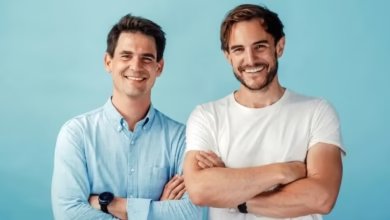
Tissium has been around since 2013, co-founded by Christophe Bancel and Maria Pereira. Pereira invented the core polymer during her PhD in the MIT Portugal Program, working in the labs of Robert Langer and Jeffrey Karp. The company sits in Paris, with a U. S. office in Cambridge, Massachusetts, and a factory in Roncq, northern France. “We are now executing on our transition into a commercial-stage medtech company,” said Christophe Bancel, the chief executive and co-founder. That long gestation is normal for medical devices, where regulators move slowly and proof takes years. It also explains the shape of this raise. Tissium is no longer trying to invent something. It is trying to sell it.
The prize is large and getting larger. The global market for peripheral nerve repair devices was worth about $13.4bn in 2025 and could reach $30.5bn by 2033, growing at roughly 15% a year. Trauma cases are rising, and surgeons are shifting toward gentler, absorbable repairs. But Tissium will not have it to itself. The U. S. firm Axogen dominates today, with a market value near $1.67bn. Its main nerve graft won full FDA biologics approval in December 2025. Integra LifeSciences holds strong positions in nerve conduits and wraps. Both, though, lean on donor-derived material, and both still need sutures to finish the job. Tissium’s wager is that surgeons will prefer a synthetic device that never touches the inside of the nerve.
The structure of the deal says something about European medtech. The EIB has become a regular backer of the region’s health and deep tech companies, recently investing in firms working on brain protection and cancer drugs. Its cash buys time without forcing a startup to give away large chunks of equity. That matters because medtech funding in Europe is tight, and investors tend to want commercial proof early. A milestone-linked loan from a public lender helps bridge the gap between a first approval and real revenue. Tissium has followed a path other EIB-backed devices took. Ireland’s Neuromod paired equity with EIB venture debt to fund its tinnitus treatment. It is also part of a wider French push into U. S. clinics. Other medtech firms from the country, like HeartFocus with its AI cardiac imaging, are making the same leap.
The science looks proven. The harder question is commercial. Can a European startup build a U. S. sales force fast enough to win surgeons’ loyalty? Axogen is busy entrenching its newly approved products in the same operating rooms. Tissium also has a pipeline to feed. Its hernia repair device, ECLIPSIUM, won an FDA investigational exemption in September 2025 and has finished European enrollment toward a CE mark. The polymer platform stretches to cardiovascular sealing too. Each new use is another costly trial.
The €60M, in other words, does not need to last forever. It needs to last long enough to turn one cleared device into a habit in the operating room. Whether surgeons reach for the glue over the needle is now the only question that matters.
(Source: The Next Web)