Blue Origin rocket reuse success offset by upper stage failure
▼ Summary
– Blue Origin successfully launched and landed a reused New Glenn booster for the first time, but the overall mission ended with a setback.
– The New Glenn rocket, standing 321 feet tall, launched from Florida and its first stage separated after three minutes.
– The booster, named “Never Tell Me The Odds,” completed its second flight by landing on a ship in the Atlantic Ocean.
– The company installed new engines for this flight but plans to reuse the engines from the booster’s first mission in the future.
– Reusing New Glenn boosters is central to Blue Origin’s strategy for competing in the launch market and achieving a faster launch rate.
Blue Origin’s third New Glenn launch on Sunday delivered a significant milestone alongside a serious complication. The mission successfully demonstrated the reuse of an orbital-class booster for the first time, a critical step toward operational efficiency. However, the flight concluded with an upper stage failure, casting a shadow over the achievement and presenting a new challenge for a rocket central to NASA’s Artemis lunar program.
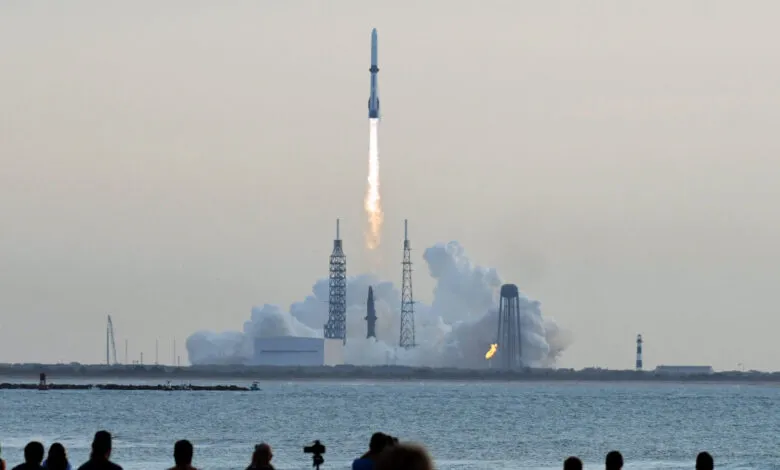
Liftoff occurred at 7:25 AM EDT from Cape Canaveral Space Force Station in Florida. The 321-foot-tall vehicle, powered by seven methane-fueled BE-4 engines, ascended steadily. Roughly three minutes into the flight, the first stage separated as planned. The booster, named Never Tell Me The Odds, then executed a precise return. After a brief arc into space, it performed a series of engine burns to guide itself toward a landing ship stationed hundreds of miles downrange in the Atlantic Ocean. The successful touchdown marked the booster’s second flight, having previously launched and landed in November.
This booster recovery represents a major technical leap for Blue Origin. While the company has extensive experience reusing its suborbital New Shepard vehicle, New Glenn operates on a far more demanding scale. It flies higher, achieves greater velocities, and is substantially larger. The company’s CEO, Dave Limp, noted that while new engines were fitted for this mission, the plan is to eventually reuse the BE-4 engines from the November flight on future launches, aiming for deeper cost savings.
The ultimate goal of booster reuse is to dramatically increase launch tempo and reduce costs, a model proven by competitors like SpaceX. Yet the mission’s conclusion underscored the difficulties ahead. Following stage separation, the upper stage, powered by two BE-3U engines, failed to complete its objectives. This setback will require a thorough investigation, delaying progress toward New Glenn’s role in the competitive launch market and its planned missions for NASA.
The mixed results highlight the complex path toward reliable, reusable heavy-lift rockets. While recovering the first stage is a foundational victory for operational reuse, resolving the upper stage anomaly is now the immediate priority for Blue Origin’s flagship launch system.
(Source: Ars Technica)