Inside a Day at America’s Most Powerful Laser Lab
▼ Summary
– The Texas Petawatt laser, one of the most powerful in the U.S., was located two floors underground at the University of Texas at Austin.
– It was a government-funded research center within the LaserNetUS network, but is currently closed due to funding cuts.
– The laser amplified light to a power exceeding the entire U.S. electrical grid and compressed it into an ultra-short pulse to create extreme conditions.
– Scientists used it to study diverse topics, including stellar physics, fusion energy, and potential cancer treatments.
– Experiments involved targeting extremely thin materials, and a typical “shot day” consisted of long preparation followed by a tense, brief firing sequence.
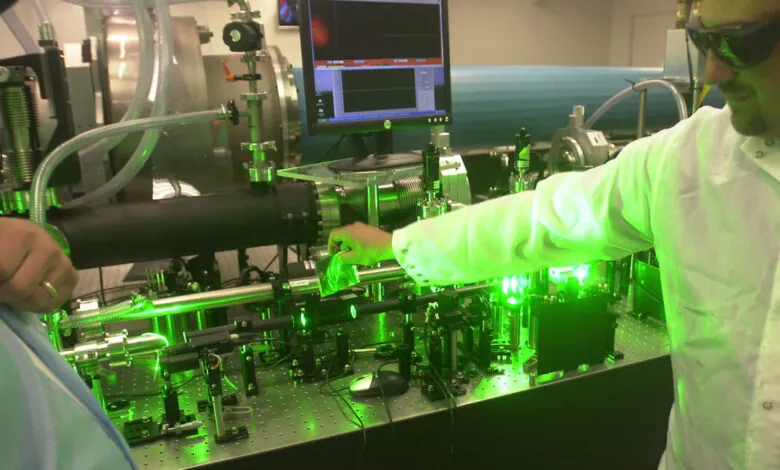
Beneath the campus of the University of Texas at Austin, hidden two floors underground, lies a facility that once harnessed the power of a star. The unassuming Physics, Math, and Astronomy building fronts a 17-story tower, but its most significant asset was concealed behind heavy, logo-stamped doors most students passed without a glance. There, the Texas Petawatt laser operated as one of the nation’s most potent sources of light, a cornerstone for cutting-edge scientific research until its recent closure.
From 2020 to 2024, I served as the lead laser scientist for this remarkable instrument, known to our team simply as the TPW. It functioned as a government-funded user facility, part of the Department of Energy’s LaserNetUS network. Researchers from across the United States would compete for precious time on the system, drawn by its unique capabilities to probe the frontiers of physics and medicine.
The core principle involves manipulating an incredibly brief pulse of light. First, the laser stretches the pulse to a manageable duration to prevent it from destroying its own optics. It then amplifies that light to an almost unimaginable intensity. For a fleeting moment, the beam delivers more power than the entire U. S. electrical grid. Finally, the system compresses the pulse back down to a mere trillionth of a second, concentrating that colossal energy to create stellar conditions inside a vacuum chamber.
A day dedicated to firing this laser, a “shot day,” was rarely dramatic in the cinematic sense. The target could be a sliver of metal foil thinner than a hair, a precise gas jet, or a microscopic plastic pellet. Each configuration was meticulously prepared to answer a specific question, whether about the inner workings of stars, the potential for fusion energy, or novel pathways for cancer therapy.
The reality of the work contrasted sharply with science fiction portrayals. It consisted largely of quiet, methodical preparation and calibration. The team would spend hours in repetitive checks and adjustments. The climax of the entire process, the actual firing of the petawatt beam, lasted only about ten seconds. In that tense, silent interval, the accumulated effort of the day culminated, holding the promise of new data and a deeper understanding of our universe.
(Source: Ars Technica)