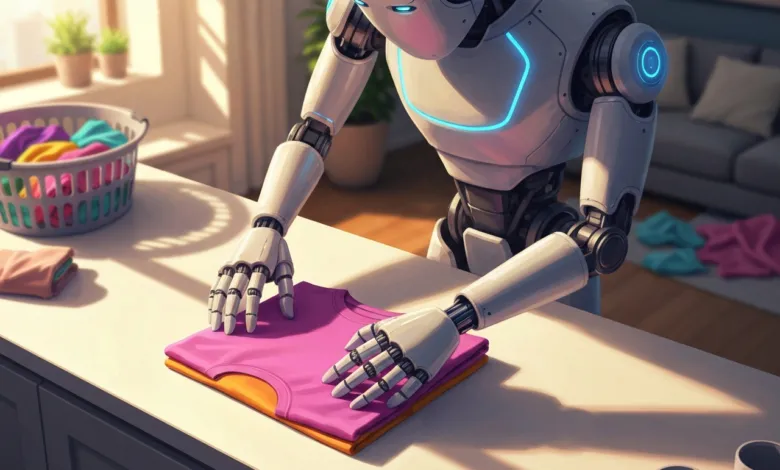
AI learns from videos of everyday tasks like folding laundry
▼ Summary
– Tech companies are using video footage of humans performing household chores to advance robotics.
– They pay gig workers hourly rates, sometimes reaching $25, to create this training data.
– The workers film themselves completing a variety of routine domestic tasks.
– This data collection is intended to help train and develop more capable AI-powered robots.
– The initiative represents a strategic effort to accelerate progress in home automation.
A quiet revolution is taking shape in the world of robotics, and its training ground is the most ordinary of places: the home. Leading technology companies are now leveraging vast libraries of video footage depicting simple domestic chores to teach artificial intelligence systems. The goal is to create robots that can understand and replicate the nuanced physical actions humans perform every day, from folding a shirt to wiping a counter.
To build these essential datasets, companies are turning to a modern workforce: gig laborers. These individuals are paid, in some cases, up to $25 per hour, to record themselves completing a wide array of household tasks. This method provides a rich, varied stream of visual data that is far more complex and informative than simulated environments or scripted demonstrations. Each video clip of a person loading a dishwasher or making a bed becomes a critical lesson in dexterity, context, and problem-solving for an AI model.
This approach represents a significant shift in robotics training. Instead of programming machines with rigid, pre-defined instructions for every possible scenario, researchers are using video learning to help AI develop a more generalized understanding of physical tasks. The algorithms analyze the sequences of movement, the interaction with objects, and the subtle adjustments people make almost unconsciously. This process, often called imitation learning or learning from demonstration, allows systems to infer the intent behind an action and adapt to minor variations in their environment.
The implications for domestic robotics and automation are profound. Success in this field could eventually lead to assistive machines that help with elder care, reduce domestic labor burdens, or perform repetitive tasks in settings like hotels and hospitals. However, the path forward is lined with immense technical challenges. Translating two-dimensional video observations into reliable, three-dimensional physical actions requires overcoming hurdles in perception, spatial reasoning, and mechanical control.
While a future with helpful robot assistants remains on the horizon, the current strategy is clear. By meticulously studying the mundane work of daily life, captured frame by frame by human hands, engineers are laying a new foundation for machine intelligence. The hope is that by learning from us in our most natural state, completing everyday tasks, robots will one day seamlessly integrate into our world.
(Source: The Washington Post)