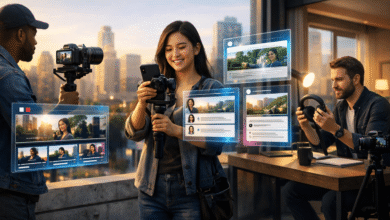
Gen Z-Proof Your Google Ads: Win the 18-24 Market

▼ Summary
– An aging customer base signals that brands are failing to reach Gen Z, who discover and evaluate products differently than older generations.
– Gen Z expects authentic, non-interruptive advertising, favoring real people, natural language, and content that blends into their feeds over polished ads.
– Product discovery for Gen Z often starts on platforms like TikTok, YouTube Shorts, and Instagram Reels, not Google Search, which they use later for verification.
– Advertisers must adapt by using conversational ad copy, native-style creative assets, and attribution models that account for Gen Z’s nonlinear, multi-platform buyer journey.
– Google’s shift toward intent-based matching and automated campaigns like Performance Max requires advertisers to update strategies beyond keyword-centric approaches to maintain visibility.
When a brand’s customer base starts to age, the issue typically isn’t a failure of the advertising platform. It’s a sign that younger consumers are finding and buying products in entirely new ways, and many established companies haven’t caught up. To connect with the 18-24 demographic, marketers must fundamentally rethink their approach to platforms like Google Ads, moving beyond traditional keyword funnels to meet this audience where they are.
Gen Z, ranging from 14 to 29 years old as of 2026, is the first truly digital-native generation. They’ve never known a world without smartphones, social video, or instant access to information. This upbringing has fundamentally shaped their expectations. They have little patience for interruptive advertising, with studies indicating their active attention for a digital ad can vanish in just over one second. For them, authenticity isn’t a bonus, it’s the baseline requirement. They prefer brands that showcase real people, use natural language, and embrace genuine, less-polished visuals over slick corporate productions. A staggering 84% of this group says they trust brands more when they see actual customers in advertisements.
Their journey to a purchase looks nothing like a traditional sales funnel. Discovery often begins not on Google, but on visual platforms like TikTok, YouTube Shorts, and Instagram Reels. Recent data shows 64% of Gen Z uses TikTok as a primary search tool, and 77% see it as a top platform for finding products. They might watch a short-form video, seek social proof on Reddit, then finally turn to a Google search to verify what they’ve learned. This loop-like path makes social proof and user-generated content (UGC) incredibly powerful, with unboxing-style clips known to boost conversion rates significantly.
Google’s own tools are evolving to meet this behavior. Performance Max and Demand Gen campaigns are designed to reach users across the YouTube, Discover, and Gmail surfaces where Gen Z naturally spends time. However, these automated campaigns are only as good as the creative assets fed into them. Legacy images and copy designed for static search ads often fall flat. Furthermore, keyword matching is shifting toward intent-based understanding. Google now emphasizes broad match and contextual targeting to align with the conversational, fragmented way Gen Z searches, which is crucial for appearing in newer features like AI Overviews.
To future-proof your Google Ads strategy for this audience, consider these tactical adjustments.
First, completely rethink your Responsive Search Ads (RSAs). Move away from keyword-stuffed templates. Use the vast combination potential of RSAs, over 43,680 variations, to test conversational phrasing, benefit-driven messaging, and copy that incorporates social proof. Analyze the tone of your inputs: is it corporate and informational, or emotional and community-focused like a brand such as Glossier? A mix provides Google’s systems the flexibility to assemble ads that resonate with user intent across all surfaces.
Second, refresh your creative asset library. Gen Z scrolls past anything that looks like a blatant ad. For Performance Max and Demand Gen, prioritize lifestyle imagery, lo-fi video, content featuring real customers, and UGC-style clips that feel native to a social media feed.
Third, embrace Smart Bidding and Data-Driven Attribution (DDA). Smart Bidding is built for the nonlinear, multi-touch customer journey, adapting to device switching and platform hopping. DDA is essential because last-click attribution completely misses the value of upper-funnel activity on visual platforms, obscuring how YouTube or Discover feeds ultimately contribute to conversions.
Finally, use Google Ads Experiments to test Gen Z-specific variants against your standard creative. This allows for clear performance comparisons without a full account overhaul. Remember, this generation is not opposed to advertising; they oppose interruption. They respond to messages that feel honest, relevant, and seamlessly part of their digital environment.
The necessary shift doesn’t demand a complete campaign rebuild. It requires intentional updates, adjusting creative, proof points, and attribution models to mirror how this generation actually discovers, evaluates, and decides. When your messaging aligns with their behavior, the results will follow.
(Source: Search Engine Journal)