Thea Energy Unveils Helios: A Pixel-Inspired Fusion Power Plant
▼ Summary
– Fusion power has immense market potential but faces major challenges in proving designs are both functional and cost-competitive with cheaper energy sources like solar and wind.
– Thea Energy claims its reactor design and control software can generate power without requiring the extreme, millimeter-level precision typically needed for fusion magnets and lasers.
– The company’s design is a novel “virtual” stellarator that uses arrays of small, identical magnets controlled by software to shape plasma, allowing for rapid iteration and easier manufacturing.
– Thea’s control system, tested with AI and reinforced learning, successfully compensated for significant manufacturing defects and installation errors in magnet arrays.
– The startup must first build a working prototype called Eos by around 2030 to prove its concept before developing its planned commercial reactor, Helios, which aims for high-capacity electricity generation.
The potential for fusion energy to transform global power markets is immense, but significant hurdles in engineering precision and cost remain. Thea Energy believes its innovative “pixel-inspired” reactor design, named Helios, offers a practical path forward by using software to compensate for physical imperfections, potentially lowering both complexity and expense. This approach could provide a crucial advantage in making fusion power commercially viable against established renewables like solar and wind.
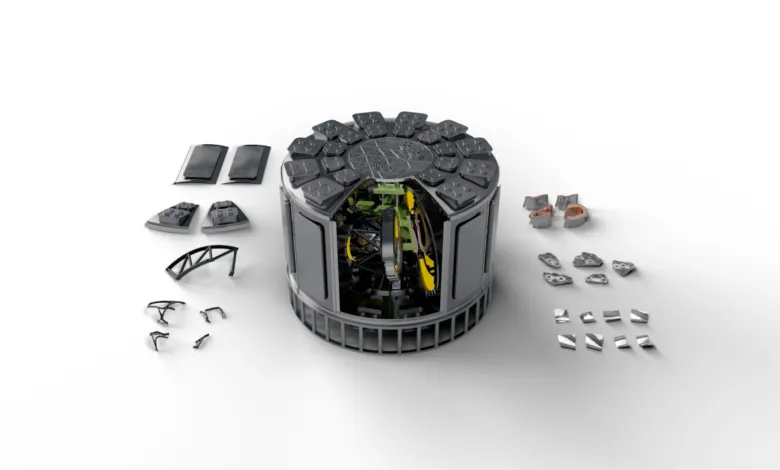
Traditional fusion reactors, particularly stellarators, rely on exquisitely crafted magnets shaped into complex forms to contain superheated plasma. Manufacturing these components to millimeter precision is extraordinarily difficult and expensive. Thea’s strategy reimagines this system. Instead of a few intricately formed magnets, Helios will employ arrays of hundreds of smaller, identical superconducting magnets. Sophisticated control software will manipulate each magnet individually to generate the precise magnetic fields needed for plasma confinement, effectively creating a “virtual” stellarator.
This modular, software-defined method offers several benefits. It allows for rapid design iteration, Thea has tweaked its magnet design over 60 times in two years. It also introduces tolerance for manufacturing and assembly flaws. In testing, the company’s control systems successfully compensated for magnets intentionally misaligned by over a centimeter and for defects in superconducting materials. The company even trained an AI model using reinforcement learning to handle the control task, with surprisingly effective results.
The Helios design incorporates two magnet types. Twelve large external coils provide the primary confinement force, similar to those in a tokamak reactor. Inside, an array of 324 smaller circular magnets performs the fine-tuning to shape the plasma. The company projects that a full-scale Helios plant would generate 1.1 gigawatts of heat, converted to 390 megawatts of electricity via a steam turbine. With a planned maintenance shutdown of 84 days every two years, the reactor could achieve an impressive capacity factor of 88%, rivaling modern nuclear power plants.
Before Helios can become a reality, Thea Energy must first demonstrate its core physics with a prototype device called Eos. The company plans to announce a site for Eos in 2026, aiming for initial operation around 2030. Work on Helios is intended to proceed in parallel, mirroring the strategy of competitors like Commonwealth Fusion Systems. The recent publication of its design overview paper marks Thea’s entry into broader scientific and industry dialogue, a step the company hopes will foster the partnerships and collaborations necessary to build its first power plant.
(Source: TechCrunch)

