OpenAI Launches GPT-5.4 Mini & Nano: Near-Flagship Power, Lower Cost
▼ Summary
– OpenAI has released new, smaller models called GPT-5.4 mini and GPT-5.4 nano designed for fast, efficient, high-volume AI workloads like coding assistants and real-time multimodal applications.
– The GPT-5.4 mini model runs more than twice as fast as its predecessor, GPT-5 mini, and shows significant performance improvements on coding and reasoning benchmarks.
– These smaller models enable developers to build cost-effective agentic systems where a larger model can plan tasks and cheaper models like GPT-5.4 mini can execute subtasks.
– Customer testing from companies like Hebbia and Notion indicates GPT-5.4 mini delivers strong performance for specific tasks at a much lower cost compared to larger models.
– GPT-5.4 mini and nano are available via API with lower pricing, making them a cost-efficient alternative to the more expensive flagship GPT-5.4 model for many applications.
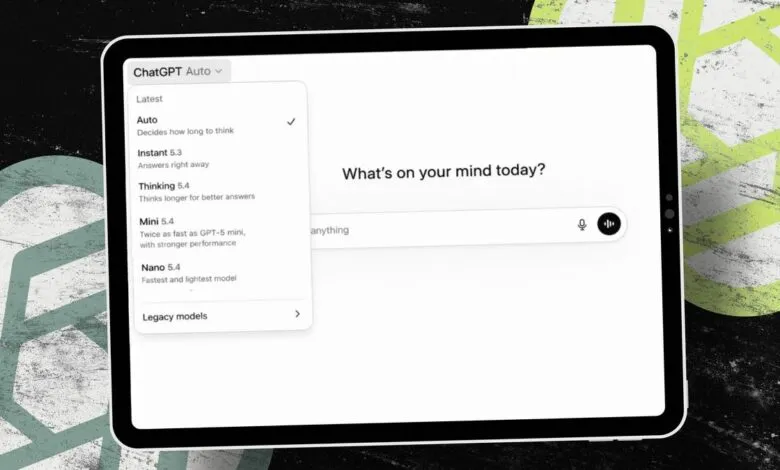
OpenAI has introduced two new, more affordable language models designed to deliver strong performance for specific tasks without the high cost of flagship systems. The GPT-5.4 mini and GPT-5.4 nano models are engineered for speed and efficiency, targeting developers and businesses that need responsive AI for coding, document analysis, and multi-step agentic workflows. These releases follow the recent launch of the more powerful GPT-5.4 Thinking model, offering a spectrum of options that balance capability with budget.
For many practical applications, the most effective AI isn’t necessarily the largest or most expensive. The ideal model often strikes a balance between solid performance, rapid response times, and dependable tool integration. OpenAI built these new models specifically for scenarios where lag directly impacts the user experience. This includes coding assistants that must feel instantaneous, subagents that handle supporting tasks quickly, and systems that process visual information like screenshots in real time.
When compared directly to its predecessor, the GPT-5.4 mini shows marked improvements. It operates more than twice as fast as the earlier GPT-5 mini while enhancing capabilities in coding, logical reasoning, multimodal understanding, and tool use. The even smaller GPT-5.4 nano is optimized for speed, aimed at straightforward jobs like classification, data extraction, and basic coding support.
The performance metrics tell a compelling story. On professional benchmarks, GPT-5.4 mini achieves scores that approach those of the full GPT-5.4 model, but at a fraction of the cost and with much faster execution. For instance, it scored 54.38% on the SWE-bench Pro test, a significant jump from the GPT-5 mini’s 45.69%. On the Terminal-Bench 2.0, it reached 60.00%, far surpassing the previous model’s 38.20%. The nano model, while not as high-performing as the mini, still offers considerable gains over older small models, making it a cost-effective choice for simpler tasks.
Early adopters are already seeing benefits. Hebbia, a company that builds document analysis tools for finance and legal professionals, reported that GPT-5.4 mini delivered strong results. Their CTO noted it matched or exceeded competing models on output tasks and citation accuracy, all at a significantly lower expense. Similarly, the productivity platform Notion found the mini model handled focused tasks like page editing with impressive precision, often outperforming a much larger, older model on complex formatting while using far less computational power.
A key application for these models is within agentic systems, where different AI models can work together like a human team. A larger, more capable model like GPT-5.4 Thinking can plan and oversee a process, while faster, cheaper models like the mini or nano execute specific sub-tasks. This could involve searching code repositories, reviewing files, or processing documents. The GPT-5.4 mini also excels at multimodal jobs, particularly those involving computer use, such as interpreting screenshots of user interfaces to complete actions swiftly.
Accessibility and cost are major advantages. The GPT-5.4 mini is available through API, in Codex, and within ChatGPT. For programmers, it’s accessible across the Codex app, command-line interface, and IDE extensions. Critically, it uses only 30% of the GPT-5.4 quota, allowing developers to handle simpler coding tasks for about one-third the price. The pricing structure highlights the value: GPT-5.4 mini costs $0.75 per million input tokens and $4.50 per million output tokens. The API-only GPT-5.4 nano is even more economical at $0.20 and $1.25 per million tokens, respectively. This stands in stark contrast to the flagship GPT-5.4, priced at $2.50 and $15.00 per million tokens.
These new models provide practical, powerful alternatives for developers and companies looking to integrate AI without incurring prohibitive costs. By offering near-flagship performance in a faster, more affordable package, OpenAI is enabling more sophisticated and responsive AI applications across a wider range of industries and use cases.
(Source: ZDNET)