AI Boosts Revenue 13% but Raises Ad Costs: Study
▼ Summary
– AI Max is Google’s major shift for Search campaigns, moving from keyword-based to intent-based matching, presenting both growth opportunities and efficiency risks.
– An analysis of over 250 campaigns shows AI Max typically increases revenue by 13% but also raises costs (CPA) by 16%, with ROAS results varying widely from +42% to -35%.
– The feature introduces three core automations: Search Term Matching, Text Customization, and Final URL Expansion, bringing Performance Max-style automation into standard Search.
– Significant pitfalls include broad match cannibalization, aggressive scaling into competitor terms, overwhelming reporting data, and inefficient spending on the Search Partner Network.
– Google plans to deprecate Dynamic Search Ads and migrate their technology into AI Max, with experts advising cautious testing, aggressive auditing, and winding down DSA campaigns.
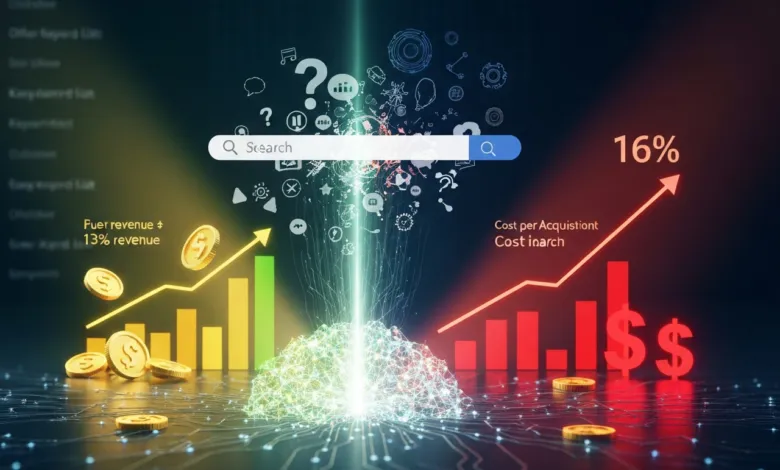
Google’s AI Max for Search represents a fundamental shift in campaign management, moving from traditional keyword targeting to a system focused on interpreting user intent. This change presents a significant opportunity for revenue growth, but it also introduces new challenges in managing advertising costs and efficiency. A recent analysis of over 250 campaigns reveals a complex picture: while median revenue increased by 13%, the median cost per acquisition (CPA) also rose by 16%. The return on ad spend (ROAS) showed dramatic variability, with results ranging from a 42% increase to a 35% decrease.
Activating AI Max is essentially a coin toss: you may see a lift, but efficiency likely won’t follow. Advertisers typically see about 14% more conversions or conversion value at a similar CPA or ROAS, according to Google’s data. This figure jumps to 27% for campaigns still heavily reliant on exact and phrase match keywords. However, it’s crucial to note that Google’s reported 14% uplift statistic notably excludes retail sectors, a significant omission for ecommerce businesses.
The technology itself brings three core automated features into standard Search campaigns. Search Term Matching combines broad match expansion with keywordless targeting. Text Customization dynamically generates ad copy, while Final URL Expansion automatically selects landing pages. This approach is distinct from Performance Max, as it applies this style of automation specifically to the Search campaign format.
Despite the potential, the analysis identified several critical pitfalls. A major issue is broad match cannibalization, where the system recycles existing query coverage up to 63% of the time instead of discovering new, valuable search terms. Another serious risk is competitor hijacking; in one case study, AI Max allocated 69% of a campaign’s total Search impressions to competitor brand terms. Marketers also face reporting overload, with search term and ad combination reports generating tens of thousands of rows of data, making manual review impractical. Furthermore, some campaigns experience Search Partner Network blowouts, where a massive volume of low-converting impressions drains budget, as seen in one instance with a 0.07% conversion rate on partners versus 3.04% on Google Search.
There’s an inherent irony in adoption: accounts already using Broad Match, Dynamic Search Ads (DSA), and Performance Max are most likely to try AI Max, yet Google indicates these same advertisers will see the smallest incremental benefit. Looking ahead, Google has confirmed plans to deprecate Dynamic Search Ads and integrate its technology into AI Max for Search, though a firm timeline has not been established.
The recommended path forward involves cautious testing. Experts advise activating the keywordless features within existing Search campaigns now and beginning to phase out DSA campaigns rather than migrating them to Performance Max. With only about 16% of advertisers currently testing AI Max, the guidance is to start with small-scale experiments, conduct aggressive and automated audits of performance data, and avoid letting the fear of missing out on new features like AI Overviews drive strategic decisions. The key is to balance the potential for revenue growth with vigilant oversight of efficiency and cost.
(Source: Search Engine Land)