Laser-Engraved Glass: The Future of Data Storage
▼ Summary
– The Silica storage system is evaluated using key metrics including voxel quality (Q), data density (ρ), usable capacity, write throughput (θ), write efficiency (η), and lifetime.
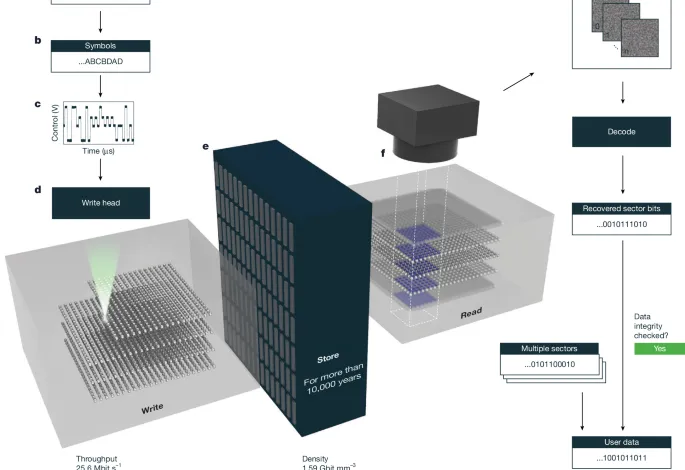
– Data is written into glass using a femtosecond laser system with precise scanning and translation stages, employing different methods for birefringent and phase voxels.
– The system uses emissions-based control during writing, involving offline calibration and closed-loop feedback to stabilize voxel formation by adjusting laser power.
– Data is read using custom wide-field microscopes: a polarization microscope for birefringent voxels and a Zernike phase-contrast microscope for phase voxels, with automated focusing and image capture.
– Machine learning, specifically a CNN, decodes the stored data, and error correction using LDPC and erasure codes optimizes the effective data density and integrity.
The quest for durable, high-density data storage has led to a groundbreaking innovation: using laser-engraved glass as a permanent archival medium. This technology, often referred to as Silica storage, represents a significant leap forward in preserving humanity’s digital legacy. By encoding information within microscopic three-dimensional structures inside ultra-pure glass, it promises unprecedented data density and a virtually unlimited lifespan, potentially lasting for millennia. The system’s performance is rigorously evaluated against several critical technical metrics that define its practical utility.
Central to the evaluation is voxel quality (Q), an average measure of user bits stored per microscopic modified volume, or voxel. This figure is always less than the total bits per voxel due to the necessary inclusion of redundant bits for error correction. The quality factor (q) expresses this relationship as a ratio. From voxel quality, we derive data density (ρ), which quantifies how many gigabits can be packed into a cubic millimeter of glass. For a practical storage device, the usable capacity metric calculates the total user data, measured in terabytes, that fits onto a standard glass platter measuring 120 mm square and 2 mm thick, after accounting for engineering overheads.
The speed and efficiency of writing data are equally vital. Write throughput (θ) defines the peak speed at which data can be inscribed, calculated from the laser’s repetition rate and the number of parallel beam lines. Equally important is write efficiency (η), which measures the energy consumed per user bit written; a lower value is preferred as it allows more parallel writing. Finally, lifetime provides an experimental estimate of how long the data remains readable within the glass, a cornerstone of the technology’s value proposition.
The writing process employs an amplified femtosecond laser, with its pulses carefully conditioned and directed. The optical path includes a tunable attenuator and, depending on the type of voxel being created, modules for polarization or amplitude modulation. A high-speed polygon scanner sweeps the laser pulses, which are then focused deep inside the glass platter by a microscope objective. The platter itself is precisely moved on a translation stage, allowing voxels to be written in a precise three-dimensional grid. A key innovation is the use of real-time photoemission feedback; a camera captures the faint light emitted during voxel formation, enabling a closed-loop control system to stabilize the writing process against variations and ensure consistent quality.
Two primary methods are used to create voxels. For birefringent voxels, the laser beam is split into seed and data pulses. These pulses pass through Pockels cells that modulate their polarization before they are recombined inside the glass, creating a durable, anisotropic modification. For phase voxels, an acousto-optic modulator (AOM) directly controls the amplitude of a single pulse, creating a small, isotropic change in the glass’s refractive index. The system can also be scaled using multibeam writing, where a single laser source is split into several beams that write in parallel, significantly boosting throughput.
Reading the stored data requires a customized microscopic approach. For both voxel types, a wide-field microscope with a scientific CMOS camera is used. The system automatically locates fiducial markers written into the glass and then finds the optimal focus position for each data sector. Birefringent voxels are read using a polarization microscope with liquid crystal variable retarders to analyze the light’s polarization state after it passes through the modified glass. Phase voxels are read using a Zernike phase-contrast microscope, a robust method that renders the subtle refractive index changes clearly visible. To mitigate optical cross-talk between layers, two images at slightly different depths are captured per data layer, improving decode accuracy.
Assessing the legendary longevity of this medium involves accelerated aging tests. Samples are annealed at high temperatures, and the decay of the written structures is monitored by measuring the diffraction efficiency of a laser beam passing through the glass. The data fits a stretched exponential model, allowing scientists to extrapolate an activation energy and estimate a storage lifetime at ambient temperatures that spans thousands of years.
Decoding the raw images into usable data is a complex task handled by a convolutional neural network (CNN). This machine learning model is trained on vast amounts of known data. It takes the sector images as input, accounts for optical effects and spatial context, and outputs probabilities for what symbol was written in each voxel. These symbol probabilities are then converted to bit probabilities.
No physical channel is perfect, so error correction is essential. The system employs a two-layer approach: low-density parity-check (LDPC) codes correct errors within individual sectors, and an erasure code spreads data across multiple sectors so the original information can be reconstructed even if some sectors are lost. The system dynamically finds the optimal balance between raw data density and the overhead of these correction codes to maximize the amount of recoverable user data.
To squeeze the maximum capacity from the physical channel, the mapping of data bits to written symbols is meticulously optimized. This involves extending Gray code principles to non-standard symbol counts and running an optimization routine to select the ideal set of laser modulation levels. A regression model analyzes how well different modulation levels can be distinguished after being written and read, and an optimization algorithm selects the subset that maximizes the mutual information, the reliable data throughput, of the entire storage channel.
Together, these interconnected components, precision laser writing, sophisticated optical reading, machine learning decoding, and robust error correction, form a complete and revolutionary data storage system. It leverages the inherent stability of glass to offer a solution for the growing challenge of preserving the world’s digital information for future generations.
(Source: Nature)