Unity’s AI Aims to Make Coding Obsolete

▼ Summary
– Unity is committed to generative AI and plans to unveil a new beta of Unity AI at the Game Developer Conference in March.
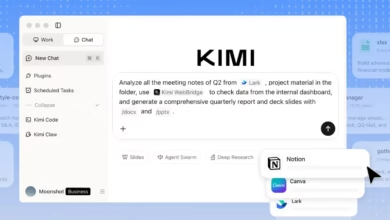
– This upgraded Unity AI will allow developers to create full casual games using only natural language prompts, eliminating the need for coding.
– The company’s CEO stated the goal is to democratize game development for non-coders and increase productivity for all users.
– Unity AI leverages a combination of its own platform understanding and external “frontier models” like GPT and Llama for its functionality.
– The company believes AI tools will enable tens of millions more people to create interactive entertainment, with Unity aiming to lead this shift.
The video game development landscape is poised for a significant shift as Unity announces a powerful new AI tool designed to streamline creation. The company plans to unveil a beta version of an upgraded Unity AI at the upcoming Game Developers Conference, a system that promises to allow developers to generate complete casual games using only natural language prompts. This move underscores a broader industry trend toward AI-driven authoring, aiming to reduce technical barriers and accelerate the journey from a simple idea to a polished, market-ready product.
During a recent earnings discussion, Unity CEO Matthew Bromberg outlined the company’s strategic focus. He positioned this AI initiative as a core priority, stating it will empower creators by leveraging the platform’s deep understanding of project context and runtime environments. By integrating what he termed the “best frontier models” available, Unity believes its tailored approach will deliver superior results for game developers compared to using generic AI tools alone. The ultimate vision is to serve as a seamless conduit, transforming initial creative sparks into sustainable digital experiences with minimal friction.
Bromberg elaborated on the anticipated impact, suggesting this technology will democratize game development for individuals without traditional coding skills. Simultaneously, it is expected to boost productivity for professional studios by automating and simplifying complex tasks. He projected a future where AI-enabled tools could catalyze a massive expansion in the creator base, leading to tens of millions of new people building interactive entertainment. Unity clearly aims to be at the forefront of this potential revolution.
The technical foundation for this ambitious project builds upon existing infrastructure. Currently, the Unity AI assistant utilizes large language models from companies like OpenAI and Meta to handle user inquiries, generate code snippets, and execute automated actions. For asset creation, the system employs a suite of specialized models from partners such as Scenario and Layer AI. These partners utilize advanced image-generation technologies, including Stable Diffusion and FLUX, to produce and refine in-game artwork and visual elements directly within the Unity ecosystem.
This integrated approach is designed to make the development process more intuitive. The promise is a workflow where a developer can describe a game concept in plain English and have the AI construct a functional prototype natively on the Unity platform. This could dramatically shorten production cycles for certain genres, particularly in the casual and mobile game markets where rapid iteration is key. The company’s strategy hinges on providing a cohesive, all-in-one environment that simplifies the transition from a basic prototype to a fully realized product ready for distribution.
While the potential for increased efficiency and accessibility is considerable, the announcement also arrives amidst ongoing industry debates about the role of AI in creative fields. Some developers express concerns about the impact on traditional skills and the ethical sourcing of training data. Unity’s push into this space represents a major bet that the benefits of augmented creativity and lowered entry barriers will ultimately drive widespread adoption, reshaping how games are made for a new generation of creators.
(Source: Game Developer)