Why Your AI Strategy Needs Data and Context to Succeed
▼ Summary
– In 2025, the critical link between accurate, well-governed data and successful AI deployment became increasingly clear.
– The conversation in 2026 emphasizes that adding context to data is now essential for AI strategies.
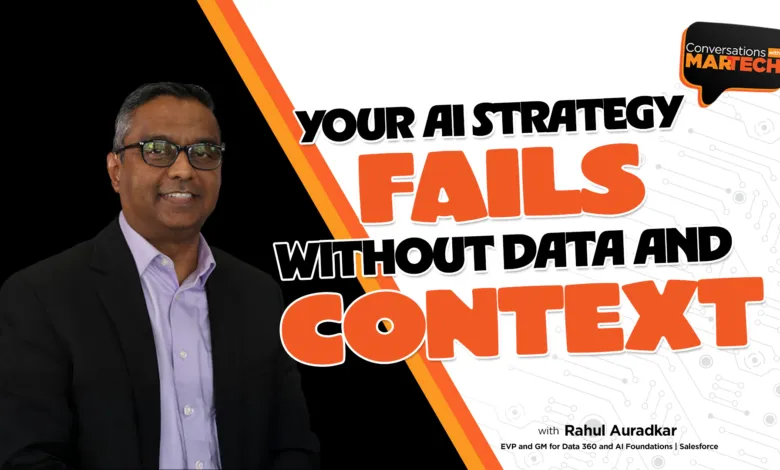
– The article features an interview with Salesforce’s Rahul Auradkar on the future of AI, agents, data, and context.
– The discussion explores how Salesforce products integrate to support AI and what customers are saying about agentic AI and their data.
– Key topics include why data remains a challenge for organizations and what the coming year holds for data, context, and AI.
The success of any artificial intelligence initiative hinges on a powerful combination: high-quality data and the essential context that gives it meaning. Without this foundation, even the most sophisticated AI models struggle to deliver reliable, actionable results. As organizations move from experimental pilots to full-scale deployment, the conversation is shifting from simply having data to truly understanding it. The integration of context, the who, what, when, where, and why behind the data, is now a non-negotiable requirement for building trustworthy and effective AI systems that drive real business value.
Rahul Auradkar, Executive Vice President and General Manager for Data 360 and AI Foundations at Salesforce, emphasizes this evolution. He notes that while the connection between data and AI was widely acknowledged, the critical role of context has become the defining theme for mature strategies. Customers are increasingly focused on moving beyond standalone large language models (LLMs) to implement practical, agentic AI, systems that can autonomously perform tasks and make decisions. This shift demands a robust data infrastructure where information is not only accurate and governed but also richly contextualized.
A key insight from customer discussions is the persistent challenge data presents. Many organizations find their data fragmented across silos, inconsistent, or poorly documented. This creates a significant barrier. AI agents, designed to automate complex workflows, require a unified and contextual view of data to function correctly. For instance, an AI agent handling a customer service request needs immediate access to that customer’s purchase history, support interactions, and product preferences to provide a personalized and efficient resolution. If that data is scattered or lacks context, the agent’s effectiveness plummets.
Salesforce’s approach involves weaving its various cloud products, like Sales, Service, and Marketing, into a cohesive data ecosystem. This integration is designed to break down silos and create a single, contextualized source of truth. By unifying data from different business functions, the platform aims to provide AI models with the comprehensive understanding they need. The goal is to ensure that an AI application in marketing has the same contextual awareness of a customer as an application in sales, leading to more coherent and intelligent automation across the entire customer journey.
Looking ahead, the trajectory for data, context, and AI points toward deeper, more autonomous systems. The next wave of innovation will likely focus on AI agents that can orchestrate multi-step processes across different applications, all predicated on a deeply contextual data foundation. The organizations that succeed will be those that treat data governance and contextual enrichment not as IT projects, but as core strategic priorities. They will invest in platforms that unify their data and imbue it with meaning, turning information into a true strategic asset that powers intelligent, reliable, and scalable automation.
(Source: MarTech)