The 5 CES Products Everyone Is Talking About
▼ Summary
– LG’s Signature ventless washer-dryer was a top-viewed product for completing a full laundry cycle in under 90 minutes, a significant improvement over previous hybrid models.
– Lovense’s Emily robot sparked debate by framing intimacy tech as an adaptive AI ecosystem for companionship, shifting focus to emotional dependency.
– Donut Labs’ solid-state battery design announcement attracted attention by promising superior safety, energy density, and charging speed compared to lithium-ion batteries.
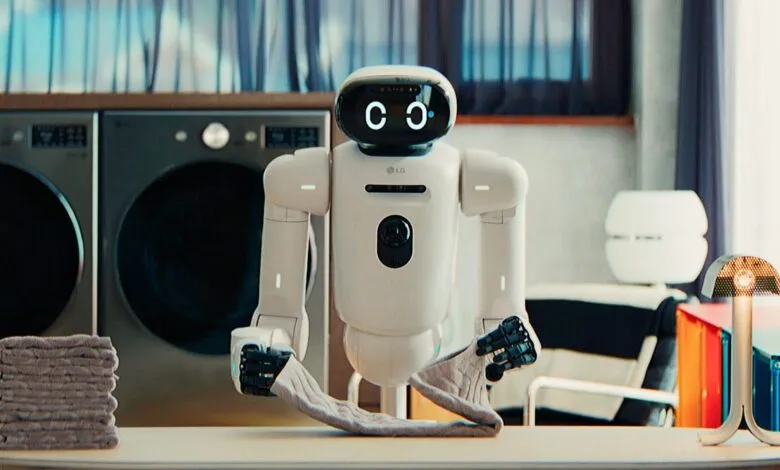
– LG’s CLOiD laundry-folding robot became popular by demonstrating a functional, though slow, solution to an undesirable household chore.
– TLC’s Rayneo display glasses were notable for their improved, non-bulky design and enhanced screen quality with better resolution and color reproduction.
The annual CES showcase consistently reveals the frontier of consumer technology, but only a select few innovations truly capture the public’s imagination and dominate online conversations. At the most recent event, a handful of products rose above the noise, generating massive viewer interest on major tech platforms. These items resonated not merely for their novelty, but because they addressed real-world frustrations, ventured into provocative new territories, or delivered tangible leaps in performance. The following five products emerged as the most discussed, representing the trends and breakthroughs that defined the show.
LG’s latest Signature ventless washer-dryer combo captivated audiences by solving a common pain point with remarkable efficiency. While the concept of a combined unit isn’t new, this model achieves what others could not: it completes a full 10-pound load, washing and drying, in under 90 minutes. For anyone familiar with traditional combo machines, where drying alone can stretch past two hours, this represents a revolutionary upgrade. The benefit is twofold, offering significant savings in both time and valuable home space, making it a practical and highly desirable innovation.
The debut of Lovense’s Emily, a life-size companion robot, sparked intense debate across social media and tech forums. Featuring a realistic silicone exterior and a posable internal skeleton, Emily represents a deliberate shift in how intimacy technology is presented to the mainstream. The company framed it not as a simple device, but as an advanced AI ecosystem capable of learning, adapting, and simulating emotional connection over time. This positioning moved the discussion far beyond hardware, forcing a broader cultural conversation about the ethics of AI companionship, the nature of emotional dependency, and the increasingly blurred boundaries between human interaction and synthetic attachment.
In the electric vehicle sector, any solid-state battery announcement is guaranteed to grab attention, and Donut Labs’ reveal was a major draw. Their new battery design promises a fundamental improvement over current lithium-ion technology, boasting lighter weight, higher energy density, significantly faster charging capabilities, and enhanced safety and stability. This kind of progress is seen as a critical step toward alleviating common consumer concerns about EV range and charging times, positioning solid-state tech as a potential game-changer for the entire automotive industry.
Addressing another universal household chore, LG’s CLOiD laundry-folding robot became an instant sensation. For years, automated laundry folding seemed like a distant fantasy, but this robot demonstrated a working, capable prototype. Observers noted that while the folding process was methodical, the robot performed the task competently, neatly stacking dish towels. Its appearance immediately sparked hopeful questions about the future of home automation, with many wondering when such robots might also put clothes away, load dishwashers, or handle other tedious tasks.
Finally, TLC’s Rayneo display glasses earned praise for tackling a persistent issue with wearable tech: aesthetics and quality. Unlike earlier, bulkier models, these glasses were designed to look like a stylish, normal pair of eyewear. The focus was squarely on delivering a superior visual experience through improved resolution, higher pixel density, and more vivid color reproduction. The result is a wearable display that offers a sharper, more immersive view, suggesting that practical and comfortable augmented reality for everyday use is finally within reach.
(Source: CNET)