Wordle gets a Clippy twist in new word game
▼ Summary
– Dartwords is a new daily word game from The Game Band where players guess a secret word using conversational clues from a Clippy-like character named Darty.
– The game’s hint system combines a local LLM trained on the English dictionary with hand-authored clues from developers, aiming for a more improvisational feel than typical word puzzles.
– The Game Band’s creative director Sam Rosenthal was inspired by loose, analog word games from his childhood, like the alphabet game, which he felt couldn’t be replicated digitally before.
– The studio uses AI tools like Claude Code for coding tasks, but all art and UI/UX in Dartwords is handmade, with human review of AI outputs.
– Dartwords enters a crowded daily puzzle market, following Wordle’s success, and its unique character Darty, inspired by Clippy, is intended to make the game feel charming and give players someone to blame for bad clues.
Daily puzzle fans know the ritual well: wake up, open the word game, take a stab at the answer, and fire off a screenshot to the group chat. Sam Rosenthal, creative director at The Game Band, the studio behind Blaseball, is no exception. But his daily habit sparked a deeper question. “When I was a kid and I played word games with my family, they weren’t the New York Times puzzle games,” Rosenthal says. “We were sitting in a car on a road trip playing these really loose games that couldn’t be made digitally before. Things like the alphabet game or our own riffs on 20 questions. That felt like a really interesting space to explore.”
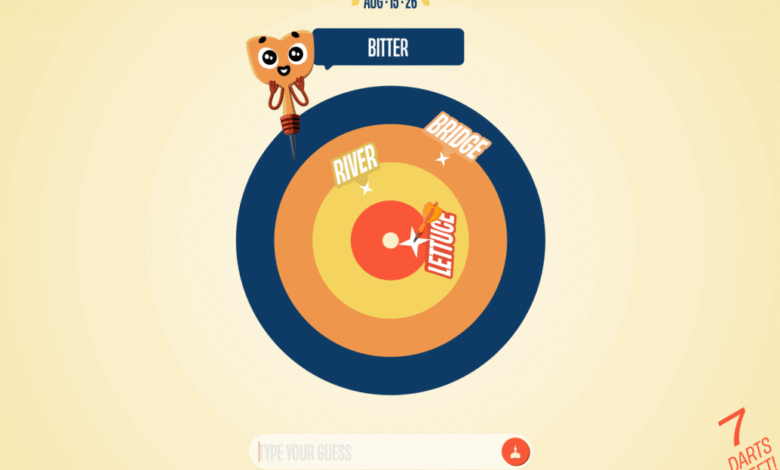
That exploration led to Dartwords, a new daily word game launching today on the web. The premise is familiar: a secret word awaits, and players get 10 guesses to uncover it. But there’s a twist. You start with zero hints. You type any word that comes to mind, and a Clippy-like character named Darty responds with clues based on your guess. Guess an animal, and Darty might tell you the answer is bigger, or that it’s manmade. Each guess sends a dart flying toward a board on screen, inching closer to the bullseye as you near the correct answer.
The daily word game space has become crowded since Wordle’s meteoric rise, but Rosenthal says Dartwords aims to stand apart by feeling “more conversational” than its peers. To pull that off, the studio built a bespoke hint engine using a local LLM trained on the English dictionary. Darty’s clues blend broader hints generated by the model with handcrafted responses written by the developers as players zero in on the solution. “It’s this interesting mixture of using hand-authored work and local models to get us to where we want to be,” he explains.
On the AI front, Rosenthal clarifies that all art and UI/UX in the game is handmade. “We do use tools like Claude Code to speed up day-to-day coding tasks, but we pair them with our taste, judgment, and careful reviews.”
For this writer, the open-ended format took some getting used to. The lack of structure can feel paralyzing at first, since every guess requires strategic thought about what hint it might unlock. But after a few rounds, the rhythm clicks. This morning, I cracked the answer in just three guesses, a personal best. Rosenthal hopes that as the player base grows, the system will sharpen. “Over time, with more people playing the game, our system will get better and better and hopefully serve better clues,” he says.
Dartwords joins a diverse catalog from The Game Band, which started with the narrative puzzler Where Cards Fall before the surreal baseball sim Blaseball went viral during the pandemic. More recently, the studio shipped Dead Man’s Party, a Knives Out-themed party game tied to Netflix’s push into interactive TV. Now, with Dartwords, the team is stepping into a fiercely competitive arena that Wordle helped define, where everyone from LinkedIn to The Atlantic now runs its own daily puzzle offering, and platforms like Puzzmo offer yet another alternative.
Rosenthal believes Darty is the key differentiator. The goofy, sentient dart has oversized expressive eyes and tiny hands perfect for clapping. “Darty was literally inspired by Clippy,” he says. “The whole intent is that we wanted it to be a loose word game. It’s more improvisational, it feels more conversational. And because of that, we need something for people to get mad at if it gives you a bad clue. We want this game to feel charming and fun, and have a little more character to it than you traditionally get in word games.”
(Source: The Verge)