Query Templates: Broadening Topical Authority Scope
▼ Summary
– Topical authority is built by covering query template variations, not just topics, with two methodologies: covering entity-attribute pairs or query template variations, with a hybrid approach being the strongest.
– Google ranks sites based on cost of retrieval, meaning ranking a site must be cheaper than not ranking it, and query templates help Google classify queries and documents more efficiently.
– A QR code generator project gained over 1 million extra clicks in three months using a hybrid approach, but image rankings dropped due to a migration error from failing to redirect all image URLs.
– Microsemantics, such as matching word order and sentence structure to query patterns, multiplies relevance across thousands of query variations, while the Query Deserves a Page principle dictates opening new pages only when search demand and semantic differences justify it.
– Across multiple case studies (rehab, word games, social media, tourism, hosting, ecommerce), topical maps are structured with commercial core sections and informational outer sections, where internal links transfer ranking signals from outer to core pages, and commercializing informational content improves rankings.
Building topical authority requires more than thorough coverage of a single subject. It demands an understanding of the many ways users phrase their searches around that subject. Query templates offer a systematic method for mapping these search variations, enabling you to construct a more robust and interconnected content network that signals expertise to search engines.
Two primary methodologies exist for establishing topical authority. The first involves covering every entity within a topic alongside its associated attributes. For instance, “calorie” is a shared attribute for all entities in the “food” class, just as “symptom” applies to every entity in the “disease” class. Processing an entire entity class through its common attributes signals comprehensive knowledge to search engines. The second methodology focuses on covering every variation of a query template. WikiHow, for example, has built authority around the “how to” template, allowing it to rank for a vast array of unrelated topics. In this scenario, authority is tied to the query format itself, not the specific subject matter.
The most effective approach combines both strategies. This hybrid model covers all entities within a class, their attributes, and every query template variation, uniting topical depth with query format breadth within a single content network.
Two prior case studies provide essential context. The first, “Visual semantics: The missing piece of topical authority,” details how web components and design elements improve query responsiveness. The second, “How semantics and topical authority improve local SEO,” explores the “Query Deserves a Page” (QDP) principle across 13 local SEO projects. Familiarity with these will clarify the concepts and results presented here.
Why does Google rely on structural similarity between queries and documents?
The answer is simple: it is more cost-effective. Google’s ranking decisions are fundamentally driven by cost savings. The principle is straightforward: the cost of ranking a site cannot exceed the cost of not ranking it. If a website’s quality is a 6/10 but its retrieval cost is a 7/10, it won’t be ranked. Query templates allow Google to satisfy a larger number of users and drive more clicks while organizing sources with lower computational overhead. When a site satisfies one query and a similar query appears, Google may trigger a test for ranking purposes. This has led to the concept of a semantic content network, where a group of web documents is semantically connected to cover an entire semantic query network, potentially triggering a re-ranking.
Query Templates for a QR Code Generator
The first example project is a QR code generator that gained over one million additional clicks in three months. This growth was driven primarily by microsemantic changes, supported by technical SEO improvements and a CMS migration. The project demonstrates a hybrid approach to topical authority, targeting both attributes and template variations based on the QDP principle.
Several technical improvements were implemented alongside the semantic changes. The website migrated from WordPress to Next.js with Sanity as the back-end CMS. The migration followed strict principles for mapping image-to-image, HTML-to-HTML, CSS-to-CSS, and JavaScript-to-JavaScript, ensuring every asset type had an equivalent on the new stack. All non-indexed URLs were removed to prune the crawl profile, and response times were improved to boost crawl efficiency. Structured data was updated, and it was ensured that the core feature, the QR code generator itself, was served without requiring JavaScript rendering. The content, layout, and URLs remained unchanged; only the back-end infrastructure was altered. The HTML structure was cleaned and the DOM size was reduced.
The importance of handling redirections at the infrastructure level became evident through image crawling and ranking data. The migration was unable to redirect all images, only the most important ones. This partial redirection is problematic because the default position should be to never change image or video URLs. Indexing these resource types is far costlier and slower, so any changes take much longer for a search engine to process and trust. The principle of cost of retrieval applies here: if ranking a site is costlier than not ranking it, deindexing begins.
While total crawl hits per day decreased after the migration, this was a positive signal. The decrease came from the non-essential “other file types” segment, while crawl requests for HTML increased. Smartphone crawl requests also increased, and the ratio of indexable HTML URLs that are self-canonicalized, included in the sitemap, and supported by internal links improved. However, image requests and image rankings moved in the wrong direction due to the migration error. Since Google creates landing page and image pairs for ranking, image rankings affect a website’s overall performance far beyond just image impressions.
The query semantics for a QR code generator change depending on the purpose, platform, and type of QR code. A contextual domain is the collection of all context vectors that can be created from a term by adding one or two more words through vectorization. For example, the predicates used for “Facebook QR Code Generator” and “PDF QR Code Generator” are mostly shared, but they differ in ways that matter for relevance. The predicate “download” is highly relevant to “PDF QR Code,” while “share” or “follow” dominate for “Facebook QR Code.”
Every ranking query, along with its historical click and impression data, increases the ranking chances of other variations within the same query template. According to the QDP principle, a new page is only opened if the query’s search demand exceeds a threshold and the query involves a different entity or pattern with low semantic similarity to existing pages. This helps Google classify the web faster and choose a single website to satisfy more queries from the same topic or template.
The QDP principle is applied to query templates by grouping the predicates that can be used with the specific entity in each query group. If the predicates of a specific template variation differ from others, it is a signal to open a new page. Even if predicates are highly similar but the entities are different, a separate page is still warranted. This is where micro- and macrosemantics come into play, differentiating textual and visual semantic optimizations on a relevance level. For example, SERP candidates for “QR Code Generator for Facebook” always have the same functionality with very similar layouts. The internal factors that differentiate them come from micro-differences.
Google’s “Determining User Intent from Query Patterns” patent demonstrates instances where changing relevance and rankings stem from small differences in documents or query interpretations. This is an example of using predictive retrieval to decrease computational costs. Microsemantics can be explained with a simple example: “Financial independence is achieved by families with the help of financial advisors” versus “Financial advisors help families achieve financial independence.” Both sentences state the same fact, but their relevance scores differ significantly depending on the target query network. If the query has “financial advisor” as the subject, your sentence should too. Matching query augmentation models with the declarative facts on your web documents is a microsemantic improvement that maximizes relevance. This small difference is multiplied by 3,000 when targeting a query template with that many variations, becoming a major ranking factor.
Query augmentation, a concept from Anand Shukla’s design, is a direct equivalent to what Google calls “query fan-out.” How Google augments a query term impacts the “relevance weight” of a term and how you should structure your sentences. Sentential semantics are part of microsemantics, used to marginally increase relevance to become a main candidate document for an entire query network.
Google uses the “possibility” of a query search by weighing the range of entities and relations to weigh a variation of a query template. Ranking for one variation helps rank other variations better. A patent design for “Generating Query Answers” explains that certain query templates require certain answer templates. The search engine looks for documents with these templated answers in a better formatted way to decrease cost and increase efficiency. For a query template like “When is [entity] born,” Google looks for answer annotations to classify a page as useful or non-useful. Ask yourself: “What type of visual or textual template does Google look for in my industry?” Google refers to these semantic conditions as constraints. When a document satisfies these constraints, it is considered template-efficient. Your content should be structured with template-efficient sentence patterns supported by strong microsemantic relationships.
Query Templates for Rehabilitation
When ranking a weaker brand with limited budget, historical data, and PageRank, stronger historical click data is needed to convince search engines to trust your web entity. In the rehab industry, it is usually better to target two main templates: “Does [entity] make addiction” and “Can I [drink/eat] [entity] [with, after, during, before] [entity].” These templates are rich enough to accumulate high volumes of historical data. Every click, impression, and search engagement makes the web entity more authoritative for other query variations.
The “addiction types” entity class has more than 30 members, and each carries sub-relations to substances, habits, therapy methodologies, withdrawal symptoms, causes, risk factors, and treatment durations. Covering each member with the same set of attributes and sub-relations turns individual pages into a topical map, following the entity-attribute path to topical authority. To implement the QDP principle for the two main query templates, attributes are extracted and connected back to the “[addiction type] rehab in [locale]” core pages through internal links. This connection works in both directions: whenever an informational templated page ranks higher, the commercial landing page connected to it also ranks better.
Structuring Core and Outer Topical Map Sections
A topical map has two main parts: the core section and the outer section. Internal links always flow from the outer section toward the core section to transfer ranking signals. The core section is mostly commercial and carries the most important concepts and entities. The outer section is mostly informational and bridges the central entity to other main entities of the topical map.
The third project operates in the word games industry and ranks mainly for the “unscramble [word]” query template. The cost of retrieval is decreased by removing unnecessary pages through the QDP principle and solving technical SEO problems that dilute ranking signals. The main issue in this industry is that every website carries the same information. Results for “unscramble carry” are identical across sites, so implementing visual and textual microsemantics better than the competition is critical. This increases relevance per document enough to compete against 1.82 million results.
The “unscramble” industry requires a programmatic SEO approach. The core section is divided into “most common and popular words” and “less popular words to unscramble.” The 1,000 most important words with evergreen search demand receive the majority of internal links, are linked directly from the homepage, and provide more unique information at a cheaper cost of retrieval. Using BigQuery is a must because Google Search Console loses nearly 40% of query-based click and impression data through k-anonymization. A programmatic command can check when a URL received its first and last impressions, helping identify candidates for revitalization. A “crawls and clicks” performance comparison shows where Googlebot spends crawl activity versus where clicks and impressions are generated. If a site receives a huge share of crawl activity on tech and asset URLs that generate no clicks, that crawl quota should be reallocated to sections that matter for historical click-satisfaction signals.
Example 1: Core, Outer, and Query Templates
A project focused on social media marketing has five main query templates: “[Social media platform] + promotion,” “[Social media platform] + engagement metrics,” “[Social media platform] + influencers,” “[Social media platform] + growth,” and “[Social media platform] + guides.” Some platforms deserve their own page, while others only deserve a section or sentence. However, if a query network contains a Boolean or explicit question, it is usually better to turn it into a page for the entire network as part of the outer section. These question pages are helpful for earning first LLM approvals for generative AI search engagement, along with SERP features like People Also Ask and Featured Snippets. A template like “does [social media platform] pay for [engagement type]” is useful for transferring ranking signals further into the core section.
Example 2: Core, Outer, and Query Templates
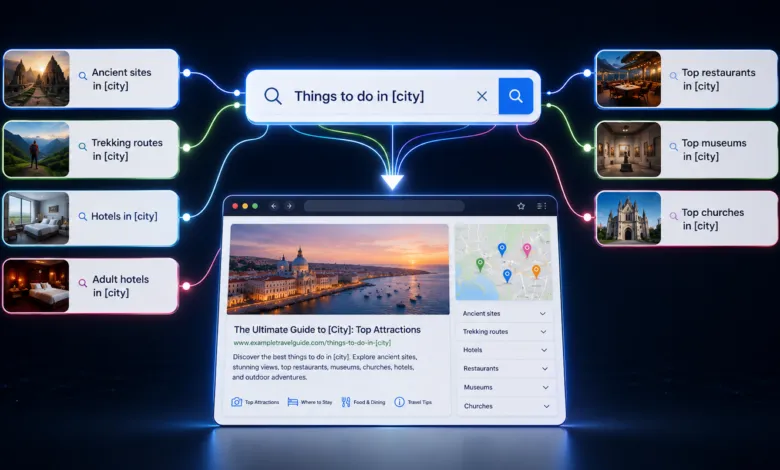
The same logic works for tourism and travel enterprises. Query templates include “Ancient sites in [city],” “Trekking routes in [city],” “Hotels in [city],” “Adult hotels in [city],” “Top restaurants in [city],” “Top museums in [city],” and “Top churches in [city].” Since one site is for hotels and the other for flight tickets, they share the same outer section of the topical map, differing only in contextual vectors and micro contexts. A contextual vector is the order of headings and page segments that flows context from one topic to another. One website directs context toward “where to stay,” while the other directs it toward “when to visit” and “how to get there.” The micro context is the representation of the outer topical map inside the same web document, while the macro context supports contextual relevance toward the core section.
Example 3: Core, Outer, and Query Templates
A website belonging to one of the biggest hosting companies shifted its core and outer sections to new subjects through different query templates. As “website builder” and “AI website generator” tools became major sources of demand, the topical map had to change. The core section moved from “hosting for [industry]” to “[industry] website builder,” while “[industry] website templates” and “how to open a [industry] business” became the main outer section subjects. The outer section can extend into further templates like “[industry] website examples,” “headers,” “footers,” “about pages,” “sign-in pages,” “product pages,” and “pop-up ideas.” All these queries and page template pairs link back to the core section to transfer ranking signals.
Example 4: Core, Outer, and Query Templates
An ecommerce company focusing on rave culture and clothing has a core section directly related to “[gender] [rave] [clothe/dress/top/crop/bottom]” category query templates. The outer section focuses on “festivals” with two main templates: “Festival + Checklist” and “Festival + Outfit ideas.” These outer pages are kept commercial by providing direct conversion elements at the top. Informational documents should be commercially related as much as possible. Even when providing checklist items or outfit ideas, they are merged with products by commercializing the informational documents. This leads to four main principles applied to semantics: visualization, verbalization, commercialization, and contextualization. Commercializing a document increases the chance of ranking in Google’s post-helpful content system updates, which favor functional websites with concrete benefits.
A case study spanning two and a half years shows a semantic content network that didn’t rank on an affiliate website began ranking better when moved to a commercial website, with exactly the same content. Every click, impression, or LLM grounding generated by the outer section reinforces the contextual relevance of commercial pages through internal linking. Every new supporting document creates additional contextual anchors for core pages. These documents expand the internal linking ecosystem, introduce fresh anchor contexts, reinforce topical relevance, and contribute to content freshness. In this system, the same anchor text is never repeated more than three times within the main content, preserving anchor diversity and strengthening contextual uniqueness.
Example 5: Core, Outer, and Query Templates
Query templates do not always require opening new pages. A topical map, or an entire semantic content network, can be exactly one page. An example from the first case study covers all query template variations as a single page. Most variations don’t even appear in the headings, yet the page penetrates all queries better than other sites. The main reasons are visual semantics, positive historical click data, and higher relevance weight from having fewer words on the page. Query templates covered as a single page include MP4 to text, MP3 to text, Video to text, Audio to text, and WAV to text.
Query Templates Require Consistency and Uniqueness
Covering more attributes or query template variations than competitors does not guarantee better rankings. SEO is a complex adaptive system, and Google continually tests websites on the SERP to determine user satisfaction. Broad Core Algorithm updates often trigger these re-rankings. NavBoost is one of the most important ranking concepts today, combining clicks, topicality, and PageRank as a hybrid ranking factor. Google relies on patterns because pattern-based ranking solves problems faster. Paul Haahr of Google explained this during his “Improving the Search over Years” speech: “If there is a query with wrong results, we won’t fix it. If this query belongs to a cluster, we will fix it. We are not interested in individual SERPs even if we know that it’s wrong.”
(Source: Search Engine Land)