Remove Nonconsensual Nudes From Apps and Websites

▼ Summary
– The Take It Down Act, effective May 19, requires tech platforms to provide a way for users to report nonconsensual intimate images (NCII), with the FTC enforcing compliance.
– Several companies supported the law but delayed or made it difficult to find their reporting forms, such as providing links only after follow-ups or hosting forms on third-party sites.
– T-Mobile stated it is not subject to the law because it provides broadband services, which are explicitly excluded in the act.
– Some companies, including Elon Musk’s X Corp., Proton AG, and Verizon, did not respond to WIRED’s inquiries about their takedown systems.
– A takedown request must include a way to locate the content (e.g., a link), a statement it was nonconsensual, a signature from the depicted person or their representative, and contact information.
Starting this Tuesday, May 19, every major tech platform must offer a clear, accessible method for users to report nonconsensual intimate images (NCII) , including deepfakes and leaked nudes. This mandate comes from the Take It Down Act, a bipartisan law championed by First Lady Melania Trump and passed last year. The Federal Trade Commission (FTC) now enforces compliance, and the law applies broadly to social media, gaming platforms, and other online services.
WIRED contacted 14 companies that disclosed federal lobbying on the act to ask whether they considered themselves covered and how users could submit a takedown request. Many spokespeople voiced support for the law, but few could quickly explain the actual process. One company insisted it had a secure reporting form but did not provide a link until WIRED followed up multiple times. Two firms appeared to update their support pages only after WIRED reached out. At least two host their forms on third-party sites, which could confuse users searching for the right portal. Several others said they would not launch their reporting systems until the law’s effective date , despite having a full year to prepare.
T-Mobile stated it supports the act but does not operate the types of platforms it covers, since its core business is wireless and broadband services , which the law explicitly excludes.
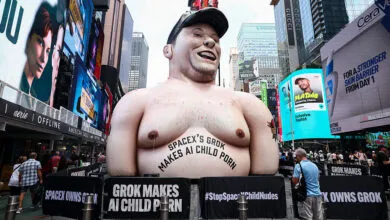
Several companies did not respond at all, including Elon Musk’s X Corp., which faced global backlash earlier this year after its AI chatbot Grok generated thousands of nonconsensual nude images of women. Proton AG and Verizon also remained silent.
The FTC did not comment, though its guidelines require platforms to make the reporting process simple and intuitive. Jennifer King, a fellow at Stanford’s Institute for Human-Centered Artificial Intelligence, emphasizes that the reporting mechanism is “one of the most important pieces” of the Take It Down Act , and “the thing that companies often overlook.” She notes that many potential reporters are teenagers, who may not know their legal rights or understand the dense legal language typical of compliance forms. “A lot of trouble with these reporting forms is that companies don’t put any resources into testing them,” King says. “They don’t test them with younger users , they probably don’t test them at all.”
How a takedown request works is straightforward under the law, explains James Grimmelmann, a law professor at Cornell Law School and Cornell Tech. At minimum, the request must include a way to locate the content (such as a link), a statement affirming it was uploaded nonconsensually, a signature from the person depicted or an authorized representative, and contact information for that person. Platforms must then act promptly to remove the material.
(Source: Wired)