Google Discover: How 20 Pipelines and 42M Cards Impact Publishers
▼ Summary
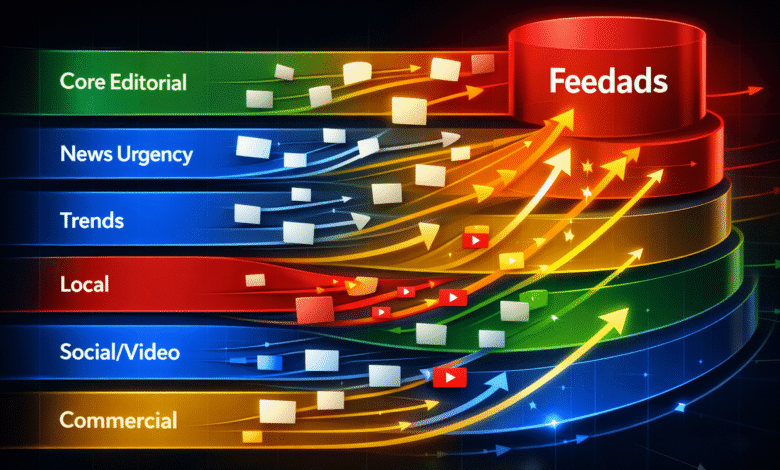
– The analysis of 42 million Google Discover cards revealed a system of 20 pipelines organized into six functional layers, not a single algorithm.
– A distinctive three-stage “YouTube cascade” of pipelines amplifies video content to broadcast-level reach in the English feed, a feature absent in French.
– AI Overviews content appears in English Discover through dedicated and general pipelines, sourcing from a small group of elite publishers like Reuters and the New York Times.
– The feedads pipeline has exceptional reach, showing ads to 58.4% of English devices, primarily from YouTube, which is significantly higher than in French Discover.
– Premier League content is systematically under-represented across multiple English pipelines, while content for other major sports is not affected.
A recent analysis of millions of content cards reveals the complex, layered architecture powering Google Discover. By tracking real user feeds over three months, researchers have mapped the function and impact of 20 distinct content pipelines, showing how they collectively shape what over a billion users see. The data uncovers a system far more intricate than a single algorithm, with specific pipelines dedicated to everything from breaking news and local stories to a powerful, English-only video amplification cascade.
The study analyzed 42 million feed cards from December 2025 through February 2026, linking each piece of content to the specific pipeline that selected it. This approach moves beyond simply naming these systems to reveal their practical operation: the volume of content they push, their speed, their audience reach, and the publishers they favor.
For each pipeline, four key metrics were calculated: Reach, or the percentage of devices that see a URL daily; Speed, measured by the median age of articles when they appear; Exclusivity, the percentage of URLs unique to that pipeline; and Volume, its share of the total feed. This data dismantles the notion of a monolithic algorithm, instead showing a structured ecosystem of six functional layers.
Core editorial pipelines like `content` and `aura` form the backbone, while news urgency layers such as `mustntmiss` prioritize timely stories. Trends, local/geo, and commercial layers serve distinct purposes, and a dedicated AI Overview pipeline exists solely in English. The social/video layer is particularly dominant in English feeds, driven by a unique three-stage amplification process for YouTube content.
This YouTube cascade is a defining feature of the English Discover feed. It begins with the `creatorcontent` pipeline, which intakes a mixed feed. Selected content then moves to `freshvideos`, where it is filtered, before finally being broadcast by the `neoncluster` pipeline to 13% of all devices. At each stage, the content becomes more purely video and its reach expands significantly. This cascade has experienced explosive growth and does not have a direct equivalent in other languages like French.
Another English-specific development is the integration of AI Overviews. A dedicated pipeline, `discoveraisummary`, is almost entirely composed of this AI-generated content. Furthermore, AI Overviews have penetrated other pipelines, making up 29% of the content in the `mustntmiss` pipeline. The sources for these summaries are concentrated among a small group of elite publishers like Reuters, The New York Times, and CNBC.
The analysis also highlights the overwhelming reach of the feedads pipeline. Each ad delivered through this channel reaches 58.4% of English devices, primarily through YouTube video advertising. This represents a monetization level far exceeding that seen in French feeds and dwarfs the reach of even the most powerful editorial pipelines.
A curious finding was the systematic under-representation of Premier League content. Terms related to the EPL showed strong negative signals across seven different pipelines, while content about other major sports like the NFL or NBA was unaffected. This suggests potential editorial restrictions, possibly related to broadcasting rights, that are baked into the system’s selection logic.
Publisher success within Discover varies dramatically by category. Quality press outlets like The Guardian and BBC enjoy a broad presence across 8-10 different pipelines. Tech and review sites find a strong visibility window in the `shoppinginspiration` pipeline but often remain siloed there unless they diversify into more editorial content. For video-first publishers, particularly those creating news, politics, or science content, the YouTube cascade offers one of the most powerful organic distribution channels available, with the final broadcast stage growing 18-fold in just three months.
This research provides a detailed snapshot of a dynamic system. The video cascade, for instance, was negligible in December 2025 but commanded significant reach by February 2026. Understanding this continuous evolution, not just a static picture, is crucial for publishers aiming to leverage Google Discover effectively. The complete interactive data, covering all 20 pipelines with their top domains and performance metrics, offers a granular view into this influential content ecosystem.
(Source: Search Engine Land)