Neanderthal brains were just as big as ours
▼ Summary
– Neanderthal skulls are lower and longer, while Homo sapiens skulls are rounder, but a new study suggests these differences don’t indicate major brain differences.
– MRI scans of modern brains and Neanderthal endocasts show more variation in brain size among modern people than between Neanderthals and Pleistocene Homo sapiens.
– Because brain size is a poor predictor of cognitive capability, Neanderthals may have been more similar to modern humans than some studies claim.
– The archaeological record supports the idea that Neanderthals were not out-competed by Homo sapiens due to superior intelligence or adaptability.
– A 2018 study with a small sample found Neanderthals had smaller cerebellums than Homo sapiens, but this finding does not capture the full picture.
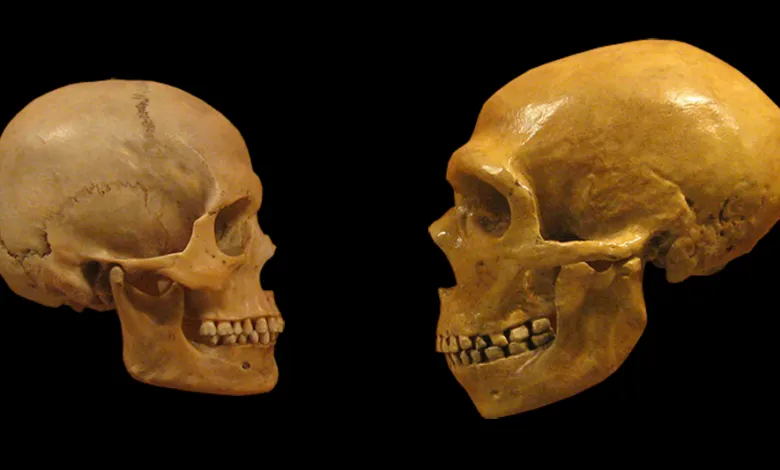
If you compare a Neanderthal skull to one from Homo sapiens, the differences are immediately obvious. Neanderthal skulls are lower and more elongated, while ours tend to be rounder. But those external differences likely don’t reveal much about the brains inside, according to new research that compared MRI scans of modern people with casts taken from the inside of Neanderthal skulls.
The findings indicate that brain size varies more among modern humans than it does between Neanderthals and Pleistocene Homo sapiens. And since brain size is actually a poor predictor of cognitive ability, Neanderthals may have been far more like us than some earlier studies have suggested. That conclusion aligns well with what the archaeological record tells us about how they lived. It also implies that our species probably didn’t outcompete Neanderthals simply by being smarter or more adaptable.
Neanderthal brains fall within the modern human range in terms of size. After death, the inner vault of your skull retains the shape of your brain. If future archaeologists create a cast of that space, they’ll produce a detailed resin model of your brain’s outer contours, known as an endocast. (Sediment that filled the skull of an Australopithecus africanus child who died 2.8 million years ago did this naturally, forming an endocast that is part rocky brain-sculpture and part sparkling crystal.) For years, researchers have studied Neanderthal endocasts, attempting to determine how their brains differed from ours. That question has sparked considerable debate.
A 2018 study compared endocasts from four Neanderthals and four early members of our species, measuring the volumes of 13 major brain regions. The authors suggested that, although Neanderthals had a larger total cranial capacity (more room in their skulls), they also had, on average, smaller cerebellums than Homo sapiens. (The cerebellum, a small structure at the back of the brain, plays a role in motor control, emotional regulation, and attention, among other functions.) And while that observation is technically true, based on a very small sample size, it didn’t capture the full picture.
(Source: Ars Technica)