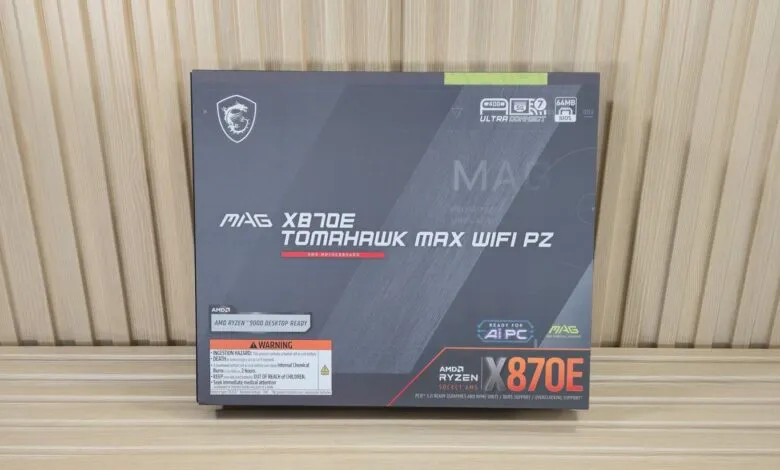
MSI MAG X870E Tomahawk MAX Wifi PZ Review: Cable-Free Build
▼ Summary
– The MSI X870E Tomahawk MAX Wi-Fi PZ is a mid-range, back-connect motherboard designed to hide cables for a cleaner PC build aesthetic.
– Key features include four M.2 sockets (two PCIe 5.0), Wi-Fi 7, 5 GbE networking, two 40 Gbps USB4 ports, and EZ DIY installation aids.
– It is part of MSI’s Project Zero ecosystem, which includes compatible PZ chassis and graphics cards to fully utilize the rear-connect design.
– The board’s performance in testing was average overall, with no significant differences that would hinder gaming or productivity tasks.
– It offers robust specifications for its ~$320 price, including a 17-phase power delivery system suitable for high-end AMD Ryzen processors.
The MSI MAG X870E Tomahawk MAX Wifi PZ motherboard delivers a compelling blend of modern features and a clean aesthetic, targeting builders who prioritize a tidy system. As part of MSI’s Project Zero lineup, this board relocates most connectors to the rear, significantly reducing cable clutter on the visible side. Priced around $320, it offers a robust package including four M.2 sockets with two supporting PCIe 5.0, 5 GbE and Wi-Fi 7 networking, and two high-speed USB4 ports. This design works seamlessly with compatible PZ chassis and graphics cards to create a nearly wire-free front view.
Performance from the X870E Tomahawk MAX Wifi PZ is solidly in line with expectations for its class. Benchmark results show it is competitive, with minor variations in speed that are typical and unlikely to be noticeable in everyday gaming or productivity tasks. The board’s power delivery, a 17-phase design with 14 phases dedicated to the Vcore, is more than adequate for even flagship AMD Ryzen 9 processors, providing stable operation without holding back performance.
A key advantage of this model is its suite of EZ DIY features, which simplify the building process. The M.2 Shield Frozr II heatsinks and the tool-free EZ M.2 Clip II make installing storage drives straightforward. Another helpful inclusion is the EZ PCIE Release, a button that easily unlocks graphics cards from the primary PCIe slot. The rear I/O panel is well-equipped, offering a total of nine USB Type-A ports alongside the dual USB4 connections, providing ample connectivity for peripherals and fast external storage.
The visual design employs a silver-and-white theme across its 8-layer PCB and large aluminum heatsinks. Since the board lacks integrated RGB lighting, users can add their own via the provided headers. The most striking visual change is the absence of front-facing connectors; the right edge is covered by shrouds, leaving only essential slots like the reinforced DDR5 memory slots and PCIe expansions visible. This creates the clean, minimalist look central to the Project Zero concept.
For storage, the board provides flexibility with its four M.2 sockets. It’s important to note that the second PCIe 5.0 M.2 socket shares bandwidth with the rear USB4 ports. By default, using this slot operates it at PCIe 5.0 x2, though you can configure it for the full x4 speed in the BIOS, which will disable the USB4 functionality. The board also supports SATA RAID configurations via its four SATA ports.
MSI’s Project Zero ecosystem aims to streamline cable management. To fully realize the clean look, using a compatible PZ case like the MAG Pano 100R PZ is recommended. These chassis are designed with specific pathways and cutouts for the rear-mounted cables. The ecosystem also includes PZ-version graphics cards, such as the RTX 5070 Ti Ventus 3x PZ, which reposition the power connector for a cleaner integration when used with these motherboards.
Overall, the MSI MAG X870E Tomahawk MAX Wifi PZ stands out as a well-equipped mid-range motherboard that successfully executes the rear-connect design. It packs strong connectivity and user-friendly installation features into a package that appeals to builders seeking both performance and a polished, cable-minimized aesthetic. The slight premium over standard models is justified for those who value the streamlined build process and final appearance.
(Source: Tom’s Hardware)