NVIDIA’s New Space-Bound Chip to Enable Orbital Data Centers
▼ Summary
– Starcloud plans to launch the NVIDIA H100 GPU, the most powerful processor flown in space, aboard its Starcloud-1 satellite next month to test orbital data processing.
– The company aims to build a 5-gigawatt orbital data center with 4-kilometer solar and cooling panels to reduce the environmental impact of Earth-based data centers.
– Orbital data centers could provide unlimited renewable energy and save 10x carbon dioxide emissions compared to terrestrial centers, with only environmental costs from launches.
– The Starcloud-1 mission will process Earth-observation data in orbit to overcome ground station limitations and deliver faster insights by identifying key images directly in space.
– Future plans include launching more powerful satellites with advanced NVIDIA GPUs, contingent on reduced launch costs when SpaceX’s Starship becomes operational in the early 2030s.
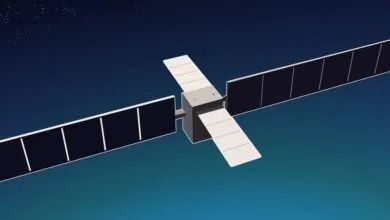
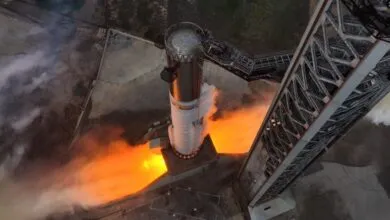
A groundbreaking mission is set to launch next month, placing an NVIDIA H100 GPU into orbit aboard the Starcloud-1 satellite. This represents a significant leap forward, as the processor is roughly one hundred times more powerful than any computing hardware previously flown in space. The launch, scheduled on a SpaceX Falcon 9 rocket, serves as a critical test for the viability of constructing large-scale data centers beyond Earth’s atmosphere.
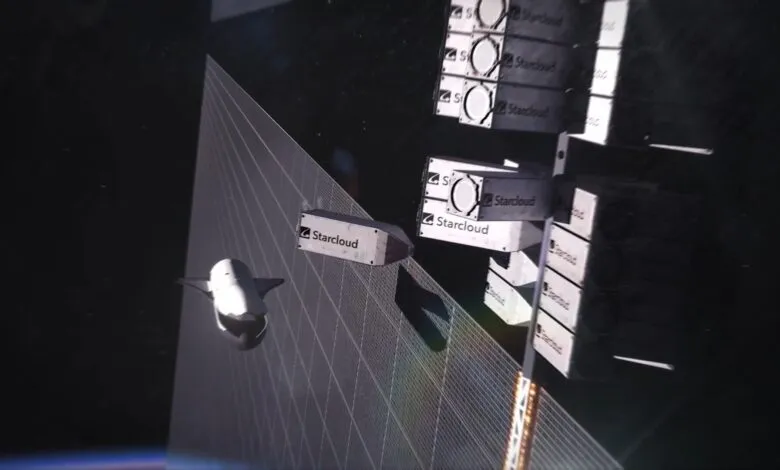
The company behind this venture, Starcloud, is based in Redmond, Washington. Their long-term vision involves building a massive orbital data center complex. This futuristic facility would be powered by enormous solar arrays and cooled by expansive panels, stretching approximately four kilometers in both width and length, with a planned capacity of five gigawatts. The primary objective of the initial satellite mission is to demonstrate how effective data processing can be when conducted directly in space.
Proponents of this concept argue that relocating data centers to orbit could substantially lessen the environmental impact of our ever-growing digital infrastructure. Terrestrial data centers are notorious for their immense consumption of electricity and water, often straining local resources. They also generate significant noise pollution and are a source of greenhouse gas emissions. In the vacuum of space, however, power from the sun is abundant and free, cooling is more efficient, and any operational noise is irrelevant.
Philip Johnston, Starcloud’s co-founder and CEO, emphasized the environmental benefits. He stated that in space, access to virtually unlimited, low-cost renewable energy is a game-changer. While the rocket launch itself carries an environmental cost, Johnston projects that over the data center’s operational lifetime, moving it to orbit would result in a tenfold reduction in carbon dioxide emissions compared to running an equivalent facility on Earth.
A major hurdle for this ambitious plan is the current high cost of launching payloads into space. Starcloud’s business model hinges on a significant reduction in these expenses. The company anticipates that the economics will become favorable once SpaceX’s fully reusable Starship rocket becomes operational, a milestone potentially reached in the early 2030s. Johnston has even predicted that within a decade, the majority of new data centers could be constructed in outer space.
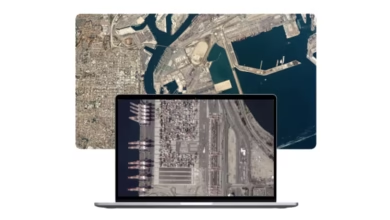
The immediate goal for the Starcloud-1 satellite is to prove the concept of in-orbit data processing. It will handle data collected by Earth-observation satellites, performing analysis to deliver rapid insights to customers on the ground. High-resolution optical and radar imagery contains massive amounts of data, creating a bottleneck when transmitting everything to Earth. With limited bandwidth and ground station availability, delays are common. By processing this data in orbit, the most valuable images can be identified and prioritized for downlink, streamlining the entire workflow.
In another space-first achievement, the satellite will also operate Google’s Gemma open language model. This demonstrates the satellite’s capability to handle advanced AI workloads directly in space. Johnston explained that for Starcloud to be competitive, its orbital systems must match the performance of terrestrial data centers. He highlighted that the NVIDIA H100 GPU is currently the most powerful platform available for tasks like AI training, fine-tuning, and inference.
Looking ahead, if this initial demonstration is successful, Starcloud plans to launch more advanced satellites in the coming years. These future missions are expected to test even more powerful NVIDIA GPU platforms, including the next-generation Blackwell architecture, which promises performance improvements of up to ten times over current capabilities.
(Source: Space.com)