Apple’s M5 Chips: iPad Innovation Leads the Mac Again
▼ Summary
– Reviews show the M5 iPad Pro continues Apple’s trend of receiving more hardware innovations than the MacBook Pro.
– The M5 iPad Pro features advanced hardware like Tandem OLED, touch support, and Face ID, which the M5 MacBook Pro lacks.
– Rumors indicate the MacBook Pro will eventually get features like OLED displays and touch support, but not until future models.
– Despite hardware differences, the MacBook Pro remains a mature and stable computing platform that performs well.
– Apple prioritizes cutting-edge technology in the iPad Pro, such as its own N1 wireless chip, while the MacBook Pro uses older components.
Evaluating the latest wave of Apple hardware, including the M5 iPad Pro, MacBook Pro, and Vision Pro, reveals a familiar pattern: the iPad continues to outpace the Mac in terms of hardware innovation. This isn’t a new development, but rather a long-standing trend that becomes especially clear when comparing the newest M5 iPad Pro with its MacBook Pro counterpart. While both devices serve different user needs, the iPad consistently receives cutting-edge technology first, leaving the Mac to follow at a later date.
It’s important to note that this isn’t about declaring one platform superior to the other. Each has distinct strengths and weaknesses. On the software front, iPadOS has historically lagged behind the robust capabilities of macOS. Even with significant updates in iPadOS 26, macOS maintains its own set of powerful advantages for professional workflows. However, when it comes to the physical components and features, the iPad is clearly Apple’s preferred vehicle for introducing its most advanced hardware.
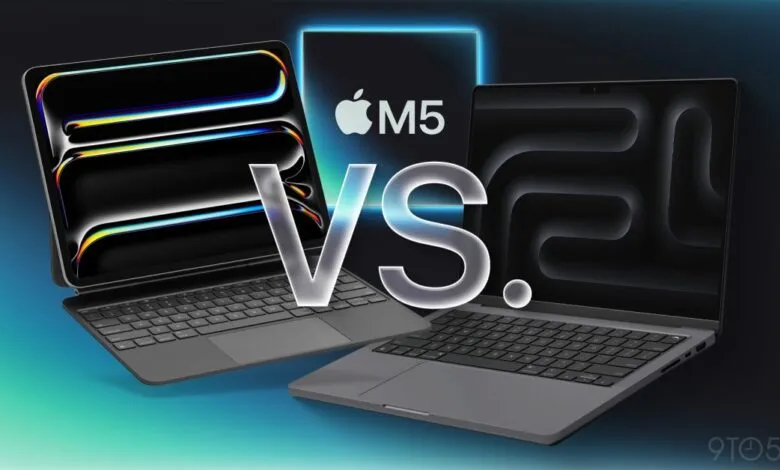
This pattern of iPad-first innovation has been evident for several years and is not exclusive to the M5 generation. A side-by-side look at the current M5 models highlights the technological gap.
The M5 iPad Pro boasts a stunning Tandem OLED Ultra Retina XDR display, while the M5 MacBook Pro makes do with a non-OLED Liquid Retina XDR screen. The iPad features a seamless touch interface and Face ID authentication, whereas the MacBook relies on a traditional trackpad and Touch ID. Physically, the iPad Pro sports an incredibly thin, year-old design, contrasting sharply with the MacBook Pro’s bulkier, four-year-old chassis. Furthermore, the iPad incorporates Apple’s proprietary N1 wireless chip and C1X modem, offering built-in cellular connectivity, a feature completely absent from the MacBook Pro, which uses standard third-party wireless components.
The question naturally arises: is there a compelling justification for the MacBook Pro to trail in these areas? The evidence suggests not, as industry rumors indicate that most, if not all, of these iPad Pro enhancements are slated to eventually reach the Mac line.
According to various reports, the MacBook Pro is expected to receive an OLED display by late next year, though it’s uncertain if it will be the advanced Tandem OLED variant. Touch support is also rumored for a similar timeframe. The integration of Face ID is reportedly still “years away.” A new, thinner design is anticipated next year, and the inclusion of Apple’s N-series wireless chips and a potential C2 modem are on the long-term roadmap.
All these references to “next year” understandably make the prospect of an M6 MacBook Pro more exciting for Mac enthusiasts than any recent release. For the present moment, however, Mac users are left with a familiar, albeit capable, machine.
To summarize the differentiation in Apple’s M5 lineup, the company’s cautious approach to updating the MacBook Pro isn’t necessarily a critical flaw. The Mac platform is mature, stable, and remains an excellent choice for a wide range of computing tasks. By all accounts, the M5 MacBook Pro is a solid and high-performing device.
Nevertheless, Apple made a conscious decision to equip the M5 iPad Pro with its latest N1 chip and modem technology, while the MacBook Pro continues with older components. The continued omission of a cellular option for the Mac is particularly notable, especially now that Apple is manufacturing its own 5G modems.
There may be valid strategic or engineering reasons behind these choices, or there may not. Regardless of the rationale, the outcome is clear: the iPad Pro consistently benefits from Apple’s most recent hardware breakthroughs far more directly than the Mac does.
For those who primarily use a Mac, does the advanced hardware found in the M5 iPad Pro cause any concern, or is it a non-issue? We welcome your perspective in the comments section below.
Discover the best accessories for both Mac and iPad to enhance your experience.
(Source: 9to5 Mac)