iPhone 17 Pro vs Pixel 10 Pro: The Ultimate Showdown Winner
▼ Summary
– The iPhone 17 Pro outperforms the Google Pixel 10 Pro in performance, battery life, and display color accuracy.
– The Pixel 10 Pro has a brighter display and more advanced AI software features, including conversational photo editing.
– Both phones have similar camera hardware, but the iPhone generally provides better overall photo quality and zoom capabilities.
– The iPhone 17 Pro starts at $1,099 with 256GB storage, while the Pixel 10 Pro starts at $999 with 128GB, making them equal in price for equivalent storage.
– The iPhone 17 Pro wins the overall comparison, but the Pixel 10 Pro remains a strong choice for Android users preferring its software and AI capabilities.
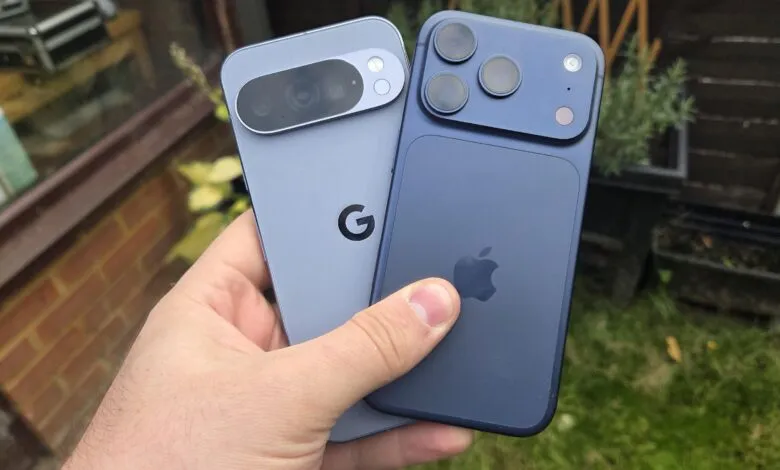
The arrival of the iPhone 17 Pro sparks inevitable comparisons with its primary Android rival, the Google Pixel 10 Pro. These two flagship devices share a focus on advanced camera systems, premium displays, and deep integration of artificial intelligence, yet they approach these features from fundamentally different philosophies. Determining which smartphone offers a superior experience requires a detailed, head-to-head examination across all critical categories.
A glance at the specifications reveals a close match on paper. Both phones feature a 6.3-inch display with a 1-120Hz adaptive refresh rate. The iPhone 17 Pro is powered by Apple’s A19 Pro chip, while the Pixel 10 Pro utilizes Google’s Tensor G5. Their camera arrays are similarly impressive, each boasting a triple-lens rear system with high-resolution sensors. However, raw specifications only tell part of the story.
Pricing and Storage
At first glance, the Pixel 10 Pro appears to hold a price advantage, starting at $999 compared to the iPhone 17 Pro’s $1,099. This comparison is not entirely straightforward. Apple has eliminated the 128GB storage tier, making 256GB the base storage for the iPhone 17 Pro. Google continues to offer a 128GB model at the entry-level price. When you configure the Pixel 10 Pro with 256GB of storage, its price increases to match the iPhone’s $1,099, effectively neutralizing the initial cost benefit.
Design and Build Quality
This year, the iPhone 17 Pro introduces a completely new aesthetic with an aluminum unibody and a prominent “forged plateau” camera bar that consolidates all lenses on the left side. This design has proven somewhat controversial due to its substantial size. The Pixel 10 Pro retains the recognizable horizontal camera bar from its predecessor. While both designs are distinctive, the Pixel’s profile is arguably more streamlined. A recent “scratchgate” controversy has also highlighted that the iPhone’s raised camera plateau may be more susceptible to visible edge damage. The phones are nearly identical in weight, but the iPhone is slightly shorter and thicker.
Display Performance
Both smartphones deliver exceptional visual experiences with their 6.3-inch adaptive refresh rate screens. For everyday use, gaming, and video streaming, both displays perform flawlessly. Objective testing, however, reveals key differences. The Pixel 10 Pro achieves a remarkable peak HDR brightness of 2,017 nits, significantly outperforming the iPhone’s 1,555 nits, making it the better choice for visibility in bright sunlight. Conversely, the iPhone 17 Pro wins in color accuracy, with a near-perfect Delta-E score of 0.23. The iPhone also incorporates an air-reflective screen to help mitigate glare.
Camera Capabilities
The camera comparison yields a complex and nuanced result. In many scenarios, the two phones trade blows. The Pixel 10 Pro often captures more foreground detail, while the iPhone 17 Pro tends to render more realistic colors and superior background clarity. The Pixel’s ultrawide lens produces brighter, more vivid images with less distortion. For zoom capabilities, the iPhone is the clear winner at 4x magnification, offering brighter and more detailed shots. However, at extreme zoom levels like 40x, the Pixel leverages generative AI to create a far superior final image, though the unprocessed photo is actually quite poor. In low-light conditions, both phones perform admirably and similarly. Overall, the iPhone 17 Pro provides more consistent, high-quality results across a wider range of shooting situations.
Processing Power and Battery Life
In terms of raw performance, the outcome is decisive. The iPhone 17 Pro’s A19 Pro chip delivers dramatically higher benchmark scores. In Geekbench 6, it scored 3,834 (single-core) and 9,988 (multi-core), dwarfing the Pixel’s scores of 2,335 and 6,375. This performance gap translates to real-world tasks; the iPhone completed a 4K video transcode in just 22 seconds, while the Pixel took 2 minutes and 19 seconds. Battery life further extends Apple’s lead. The iPhone 17 Pro lasted 15 hours and 32 minutes in battery testing, nearly two hours longer than the Pixel 10 Pro. The iPhone also supports faster wired charging, reaching a 72% charge in 30 minutes.
Software and Artificial Intelligence
The software experience presents a contrasting picture. iOS 26 introduces the Liquid Glass design language and features like Call Screening and Live Translation. However, Apple’s AI features, branded as Apple Intelligence, feel less comprehensive compared to Google’s offerings. The Pixel 10 Pro shines with its AI-centric tools, including conversational editing in Google Photos, which allows for voice-controlled, generative AI photo edits. Features like Magic Cue and Camera Coach, while subtle, add meaningful utility. For users who value innovative and powerful AI integrations, the Pixel 10 Pro holds a distinct advantage.
Final Verdict
The iPhone 17 Pro emerges as the more well-rounded and powerful device, securing victories in performance, battery life, and overall camera consistency. It is the definitive choice for users who prioritize raw speed and reliability. That said, the Google Pixel 10 Pro is far from a weak contender. It boasts a superior display for brightness, a more contentious but arguably sleeker design, and a software suite packed with groundbreaking AI capabilities. For Android enthusiasts and those who want their phone to offer intelligent, automated features, the Pixel 10 Pro remains an exceptionally compelling option.
(Source: Toms’s Guide)