ASRock X870 Nova WiFi Review: Storage King, But At What Cost?
▼ Summary
– The ASRock X870 Nova WiFi is a well-rounded, budget-friendly motherboard priced at $269.99, featuring high-quality audio and a visually appealing design with purple accents and RGB lighting.
– It offers extensive connectivity, including five M.2 sockets (two PCIe 5.0), multiple USB ports with 40 Gbps USB4, 5 GbE and Wi-Fi 7 networking, and a flagship Realtek ALC4082 audio codec.
– Performance testing showed the motherboard performs well overall, often at or above average, and it supports up to DDR5-8400 memory speeds, though compatibility with very high-speed kits may be limited.
– A key limitation is significant PCIe lane sharing among M.2 sockets, USB, PCIe, and SATA ports, which can reduce bandwidth when multiple devices are used simultaneously.
– The board includes essential accessories like SATA cables and a Wi-Fi antenna, and it has a 3-year warranty, making it a capable option for most builds but less ideal for all-M.2 storage setups.
The ASRock X870 Nova WiFi stands out as a well-equipped motherboard offering impressive storage options, strong audio performance, and a design that fits most build aesthetics. Priced competitively at $269.99, it delivers a compelling package for budget-conscious builders seeking modern features. However, potential buyers should be aware of significant PCIe lane sharing when using multiple M.2 drives alongside other peripherals.
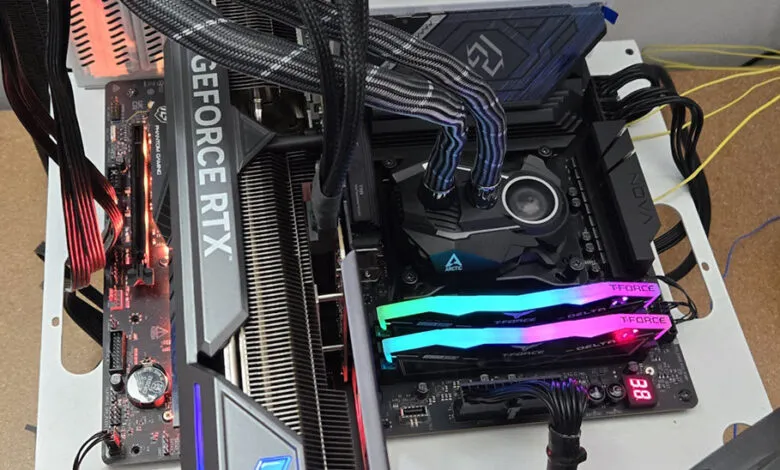
This board includes five M.2 sockets, two of which support PCIe 5.0, along with USB4 ports offering 40 Gbps speeds, native 5 GbE and Wi-Fi 7 networking, and a high-end Realtek ALC4082 audio codec. Its visual design features purple Phantom Gaming accents and integrated RGB lighting, particularly a vibrant strip beneath the bottom M.2 heatsink. While the X870 chipset lacks the second Prom21 found in higher-end models, it still provides extensive connectivity, though with notable bandwidth limitations.
During testing, the X870 Nova performed reliably, handling mid-range RAM speeds and default BIOS settings with ease. It consistently met or exceeded average benchmarks, proving itself as a capable platform for general use. The board supports up to 256GB of DDR5 memory, with official speeds reaching DDR5-8400, though real-world compatibility may vary.
A closer look at the board’s layout reveals a robust 21-phase power delivery system using 80A MOSFETs, sufficient for high-end CPUs like the Ryzen 9 9950X even with moderate overclocking. Four reinforced fan headers and an AIO pump header offer flexible cooling options. The rear I/O is generously appointed with 11 USB ports, including two USB4 Type-C connectors, multiple high-speed USB 3.2 ports, and legacy USB 2.0 connections.
Where the X870 Nova demands attention is its shared bandwidth structure. Occupying the M22 slot reduces the rear USB4 ports and the slot itself to x2 mode, effectively halving PCIe 5.0 speeds. Using M23 disables both SATA ports, and installing a drive in M25 downgrades the secondary PCIe slot to x2 mode. Only M21 and M2_4 operate without sharing constraints.
Included accessories are minimal, two SATA cables, a Wi-Fi antenna, a thermistor cable, and an ARGB splitter, which is typical for motherboards in this price range. The packaging reflects a no-frills approach, focusing value on the board itself rather than extras.
For builders prioritizing massive SSD storage and modern connectivity, the X870 Nova represents a solid value. Its sleek appearance, capable power delivery, and extensive USB and M.2 support make it an attractive option. However, those planning to maximize every slot and port should carefully review the manual to avoid unexpected performance trade-offs.
(Source: Tom’s Hardware)