AI Spending Per Employee Drops at Top Firms in August
▼ Summary
– Business adoption of AI tools slowed in August, with only a 0.4% increase in spending among Ramp customers.
– This slowdown raises concerns about revenue potential for the massive infrastructure investments made by major AI labs and hyperscalers.
– Ramp’s data may overstate overall market adoption compared to the US Census Bureau’s finding that only 22% of businesses use AI.
– Competition between OpenAI and Anthropic has driven down token costs, leading companies to choose older, cheaper models over newer frontier releases.
– The decline in spend per employee at top firms suggests price cuts have not yet been offset by sufficient growth in usage volume.
AI adoption rates among enterprise customers experienced a slight deceleration in August, according to new spending data from Ramp. The payments platform analyzed transactions across 70,000 companies and found that 56% of its clients paid for AI products during the month. This figure represents a marginal increase of just 0.4% compared to July, marking a notable pause in the rapid expansion previously seen in the sector.
This hesitation is not unprecedented for Ramp’s metrics. Historical data indicates that AI adoption often stagnates between August and October, with momentum typically resuming only toward the end of the year. However, given the massive capital expenditures currently being deployed by frontier labs and hyperscalers, even minor dips in growth warrant attention. These entities have invested heavily in infrastructure under the assumption that sustained revenue will justify the costs. While usage has surged recently, driven largely by software engineers embracing agentic coding tools, any significant slowdown in this adoption could directly impact future revenue streams.
Pricing Pressures and Model Selection
Ramp’s data likely overstates general market adoption due to its focus on tech-forward clients. In contrast, an ongoing US Census Bureau survey updated on August 23 reveals that only 22% of all businesses report using AI. Despite this discrepancy, Ramp’s dataset remains one of the few direct indicators of corporate spending and may serve as a leading signal for broader trends.
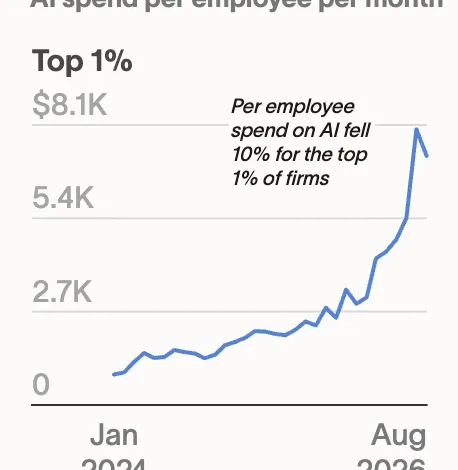
The timing of the data collection also plays a role, as August traditionally sees reduced activity across many industries. However, Ara Kharazian, Ramp’s economist, points to more structural warning signs within the numbers. Most notably, there was a nearly 10% drop in AI spend per employee among the top 1% of firms in Ramp’s sample, bringing the average down to $7,205.
While part of this decline may reflect seasonal vacation patterns, it also highlights the impact of falling token costs. As competitors like OpenAI and Anthropic slash prices, the average cost per million tokens has dropped to $0.68. This is a significant decrease from the peak of $1.15 per million tokens recorded in March 2026. Consequently, many customers are opting for older, more affordable models such as OpenAI’s ChatGPT 5.6-Terra and Anthropic’s Sonnet rather than paying premium rates for the latest frontier releases. Industry insiders have noted that model training costs are typically recouped within weeks of a new launch, meaning slower adoption of these high-end tools threatens that financial dynamic.
Competitive Dynamics and Market Outlook
Despite widespread speculation that open-weight models might disrupt the dominance of major AI developers, their influence remains limited in the short term. Only 6.4% of businesses spending on AI utilized model-serving or inference platforms in August. Although this share is growing, it is not expanding rapidly enough to alter the fundamental dynamics of business-wide AI integration.
The intense rivalry between major providers is reshaping the economic landscape for enterprises.
> “We are showing that competition between OpenAI and Anthropic is making AI more accessible, and also driving the price down for companies,and not just driving the price down, but driving spend down at the top 1% of companies that previously the market was expecting to drive much of the growth going forward,” Kharazian said.
This shift explains why AI laboratories are increasingly targeting non-technical users with co-working tools, seeking to expand their user base beyond early adopters. For investors and hyperscalers holding billions in chip inventory, these August figures might appear concerning. Yet, the impact varies significantly depending on one’s position in the value chain. As Kharazian concluded, the data suggests a mixed bag:
> “it depends on who you are in the market. If your company is using AI, it’s great.”
(Source: TechCrunch)