Pacific Fusion’s Next Machine Targets Key Commercial Hurdle
▼ Summary
– Pacific Fusion has broken ground on a new fusion facility in Albuquerque, New Mexico, aiming to achieve net facility gain by 2030.
– The company utilizes intense electrical pulses to create magnetic fields that squeeze fuel targets until atoms fuse, with plans for commercial power plants by the mid-2030s.
– Each pulse at the new demonstration site will generate approximately 100 megajoules, significantly exceeding the output of existing facilities like the National Ignition Facility.
– Founded in 2023, Pacific Fusion is well-funded with over $1 billion raised and intends to lead global development of high-yield fusion technology.
– The facility will also support national security experiments involving high-yield fusion, addressing aging infrastructure at other government research sites.
Pacific Fusion has taken a significant leap toward making fusion energy a commercial reality by breaking ground on a new facility in Albuquerque, New Mexico. This site is specifically engineered to achieve net facility gain, a critical industry milestone where the reactor generates as much energy as it consumes. While several startups are advancing rapidly, this project marks a distinct step forward in the race for viable power generation.
“It’s a huge step forward for commercial fusion power,” Carrie von Muench, co-founder and chief operating officer at Pacific Fusion, told TechCrunch. “To our knowledge, there’s no such facility being constructed in the country.”
The Path to Net Facility Gain
The fusion sector has seen impressive experimental successes, yet no device has yet produced enough output to sustain its own operations. The National Ignition Facility demonstrated that controlled fusion can yield more energy than the laser input requires, but that result falls short of powering the entire facility. Pacific Fusion aims to bridge this gap by achieving net facility gain by 2030, with plans to operate a commercial plant in the mid-2030s.
To transition from a demonstration system to a full-scale power plant, the company must eventually generate roughly five times more energy than its current prototype. This excess power is necessary to run the additional equipment required for continuous electricity production. The new Albuquerque campus will serve as the testing ground for this ambitious goal.
A Unique Magnetic Approach
Pacific Fusion utilizes a proprietary method involving intense, synchronized electrical pulses to create a magnetic field around a fuel target. This target, comparable in size to a pencil eraser, is compressed until the atoms fuse. The demonstration facility is designed to fire a limited number of shots daily, a stark contrast to the one shot per second required for a commercial power plant.
Keith LeChien, co-founder and chief technical officer at Pacific Fusion, explained the operational differences to TechCrunch: “A full-size power plant will need to complete one shot per second.”
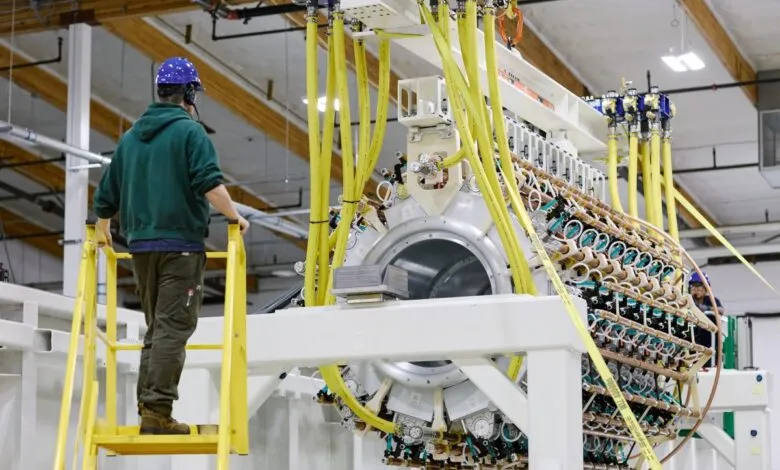
The electrical pulses driving this process are generated by 156 pulser modules. Each module comprises 32 circular stages, with each stage containing ten bricks. Every brick houses two capacitors for power storage and a switch for release. Earlier this year, the company successfully tested a one-third-scale version of these modules, achieving a peak power release of 440 gigawatts within 80 nanoseconds. These promising results provided the green light to proceed with construction.
National Security and Global Competition
Beyond commercial energy, the new facility will support national security initiatives focused on high-yield fusion experiments. While the U. S. government currently relies on sites like the National Ignition Facility, that infrastructure is aging. LeChien noted that each pulse from Pacific Fusion’s system will produce approximately 100 megajoules, which is about ten times the output of the existing national lab.
“This exists nowhere in the world,” he said. “China is building these types of facilities, and we intend to be the first to deliver them.”
Strategic Funding and Market Position
Founded in 2023, Pacific Fusion is among the youngest players in the fusion landscape, yet it stands out due to its substantial financial backing. The company secured over $1 billion in a milestone-based Series A round, allowing for long-term strategic planning without the immediate pressure of frequent fundraising.
“I don’t think it would have been possible to move at this speed if we hadn’t designed the capital stack the way that we have,” von Muench said.
This financial stability positions Pacific Fusion well against a growing cohort of competitors. Well-funded rivals such as Commonwealth Fusion Systems, Helion Energy, Proxima Fusion, and Inertia Enterprises are also targeting grid connection by the mid-2030s. In this increasingly crowded field, Pacific Fusion’s rapid progress and unique technological approach aim to secure a leading position in the next era of clean energy.
(Source: TechCrunch)