Nvidia in talks to acquire Korean AI chip designer Rebellions
▼ Summary
– Nvidia is in early talks with Korean AI chip designer Rebellions about a technical partnership, investment, or possible acquisition, following a meeting between Jensen Huang and CEO Sunghyun Park.
– Rebellions, founded in 2020, designs neural processing units for AI inference, has raised about $850mn from investors like SK Hynix and Samsung, and is valued at roughly $2.3bn.
– Nvidia has used a template of licensing technology and hiring engineers without full acquisitions, as seen with Groq ($20bn licence) and Poolside ($6bn deal).
– The Groq licence, productised as Nvidia’s Groq 3 LPU, shows per-chip economics are poor, with Nvidia’s data centre head noting low tokens per second per chip.
– A deal faces hurdles from US antitrust review and Korean national security concerns over advanced semiconductors, while Rebellions has been pursuing an IPO rather than an exit.
Nvidia has opened preliminary discussions with Rebellions, a South Korean designer of AI inference chips, about a potential technical partnership, equity stake, or full acquisition, according to a Bloomberg report on Friday. The talks signal another move by the US chip giant to secure alternative architectures without absorbing entire companies.
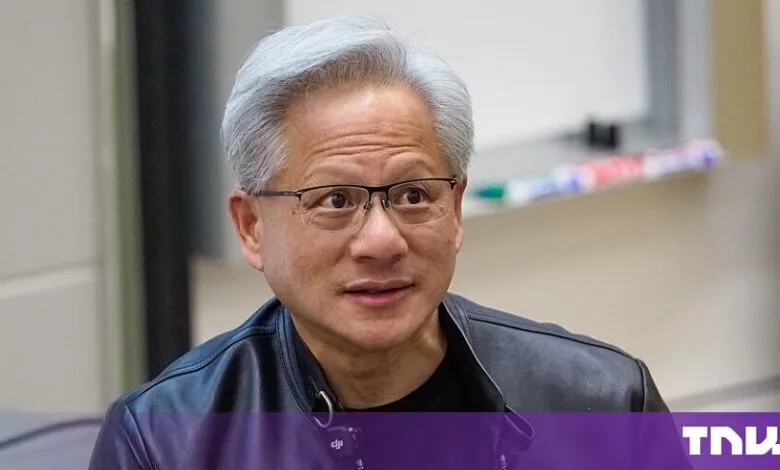
Jensen Huang, Nvidia’s chief executive, met with Rebellions co-founder and CEO Sunghyun Park at the company’s Santa Clara headquarters earlier this week, sources familiar with the matter told Bloomberg. The individuals requested anonymity because the discussions remain private.
The conversations are at an early stage and may not result in a deal. Nvidia declined to respond to Bloomberg’s inquiries, while a Rebellions representative also declined to comment.
If completed, this would mark the fourth arrangement of its kind in less than a year. Over that period, Nvidia has consistently opted to license rival chip designs and bring on engineering teams rather than purchase companies outright.
What Rebellions brings to the table
Founded in 2020 and headquartered in Bundang, just south of Seoul, Rebellions develops neural processing units for data centre workloads, with a focus on AI inference rather than model training. Inference, the process of running a trained model to serve queries, demands less compute per request than training but far greater total volume across production systems.
The company has raised roughly $850 million from investors including SK Hynix, Samsung Ventures, and Arm, and holds a direct investment from the South Korean government. Its most recent valuation stood near $2.3 billion.
By comparison, Nvidia’s investment portfolio exceeds $63 billion, largely concentrated in Intel and SpaceX, while Nvidia itself carries a market value of about $5.2 trillion.
Rebellions has shipped products for three years. Its Atom and Atom Max NPUs entered mass production in 2023, with deployments reported in Japan, Saudi Arabia, and the United States. In 2024, the company merged with Sapeon Korea, a chip business spun out of SK Telecom in 2016, and partnered with Marvell last year on hardware aimed at sovereign AI projects.
A familiar playbook
The structure Bloomberg described matches a pattern Nvidia has used repeatedly: secure a licence, absorb engineering talent, take a minority stake, and leave the target company operating independently.
Earlier this year, Nvidia paid Groq $20 billion for a nonexclusive licence and brought on most of its engineering staff. Nvidia insisted the arrangement was not an acquisition, as Groq continues to run its cloud business separately.
The same template surfaced again this week. Nvidia agreed to pay Poolside $6 billion for its model factory and hired 109 of its employees.
Competitors are following suit. AMD acquired Taalas, a startup that embeds models directly into silicon, in August.
The Groq precedent carries a warning
Groq offers the clearest case study, and the outcome has not favoured the startup.
Nvidia valued the Groq licence at $20 billion. Groq subsequently raised $650 million for its remaining operations. This month, it closed an additional $350 million round at a $3.5 billion valuation, with Nvidia participating as an investor.
That valuation represented a drop of nearly half from its previous mark, according to Silicon Republic. In short, a company Nvidia paid $20 billion to license is now worth $3.5 billion as a standalone business.
Why Rebellions fits the pattern
The logic behind the Rebellions talks becomes clearer when considering what Nvidia has already done with the Groq technology.
Nvidia converted the Groq licence into its own inference product, unveiling the Nvidia Groq 3 language processing unit at GTC in March. The company said it would introduce a new LPU architecture annually alongside its GPU roadmap.
The chip is slated to ship in the second half of this year in liquid-cooled racks containing 256 LPUs, with 128GB of on-chip memory and 640 terabytes per second of scale-up bandwidth.
Rebellions designs the same category of hardware. Nvidia, having already productised one inference architecture, would be licensing a second.
Nvidia’s own executive flags the economics
Ian Buck, who leads Nvidia’s data centre business, outlined the trade-offs at GTC.
“The LPU is optimized strictly for that extreme low-latency token generation, offering token rates in the thousands of tokens per second,” he said. “The trade-off, of course, is that you need many chips in order to get that kind of performance. And the economics, or the tokens per second per chip, is actually quite low.”
That is Nvidia’s data centre chief describing the per-chip economics of the category as weak, and he was referring to Nvidia’s own product.
Regulatory hurdles ahead
Two separate authorities would likely scrutinise any deal.
Nvidia’s dominance in chips used to train frontier models already attracts antitrust attention, Bloomberg noted, and large technology acquisitions typically require clearance from the US Department of Justice. The licence-and-hire structure avoids the regulatory review a full purchase would trigger.
South Korea presents a second obstacle. Seoul classifies advanced semiconductors as strategic national assets, and Samsung and SK Hynix coordinate closely with the government on investment initiatives. SK Hynix is a shareholder in Rebellions and also backs Etched, a competitor whose valuation doubled to $10.3 billion in seven months.
Rebellions has signalled an IPO path
The company has consistently pointed toward a public listing rather than an acquisition.
Chief financial officer Sungkyue Shin said a year ago that going public was the “master plan.” In March, Rebellions raised more than $400 million in what it described as a pre-IPO round, using the occasion to launch two rack-scale platforms, RebelRack and RebelPod.
No listing date has been announced. An Nvidia licence would provide the company with cash without requiring a public offering, the same trade Groq and Poolside accepted.
What remains unconfirmed
No agreement exists. Bloomberg’s sources described the discussions as preliminary and cautioned they may not lead to a transaction.
No structure, price, or stake has been reported. Whether this becomes a licence, a minority investment, or an outright purchase is precisely the question the sources left unanswered.
Neither company has commented publicly, and neither has clarified what a partnership would involve if it stopped short of an investment.
Separately, Nvidia spent this week denying an unrelated chip report. Asked about claims it had developed a China-specific LPU, a spokesperson said the reporting “is incorrect,” adding: “We have no LPU sales in the China market today, and no China-specific LPU product in our roadmap.”
(Source: The Next Web)