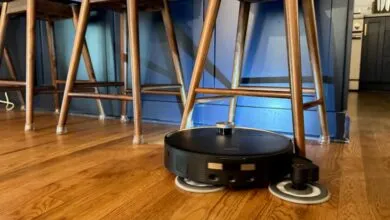
This Robot Vacuum Cleans Up When You Just Point at a Mess

▼ Summary
– Matic launched Matic Cues on August 13, adding voice and gesture control to its robot vacuum, with the price set to rise from $1,245 to $1,495 on September 9.
– Gesture control, a unique feature among robot vacuums, lets users point at a mess and say “clean here,” using the robot’s five cameras for on-device processing; it can also follow users to clean specific spots.
– The voice assistant uses the Gemini API for natural language understanding, supporting commands like “clean the toekicks in the kitchen” and chained tasks, though it displays responses on screen instead of talking back.
– Voice commands require an internet connection and cloud processing, with wake word “Hey Matic” handled on-device; sent commands are anonymized, and the feature is opt-in with microphones that can be disabled.
– The update is available to all existing Matic robots, and the author found it more intuitive than competitors’ voice assistants, solving the pain point of precise spot-cleaning.
Matic, already my top pick for robot vacuums, is getting considerably smarter. The company just unveiled Matic Cues, a new feature set that introduces both voice and gesture controls to the device. This means you can now speak directly to your vacuum to assign tasks, or simply point at a specific spill or pile of debris for a targeted clean-up.
The feature goes live today, August 13 at 2 pm ET, appearing in the Matic app under Settings > Matic Cues. This update lands right before a planned price increase on September 9, when the WALL-E-inspired robot’s cost will jump from $1,245 to $1,495.
I’ve spent about a day testing Matic Cues, and the early results are promising. The gesture control is the real differentiator here; it is a capability no other robot vacuum offers. The company’s founders, both computer vision engineers with backgrounds at Google Nest cameras, have been developing this specific feature since 2017.
Here’s how it works: You wake the robot with the phrase “Hey, Matic,” and it turns toward your voice to “see” you. Then, you point at the mess, say “clean here,” and the robot gets to work. I did find that for a smaller target area, I had to crouch down to point more precisely. Gesturing from a standing position resulted in the robot cleaning a broader zone, which naturally took more time. The robot can also follow you, so saying “Hey Matic, follow me,” walking to the mess, and pointing at it is enough to start the cleaning process.
Since the system relies on the robot’s existing vision hardware, which includes five cameras, the gesture control operates entirely on-device. This means the feature will be available on all existing Matic robots, not just new purchases.
Most robot vacuums handle spot cleaning by having you draw a zone in the app, a method I have always found imprecise and too slow for quick cleanups. Others respond to a “clean here” voice command, but that typically targets the general area where you are standing. Matic’s gesture-based approach feels far more precise and intentional.
The new built-in voice assistant also performed well during my initial testing. While voice control is nothing new for robot vacuums, with many supporting Alexa, Google, or Siri and several brands like Roborock, Ecovacs, and Narwal offering their own onboard assistants, my long-term experience with these has been mixed. Many require memorizing exact phrases. While “vacuum the kitchen” is easy, other commands are less intuitive and less flexible than what Matic is offering.
Matic leverages the Gemini API to parse natural language. You can issue commands like “vacuum the inside of the carpet” to avoid the tassels, “clean just the hard floors,” or “clean the toekicks in the kitchen,” the latter being something I always want done after cooking dinner.
The robot could hear me from another room and responded quickly, though there was a slight pause before it executed the command. It doesn’t talk back; instead, its small display confirms it heard you and shows what it is doing.
I was impressed by the number of commands it understood, including chained requests like “clean the kitchen, vacuum the living room, and then mop the bathroom.” It also retreated to its dock when I said, “Hey Matic, go away,” which is handy when it gets underfoot in the kitchen.
A key selling point for Matic has always been its ability to function without the cloud or an internet connection. However, voice control requires both. The company states that the “Hey Matic” wake word is processed on-device, so no ambient conversation is sent to the cloud. But any command that follows is sent to the Gemini API. A short chime alerts you when data is leaving the device.
Mehul Nariyawala, cofounder and president of Matic, says the commands are anonymized. He explained that Matic chose cloud processing to support over 75 languages and a wider range of commands. The company plans to eventually bring the top 20 or 30 most-used commands on-device. Matic Cues is opt-in, and you can disable it and the microphones in settings.
The tension between added convenience and privacy is a constant issue in the smart home. Roborock’s “Hey Rocky” assistant is entirely on-device, but I rarely use it because it is not intuitive. In contrast, I have already found myself using “Hey Matic” much more often, simply because talking to it is easier. The gesture control also solves a long-standing frustration of mine: getting a robot to clean the exact spot I have in mind. For current Matic owners, this is a valuable update. For anyone on the fence, it is a new level of convenience that makes an already excellent robot vacuum even better.
(Source: The Verge)