Vintage computer collecting thrives as AI reshapes tech
▼ Summary
– Vintage computer collectors like Josh Dersch preserve early machines from Atari, Commodore, and IBM, viewing them as historical artifacts rather than junk.
– The Vintage Computer Federation’s annual festival in Mountain View drew over 3,500 attendees in August, celebrating Apple’s 50th anniversary with a panel featuring co-founders Steve Wozniak and Ronald Wayne.
– Interest in vintage computing is growing, with more festivals worldwide and rising demand on online marketplaces, where rare items like the Apple-1 can sell for hundreds of thousands of dollars.
– Dersch showcased his restored Xerox Alto, a 1970s computer considered the “grandfather of the modern computer,” which pioneered the mouse and graphical user interface that inspired Steve Jobs and Bill Gates.
– Erik Klein, president of the Vintage Computer Federation, downsized his personal collection of up to 150 systems due to space and family concerns, now focusing on organizing events and workshops to promote the hobby.
Software engineer Josh Dersch spends his weekends elbow-deep in the guts of machines that most people would toss in a dumpster. In his Seattle garage, he patiently resurrects relics from the early days of personal computing, and his home now holds more than 200 vintage computers and peripherals. For him, the appeal is both intellectual and nostalgic.
“I have always been drawn to understanding where things come from,” Dersch said. “There’s a real satisfaction in debugging and repairing these systems. You can grasp the entire architecture, from the ground up.”
Dersch belongs to a fast-growing network of enthusiasts dedicated to preserving the landmark hardware that powered the digital age. Even as Silicon Valley pivots aggressively toward artificial intelligence, these collectors are making sure the Ataris, Commodores, and IBM machines that paved the way for today’s smartphones and laptops are not forgotten.
What looks like obsolete clutter to the average person is, to this community, a piece of computing heritage deserving of care and reverence. They revel in the nostalgic chirps and beeps of their youth, and they still light up pixelated rounds of “Pong” or “Space Invaders” with genuine joy.
“The appetite for computing history and everything connected to it is definitely expanding,” said Erik Klein, president of the Vintage Computer Federation, the group behind the annual festival held at the Computer History Museum in Mountain View, the epicenter of the tech world.
Vintage computer festivals unite collectors worldwide
This summer, the two-day Vintage Computer Festival drew more than 3,500 attendees, marking the 50th anniversary of Apple, which was founded in 1976 just down the road in Cupertino. A highlight was a panel discussion featuring co-founders Steve Wozniak and Ronald Wayne, who shared stories from the company’s scrappy startup days under the late Steve Jobs.
More than a dozen similar gatherings have now sprouted across North America, South America, and Europe, and the movement shows no signs of slowing.
Klein notes that the surge in interest is visible in online marketplaces, where demand for classic machines has climbed. Legendary systems, such as the Apple-1, the company’s very first product, have been known to sell for hundreds of thousands of dollars.
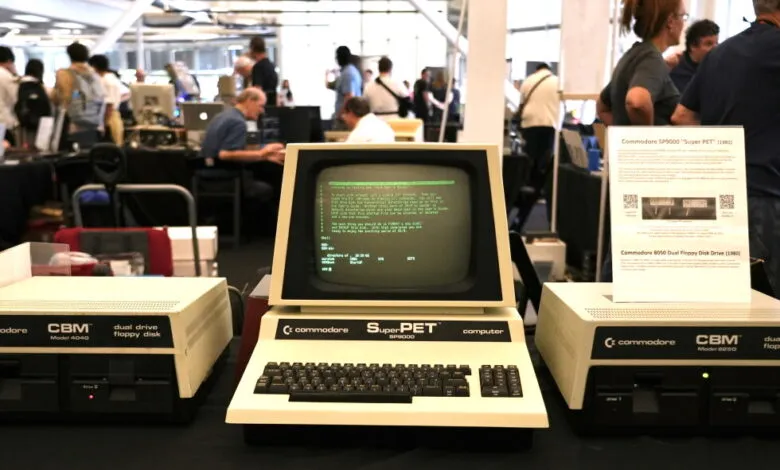
At these festivals, collectors proudly display painstakingly restored systems in full working order, giving visitors a hands-on chance to interact with computers that predate the internet, social media, and AI.
Resurrecting the grandfather of the modern computer
Dersch drove down from Seattle to unveil the crown jewel of his collection: the Xerox Alto. He devoted years to restoring a machine widely regarded as the ancestor of every modern computer, developed at Xerox’s legendary Palo Alto Research Center in the 1970s.
The Alto was a pioneer in moving beyond text-based interfaces. It introduced the mouse and the graphical user interface, complete with windows, icons, and cursors, all of which later became industry standards. Its influence was profound, famously inspiring both Steve Jobs and Bill Gates to weave those innovations into their early products.
Dersch’s display featured a completely operational Xerox Alto workstation, complete with its boxy vertical monitor, hefty keyboard, and mouse, alongside pizza-box-sized spinning disks that hold a laughably small amount of data by today’s standards.
“Sharing what I’ve restored is a lot of fun, and I also enjoy seeing what others have accomplished,” Dersch said. “Plus, there’s a consignment area where I can pick up more junk to haul home. That’s always a bonus.”
Klein, who manages software engineering by day, was once a voracious collector himself. At his peak, he crammed nearly 150 complete computer systems, along with accessories, manuals, and original packaging, into every closet and corner of his garage.
Eventually, he realized his beloved hoard had become an “albatross,” and he worried about leaving his family with the burden of managing it. He began selling and donating machines until only a handful of favorites remained.
A global movement takes root
These days, Klein focuses his energy on spreading the gospel of vintage computing. As president of the Vintage Computer Federation, he organizes festivals, repair clinics, swap meets, and other community events.
“It’s really about championing the history and promoting the hobby of preserving, collecting, and enjoying this vintage technology,” Klein said.
Sellam Ismail, who organized the very first festival in 1997 with roughly 150 attendees at a venue east of San Francisco, is delighted to see how the community has grown and matured. He ran the events for a decade before co-founding the Vintage Computer Federation, which now hosts festivals in the U. S. and Canada. He has also mentored groups in Argentina, Germany, and Switzerland to launch their own events.
“The community has really come into its own. More and more people are picking up old machines and starting collections,” said Ismail, who once kept a massive trove of hardware in a warehouse. “Next year marks the 30th anniversary. And I fully expect this momentum to keep building.”
(Source: Associated Press)