AI Designs New Viruses Using Genome Models
▼ Summary
– AI work in biology has focused on designing proteins because they catalyze chemistry and structure cells, enabling new biochemical functions.
– Large genome models, trained on DNA sequences, can output DNA that encodes functional proteins in bacteria and mimics gene structures of complex cells.
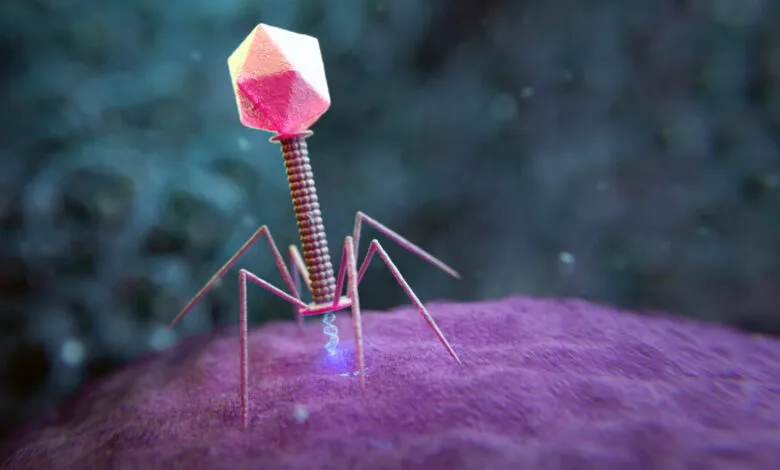
– These models have now generated genomes of viruses that infect bacteria, all closely related to existing viruses but with distinct features hard to evolve naturally.
– Stanford researchers suggest preparing for the potential that similar AI could design viruses targeting vertebrates.
– Large genome models must recognize biological context in genomes, where some sequences are critical and others are flexible, enabling outputs like functional proteins from gene clusters.
Artificial intelligence in biology has largely centered on protein design, and for good reason. Proteins handle most of life’s heavy lifting, from catalyzing chemical reactions to providing structural support inside cells. The ability to engineer a novel protein means you can directly manipulate biochemistry, opening the door to new, potentially valuable functions.
But DNA is a different beast. Because the genetic code acts as an abstraction layer between genes and the proteins they produce, it wasn’t immediately clear what a model trained purely on DNA sequences could accomplish. Still, researchers pressed forward, building what are now known as large genome models. The results surprised many: these models can generate DNA sequences that encode functional proteins in bacteria and replicate the gene architectures seen in complex organisms. Now, the same technology has been pushed further, producing complete viral genomes that infect bacteria.
This isn’t speculative fiction. Every virus the model generated is closely related to an existing phage. Yet each carries distinct mutations that would be difficult, if not impossible, to produce through natural evolution. The team behind the work, based at Stanford University, is already raising a forward-looking concern: we may need to prepare for the possibility that a similar AI could one day design viruses targeting vertebrates.
How large genome models work
Large language models learn by predicting the next piece of text in a massive dataset of human writing. Large genome models apply the same principle to DNA. In some ways, that task is simpler, since DNA uses only four letters: A, T, C, and G. But it’s also trickier, because genomes are a patchwork of highly constrained regions, where every base matters, and flexible stretches, where the next nucleotide could be anything without consequence.
A successful genome model must therefore recognize biological context even in sequences where human understanding is still incomplete. Feed it enough genomic data, and it appears to figure things out on its own. Bacterial genes with related functions often sit side by side in clusters. Prompt a model with part of such a cluster, and it will generate DNA that encodes proteins with matching functions, including working proteins that resemble nothing we’ve cataloged before.
(Source: Ars Technica)