Why boring foldables are great news for Apple
▼ Summary
– Foldable phones began with Royole’s FlexPai in 2018, followed by Samsung’s flawed Galaxy Fold in 2019, which delayed Huawei’s Mate X and led to poor initial reviews of early Motorola and Samsung models.
– Modern foldables have improved in durability, with IP68/IP69 ratings, thinner designs, larger batteries via silicon-carbon tech, and nearly invisible creases, as seen in Honor’s Magic V6 and Oppo’s Find N6.
– Cameras in foldables still lag behind top slab flagship phones due to cost and design constraints, though recent models from Oppo and Vivo approach comparable quality.
– Foldables remain niche, comprising only 1.6% of the 2025 smartphone market, but Apple’s first foldable iPhone, expected next month, is predicted to capture 34% of the foldable market by value in its first year.
– Apple’s entry has already influenced wider fold designs from Huawei, Samsung, Oppo, and Honor, though trifolds and rollables face uncertain futures, and the next 12 months will test if foldables go mainstream or remain a premium niche.
Foldable phones have had a rough ride since their debut, but the technology has quietly matured into something surprisingly dependable. Now, with Apple expected to enter the market, the industry is bracing for a major shift. The first generation of folding devices was plagued by fragile screens, questionable durability, and sky-high prices, yet the latest models have evolved into polished, practical gadgets. The question is whether Apple’s arrival will finally push these devices into the mainstream or expose the limits of consumer interest.
The early days were chaotic. Royole, a now-defunct flexible display maker, beat everyone to the punch with the FlexPai, a device widely described as charmingly awful. Samsung’s first Galaxy Fold followed a year later, but its launch was a disaster, with review units failing within days. That stumble forced Huawei to delay its Mate X, an unconventional design with the screen wrapped around the outside, which never found an audience. Motorola’s Razr and Samsung’s Z Flip arrived next, but both earned mediocre reviews. The first two years were, to put it mildly, a rocky start.
Improvement came steadily. Samsung’s later foldables no longer broke at the slightest provocation, and the company learned that screen protectors shouldn’t be removable parts of the display. Competitors piled in, with Google, OnePlus, Oppo, Vivo, Xiaomi, and Honor all releasing their own takes on the form factor. Prices began to drop, too. While flagship book-style models have hovered around $2,000 for years, cheaper options emerged, like Motorola’s $799 Razr and Samsung’s $899 Z Flip FE.
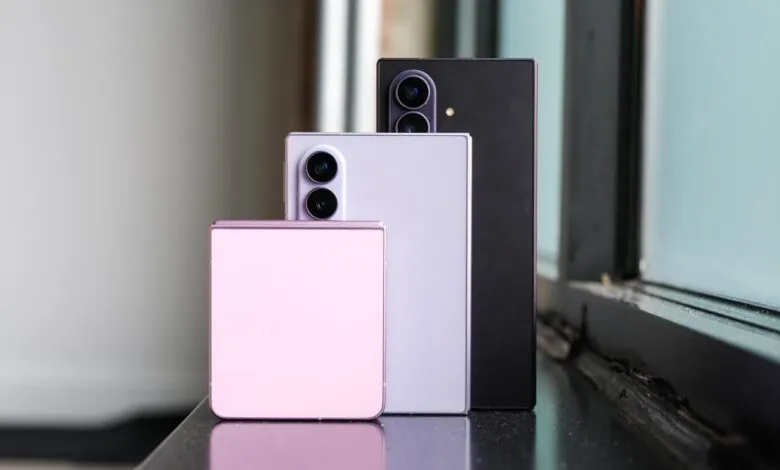
Hardware has come a long way. Modern foldables are thinner, lighter, and more durable, with creases that are increasingly difficult to spot. Some models now support styluses, and cameras have closed much of the gap with traditional flagships. The form factors themselves have also evolved, moving beyond the two basic categories of compact flips and book-style devices. Google’s Pixel 10 Pro Fold introduced an IP68 rating, while Honor’s Magic V6 pushed it further with IP69. That phone also holds the title of thinnest foldable and largest battery, thanks to new silicon-carbon battery technology that packs more energy into smaller spaces. Closed, these devices are barely thicker than regular phones, and open, they’re nearly as slim as a USB-C port.
Oppo’s Find N6 is nearly as thin and long-lasting, but its standout feature is an almost invisible crease. You can still find it if you look closely, but it often takes deliberate effort to locate. Cameras remain the one weak spot, though recent models from Oppo and Vivo deliver triple rear setups that rival many slab flagships. They still trail the absolute best Ultra-tier cameras, and the cost of foldables means that gap may never fully close. Design and pricing constraints will likely keep the top-tier photography on traditional phones for the foreseeable future.
Despite these advances, foldables remain a niche product. Counterpoint data shows they accounted for just 1.6 percent of the smartphone market in 2025. That could change soon. Apple’s first foldable iPhone is widely expected to launch next month alongside the iPhone 18 Pro models. IDC analyst Francisco Jeronimo called the impending release “a turning point for the foldable segment,” predicting Apple will capture 34 percent of the market by value in its first year.
The big unknown is whether Apple can expand the foldable market or simply cater to those who were already waiting for an iOS option. If the price lands at a premium, as expected, its reach will be limited. But the foldable iPhone has already influenced the industry. Wider screen designs from Samsung and Huawei appeared just months before Apple’s rumored launch, and leaks suggest Oppo and Honor are following suit. The next year will reveal whether this form factor truly resonates with users or whether Android makers will regret chasing Apple’s lead.
Trifolds remain a question mark. Huawei has been optimistic about its Mate XT sales, suggesting it will stick with the design. Samsung, however, pulled its TriFold after less than three months, though it’s unclear whether that was due to weak demand or a limited production run. Rollables and other experimental concepts will likely wait a few more years before hitting the market.
Foldables have reached a point where they’re good enough to be boring. The annual updates are incremental, and price is the main barrier for most consumers. Apple’s entry will either broaden the appeal of folding phones or prove that most people simply don’t want them, at least not at current prices. Either way, the next few months will be telling.
(Source: The Verge)