Quantum Systems secures $1.2B at $8B valuation
▼ Summary
– German drone maker Quantum Systems raised $1.2bn in a Series D round, doubling its valuation to about $8bn in one of Europe’s largest defence startup raises.
– The company builds autonomous drones for reconnaissance and battlefield intelligence, and its software platform ties hardware, sensors, and counter-drone tools into one network.
– Quantum Systems flew over 19,000 missions in Ukraine in 2025, is profitable with double-digit margins, and doubled revenue to about €300mn.
– The new funding will expand production, harden supply chains, push into allied markets, invest in AI, and fund acquisitions.
– The raise reflects a broader defence-tech boom, with Blackstone’s involvement signaling a structural shift in European defence investment, and Quantum’s founder left the door open to a potential merger with co-founded firm Stark.
Europe’s defence-tech landscape has just witnessed a landmark moment. Quantum Systems, a German manufacturer of autonomous drones, has secured a massive $1.2 billion in Series D funding, catapulting its valuation to approximately $8 billion. This represents one of the largest fundraising rounds ever for a European defence startup, more than doubling the company’s previous valuation of around $3 billion from late last year.
The Bavarian firm announced the round on Thursday, with Blackstone, Noteus, Airbus, and Advent serving as co-lead investors. Additional participants include Bond, Fidelity, Wellington Management, A. P. Moller Holding, and returning backers Balderton and HV Capital. The raise lifts Quantum Systems to roughly €7 billion, signalling strong investor confidence in its war-tested technology.
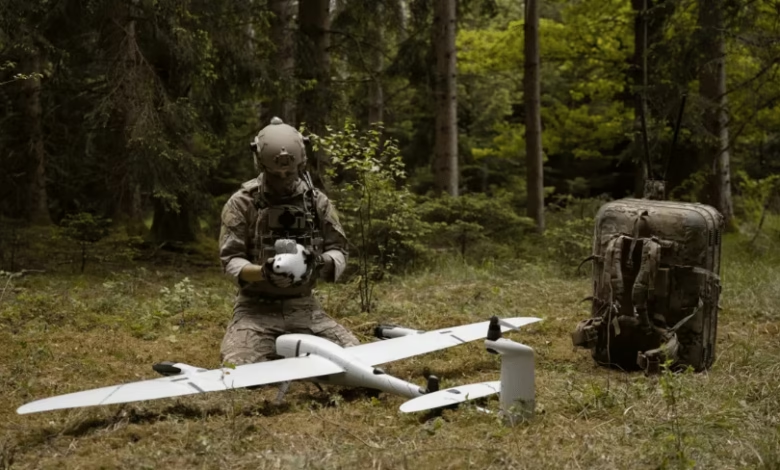
Quantum Systems builds unmanned systems for air, land, and sea. Its vertical-takeoff drones are deployed for reconnaissance and battlefield-intelligence missions. A proprietary software layer called MOSAIC UXS integrates hardware, sensors, and counter-drone tools into a single network. The company reports profitability with double-digit margins, and its revenue doubled to approximately €300 million in 2025.
The company’s technology has been battle-proven. Quantum’s drones flew more than 19,000 missions in Ukraine in 2025, demonstrating real-world durability. Production now spans Germany, Ukraine, the United States, Australia, Romania, the UK, and the Baltics. Founder and co-chief executive Florian Seibel, a former Bundeswehr helicopter pilot, launched the firm in 2015. He envisions Quantum Systems becoming a “next generation neo prime” in the defence sector.
The new capital will accelerate production expansion, harden the supply chain, push into allied markets, and invest heavily in AI. Quantum Systems also plans to pursue acquisitions. Seibel noted that the firm now has “more than $1.2 billion of dry powder to execute” its growth strategy.
This fundraising comes amid a defence-tech gold rush. Startups in the sector have raised a record $17.4 billion so far this year, according to Dealroom, far exceeding the $11.2 billion raised in all of 2025. The largest cheques have gone to US firms, with Anduril raising $5 billion in May. In Europe, the money is flowing to a select group of players. Rival Munich drone maker Helsing is poised to raise $1.2 billion at an $18 billion valuation, while Stark Defence banked €500 million in June.
Blackstone’s involvement is particularly significant. The firm manages over $1.3 trillion, mostly in property, credit, and buyouts, and rarely backs drone startups. Senior managing director David Kaden cited a “structural shift in the European defence market” as driving fresh demand for capital. Mainstream finance has now moved into a sector it once avoided, with the trend extending from large raises to early seed rounds in air defence.
The raise also reignites questions about consolidation. Seibel co-founded Stark as a separate company in 2024, partly due to weapons restrictions on some Quantum investors that barred it from building strike drones. Speaking at a press conference, as reported by Bloomberg, he left the door open to a merger: “If it makes sense, we’ll do it.” A Stark spokesperson said there are no plans to combine. Together, the two firms are valued north of $10 billion.
Seibel is also looking beyond defence. He named robotics and humanoids as potential areas for Quantum Systems, arguing that “European answers are necessary.” For now, the immediate priority is scaling. The company has run an IPO readiness review but says it is in no rush to list. Europe now hosts at least three drone unicorns chasing the same NATO contracts.
The harder question is whether the continent’s budgets can sustain them all. Quantum’s drone-swarm tests and its new war chest suggest it intends to be a survivor, part of a boom that also lifted cruise-missile maker Destinus.
(Source: The Next Web)