Queue secures $12.6M for autonomous robotic pharmacy
▼ Summary
– Queue has built a fully autonomous robotic pharmacy that fills and verifies prescriptions in about one minute without human involvement.
– The startup raised a $12.6mn seed round led by AlleyCorp, adding to a $6mn pre-seed, for a total of $18.6mn.
– The machine dispenses up to 600 pills per minute, stocks 250 medications, and claims to cut dispensing costs by 96 percent.
– Queue aims to address pharmacy deserts and pharmacist burnout by automating pill counting, freeing pharmacists for patient counseling.
– State laws requiring a pharmacist’s final check on prescriptions pose a regulatory hurdle, as Queue must prove its robot’s checks match a human’s.
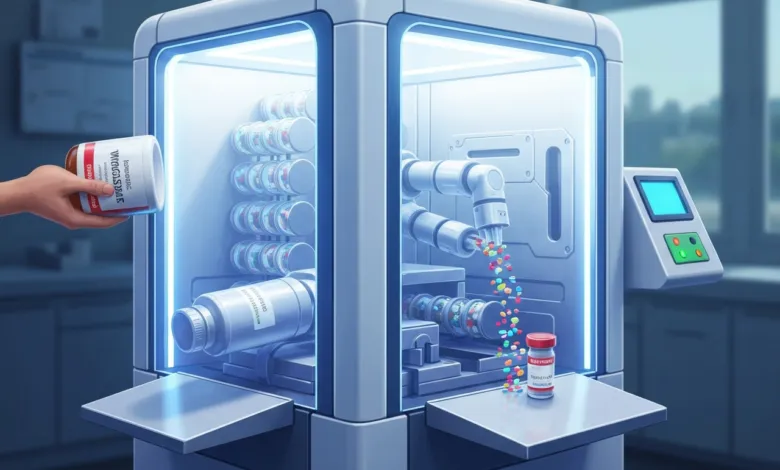
A Silicon Valley startup claims to have built a fully autonomous robotic pharmacy that requires no pharmacist behind the counter. Sealed wholesale bottles go in one end, and filled, verified prescription vials emerge from the other in roughly 60 seconds.
The company, Queue, exited stealth mode on Tuesday with a functioning machine and fresh capital. It has secured a $12.6 million seed round led by AlleyCorp, building on a $6 million pre-seed from Riot Ventures less than a year ago. Total funding now stands at $18.6 million, with Ubiquity Ventures and House Capital also participating.
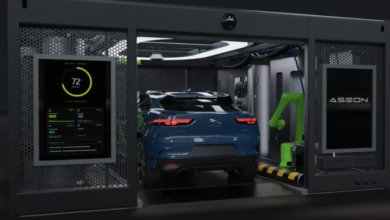
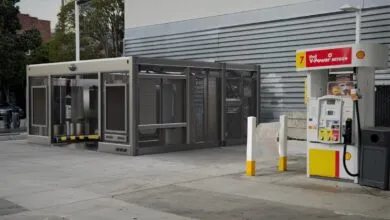
The product is a self-contained unit that Queue describes as the world’s first fully autonomous robotic pharmacy. The system requires zero human intervention, dispenses up to 600 pills per minute, and stocks 250 different medications. The company claims it reduces the cost to dispense by 96 percent and delivers a patient’s prescription in under a minute.
Addressing the pharmacy desert crisis
The need Queue targets is acute. The company reports that one in three U. S. pharmacies have closed, and those still operating push their pharmacists to the brink. Large swaths of the country are now pharmacy deserts, where the nearest counter is miles away.
The core pitch is straightforward: a machine handles the mechanical tasks of counting and bottling pills. That frees pharmacists to focus on what only they can do, such as counseling patients and catching dangerous drug interactions.
Automated dispensing isn’t new. Hospitals have used pill-picking robots for years, and retail chains have experimented with kiosk pharmacies. Queue’s innovation is removing the human from the loop entirely and compressing an entire pharmacy into a single box that can be placed anywhere patients gather.
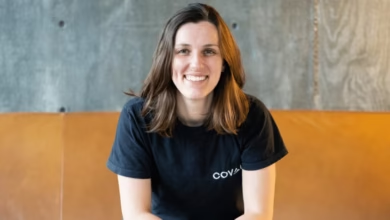
The founders bring relevant experience. Nick Desai has launched six companies and previously ran the house-call service Heal. His co-founder Joshua Liu came from Tesla, Waymo, and the delivery-drone firm Zipline. The team remains small, at roughly 20 people.
Riding the robotics investment wave
Queue enters the market amid a surge of funding for physical machines. Investors who long favored pure software are now backing robots that perform real-world work. Startups are automating tasks once considered safe from disruption, from hair braiding to construction, and increasingly into healthcare, where robots now range from companion pets to prescription counters.
Y Combinator has even advised founders to build hard tech as software loses its competitive edge. Much of the talent flows from automakers and their self-driving divisions, the same pipeline that ex-Tesla engineers have followed into robotics.
The regulatory challenge
Queue’s claims raise an obvious question. In much of the U. S., state law requires a licensed pharmacist to give the final check before a prescription reaches a patient. Controlled substances face even tighter federal rules. A machine promising zero human involvement will need to convince state pharmacy boards that its checks match a human’s.
Queue frames the pharmacist as freed rather than eliminated, which may be the key distinction. The robot does the counting. A pharmacist still owns the sign-off, at least on paper.
There is also the gap between a working demo and a full rollout. Queue has a functioning unit and an ambitious name. It has not yet demonstrated the system running across multiple sites, under real prescription volumes, for months at a time. The new funding buys it the chance to try. Whether a box of robotics can safely replace the corner pharmacy is the test that now begins.
(Source: The Next Web)