GM’s electric future hinges on new battery and this plant
▼ Summary
– GM’s new Battery Cell Development Center (BCDC) is a 500,000-square-foot facility central to its plan to cut EV costs by nearly 10% and bring lower-cost batteries to market a year faster.
– The center aims to scale up production of a new LMR battery chemistry, which is nearly as energy-dense as NMC but costs comparable to cheaper LFP, potentially saving $6,000 per vehicle.
– The BCDC bridges the gap between small-scale research at the Wallace Center and full-scale production, producing about 2,500 cells daily to test commercial viability with an 85% yield target within 18 months.
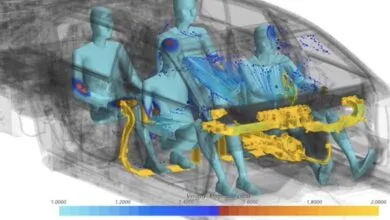
– GM uses AI models and a digital twin of the BCDC to simulate processes, saving millions by optimizing equipment clearance, control systems, and production changes.
– The facility is critical for GM to launch LMR-powered vehicles by 2028, helping it compete globally despite a softening U.S. EV market and past production setbacks.
Nestled among the iconic buildings of General Motors’ Warren Tech Center outside Detroit sits a modest-looking facility that could determine the automaker’s electric future. The unassuming 500,000-square-foot pair of off-white structures, which house GM’s new Battery Cell Development Center, may not draw attention from passersby. Yet inside lies the critical piece of GM’s $900 million bet on cutting EV costs by nearly 10%.
While some automakers retreat from electric vehicles, GM is doubling down with a strategic reboot centered on this new facility. The company told TechCrunch that the Battery Cell Development Center will allow it to deliver a new generation of lower-cost batteries a full year ahead of schedule.
GM hasn’t escaped the broader struggles in the U. S. EV market. Last year, the company recorded a $1.6 billion charge while restructuring its EV production capacity, resulting in thousands of layoffs. Reports also indicate the automaker has paused, at least temporarily, updates to its full-size electric trucks and SUVs.
To revive its EV momentum, GM is betting heavily on LMR (lithium-manganese-rich) battery chemistry, a technology championed by Kurt Kelty, the company’s vice president of battery and sustainability. Kelty, who previously led battery development at Tesla, has made LMR his signature initiative since joining GM two years ago.
“That is really going to be our bread and butter,” Kelty told TechCrunch. “That is going to be our main product line.”
GM’s uneven EV rollout mirrors the broader U. S. battery industry, which has advanced in fits and starts over the past two decades. Early startups failed to deliver on promises, and intense competition from Chinese firms has forced automakers and battery manufacturers to revisit strategies set just five years ago.
At GM, that pressure led to a shortened lifespan for Ultium, the branded battery platform powering its current EVs. Like much of the industry, GM had invested heavily in NMC (nickel-manganese-cobalt) chemistry, which proved expensive as materials costs rose and China dominated critical mineral supplies. While NMC won’t disappear entirely, GM will reserve it for premium vehicles.
In its place, LMR promises nearly the same energy density as NMC but at costs comparable to cheaper LFP (lithium-iron-phosphate) chemistry used in models like the Chevrolet Bolt. When GM introduced LMR last year, the company said it could preserve most of the Chevrolet Silverado EV’s 400-mile range while cutting costs by at least $6,000, bringing mid-range EVs close to the price of their gas-powered counterparts.
Discovering a new battery chemistry is one challenge. Manufacturing it at gigawatt-hour scale is another, especially under the pressure of competing with giants like BYD and CATL. GM aims to have LMR-powered vehicles on the road by 2028, and the new Battery Cell Development Center must deliver to meet that deadline.
The facility serves as the keystone of GM’s battery strategy. The company opened its Wallace Battery Cell Innovation Center and first gigafactory in 2022. What was missing was a bridge connecting breakthroughs from Wallace to production lines in Tennessee and Ohio.
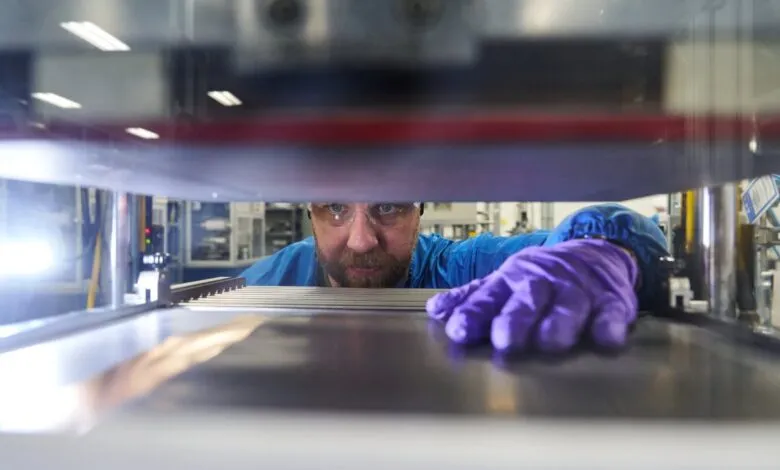
The BCDC, as insiders call it, functions like a pilot line but on a larger scale. When fully operational, it will produce about 2,500 cells per day, or roughly half a gigawatt-hour annually. It will take small batches of batteries developed at the Wallace Center and determine if they’re ready for mass production.
Many battery recipes fail when scaled to commercial levels, and companies lack time to fix problems. According to a McKinsey report, if a new chemistry can’t achieve 85% yield within 18 months on a production line, it shouldn’t be considered commercially viable.
The challenge resembles scaling a recipe for four people to feed 400 guests. It’s not just about throughput, either. Research batteries start as small coin cells, but EV batteries resemble small cutting boards.
“Once you learn how to make the recipe in Wallace, then you’ve got to figure out, well, how do you make this in high volume?” Kelty said. “You really learn a lot going from that coin cell to the large format because it doesn’t transfer perfectly.”
The BCDC aims to ease that transition. A test run at the facility costs about $200,000, far less than at the full-size Ultium plant. When the BCDC team confirms the process is ready, the move to full production should be smoother, Kelty said. “The equipment is almost the same between them, and so it shouldn’t be as hard of a handoff.”
The BCDC is one or two orders of magnitude smaller than the 2.8-million-square-foot Ultium factory in Tennessee, which produces about 300,000 cells annually. The BCDC has fewer production lines, makes about a hundredth as many cells, and its mixing tanks hold 40 liters instead of 2,000. Yet it remains ten times larger than the Wallace Center next door.
“The BCDC is intended to bridge the gap,” Mo Gallegos, head of the facility, told TechCrunch.
To further reduce costs, GM has turned to AI models to simulate as many processes as possible. The company has invested heavily in computing power, described as “national lab-scale,” though no one would specify the amount.
GM has developed physics-based models to predict how changes to chemistry or production processes will affect battery cell performance.
“On LMR, we’ve logged over 150 million CPU hours,” said Radu Theyyunni, director of global virtual electrification and powertrain at GM. “Most engine programs do not use that many core hours.”
The company also created a digital twin of the entire BCDC, including equipment control boards, wiring, and mixing tank blades. Before visiting the facility, the team had me wear a VR headset and walk through the digital twin, following the production line from start to finish.
As the BCDC took shape, the digital twin helped with tasks like ensuring enough clearance around equipment for maintenance and simulating control systems to verify proper operation.
“Does the equipment run how it’s supposed to? Does it run safely? Is it doing all the things we think this control system is going to do? That shortens our debug and ramp up time,” Gallegos said. GM says the simulations have saved millions of dollars.
The automaker needs all the speed it can get. While the U. S. EV market has softened, global EV sales grew 20% last year. The combination of high oil prices and declining battery costs suggests the transition from fossil fuels will continue, eventually.
If LMR is ready in time, it could help GM offer cost-competitive EVs with enough range to satisfy cautious American buyers. But first, LMR must pass through the BCDC. Gallegos expects the first batches to roll off the line later this year.
Over the next decade, battery development will become as crucial to automakers as engine development was in the last century. GM’s electric future depends on its ability to move new chemistries from research through production.
Kelty often says GM is developing “the right battery for the right application,” echoing an old company slogan. LMR may be the BCDC’s first test, but it likely won’t be its last.
(Source: TechCrunch)