Green Maritime Tech Arrives, Ending ‘Ferrynoia’
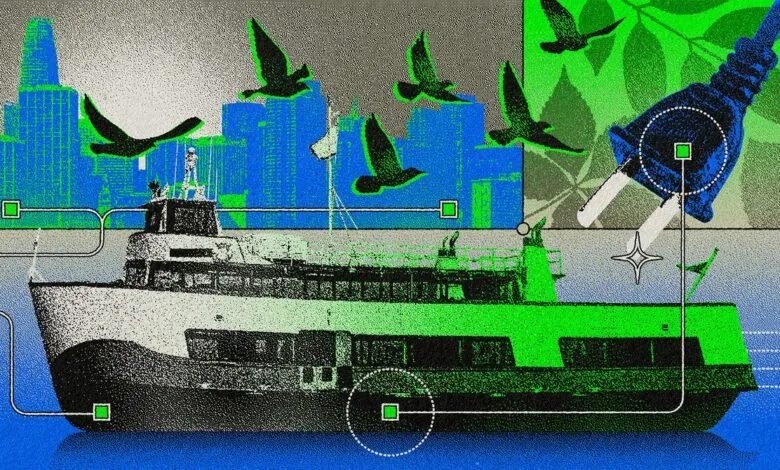
▼ Summary
– The Harbor Charger, New York state’s first hybrid-electric public ferry, will begin its first full summer service between South Ferry and Governors Island, offering a 10-minute trip.
– The $33 million ferry is 66% faster than the previous 70-year-old vessel, cuts carbon dioxide emissions by at least 600 tons annually, and carries 1,200 passengers.
– It operates on 22 lithium-ion battery packs with backup diesel generators, can run on battery for 90 minutes, and is expected to save $200,000 in fuel yearly.
– Operators face challenges like training crew on digital controls and addressing “ferrynoia,” or fears that technical glitches could disrupt essential transport for island residents.
– San Francisco Bay Ferry plans to launch the first high-speed fully battery-electric passenger ferry in the US by early 2027, part of a $55 million federal grant toward a zero-emission fleet by 2035.
The Harbor Charger, New York state’s first hybrid-electric public ferry, is preparing for its inaugural full summer season, shuttling passengers between Manhattan’s South Ferry terminal and Governors Island, the 172-acre recreational haven across New York Harbor. The island draws crowds with its outdoor concerts, art installations, and expansive green spaces, making the ferry itself part of the attraction.
“A lot of what we do on the island is focused on public recreation, exploring the outdoors and public art,” says Clare Newman, president and CEO of the Trust for Governors Island. “The Harbor Charger reflects all three of those pillars, with the idea being that the boat ride itself is part of your Governors Island experience.”
Built at a cost of $33 million, the vessel was designed by Seattle’s Elliott Bay Design Group and constructed at the Conrad Shipyard in Morgan City, Louisiana. It is 66 percent faster than its predecessor, the nearly 70-year-old Lt. Samuel S. Coursen, which burned roughly 420 gallons of diesel daily. The Harbor Charger completes the one-way trip in just 10 minutes and is expected to cut carbon dioxide emissions by at least 600 tons annually.
The ferry accommodates up to 1,200 passengers and 30 vehicles, powered by 22 lithium-ion battery packs from Siemens Energy, supplemented by backup diesel generators. Newman says the goal was to showcase cutting-edge technology, and she has already fielded inquiries from other cities looking to electrify their public fleets.
Decarbonizing maritime transport has historically been challenging due to the physics of moving heavy hulls through dense water. Beyond training crews to swap a traditional ship wheel for a digital, video-game-like console, operators must learn to maintain, repair, and charge these vessels. Then there is “ferrynoia” , the anxiety among some island residents that a software glitch or faulty battery cell could strand them, cutting off access to medical care, groceries, and school commutes.
Hybrid-electric ferries offer advantages: they are faster, quieter, and cheaper to maintain because of simpler drivetrains. The Harbor Charger can run on battery power for up to 90 minutes before switching to hybrid mode, generating an estimated $200,000 in annual fuel savings. This is a modest start before dockside rapid-charging stations are installed; once that infrastructure is in place, the ferry will operate entirely on electricity, eliminating another 800 tons of carbon dioxide per year.
Meanwhile, on the West Coast, San Francisco Bay Ferry is preparing to launch the first high-speed, fully battery-electric passenger ferry in the United States. Specialized electric charging floats at certain terminals will draw power from the city grid.
Scheduled to begin service in early 2027, the 150-passenger vessel will make an eight-minute trip from the city’s Ferry Building downtown to Treasure Island, a secluded 400-acre parcel that San Francisco hopes to redevelop into a destination for festivals, biking, and windsurfing.
“The island has historically hosted festivals, but it’s been hard to get on and off the island,” says Thomas Hall, San Francisco Bay Ferry’s director of operations and customer experience. “We’ll have lounge-style seating, bike storage, and outdoor viewing areas” on the ferry.
Backed by a $55 million federal grant, the agency is purchasing several battery-electric catamarans and ferries to connect downtown hubs with emerging waterfront neighborhoods like Mission Bay and Treasure Island. The five boats, named through a public vote, represent the initial phases of a goal to achieve a fully zero-emission fleet by 2035.
Hall expects a more relaxed experience for commuters and visitors, even though the ship designs omit traditional concessions and bars in favor of more seating and storage. “We just didn’t think the faster trips would justify the extra weight and staffing that would be required,” he explains. “Instead, you’ll be able to hear the sounds of the water and be able to hold a conversation without shouting.”
(Source: Wired)