Nvidia’s Huang: Robotics to fuel Korea’s next growth wave
▼ Summary
– Nvidia CEO Jensen Huang began a four-day visit to Seoul by pitching robotics and physical AI as the next major sector for Korea, aiming to expand Nvidia’s relationship beyond memory chips.
– Huang’s schedule included executive meetings, a TV talk-show slot, and baseball appearances, blending business with a charm offensive in Korea, a key supplier of high-bandwidth memory for Nvidia’s accelerators.
– Nvidia seeks deeper ties with Korea in high-bandwidth memory, AI data centres, autonomous driving, robotics, and physical AI, with robotics as the headline focus.
– Huang argued that Korea’s manufacturing and technology strengths position it to scale physical AI, which Nvidia sees as its next growth frontier after training accelerators.
– Meetings with gaming company Krafton and other partners beyond chipmakers signaled Nvidia’s intent to broaden its mutual dependency with Korea into more sectors, though concrete deals were not finalized during the trip.
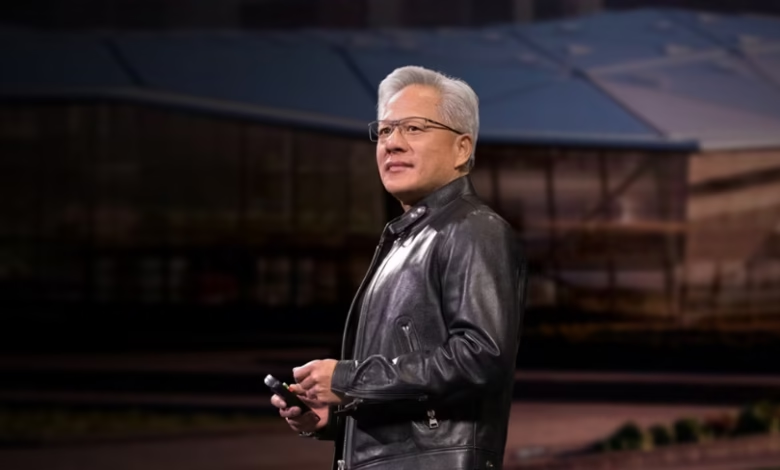
Nvidia CEO Jensen Huang arrived in Seoul for a four-day visit with a clear message: robotics and physical AI represent Korea’s next major growth engine, and the country’s manufacturing expertise makes it a natural leader in AI-driven automation. Even before leaving Gimpo Airport, Huang told reporters that “robotics is going to be the next major sector here in Korea,” framing the trip around opportunities beyond the memory chips that already tie Nvidia to the nation.
The visit blended business with spectacle. Huang’s schedule included executive meetings, a television talk-show appearance, and baseball game stops, a calculated charm offensive in a country that supplies the high-bandwidth memory essential for Nvidia’s accelerators. Beneath the performance lay a concrete agenda: deepening ties in high-bandwidth memory, AI data centres, autonomous driving, robotics, and physical AI.
Huang chose robotics as the headline. South Korea’s strengths in manufacturing and technology, he argued, position it to scale the kind of AI-driven automation Nvidia now sells as physical AI, applying its models to machines that move and act in the real world, not just software running in data centres. For a company built on training and inference, robotics represents the next surface where Nvidia wants its chips embedded.
This focus also reflects where Nvidia sees its own future growth. After saturating the market for training accelerators, the company has increasingly promoted physical AI as the next frontier: machines in factories, warehouses, and vehicles that require the same compute power as data centres, only embodied. Korea, with its dense concentration of manufacturers and appetite for automation, is the market where that thesis will either prove out or stall.
Huang’s meetings matched the strategy. He was scheduled to meet with executives from gaming company Krafton, including chairman Chang Byung-gyu and senior AI leadership, to discuss collaboration in physical AI, humanoid robotics, and AI-powered gaming. That agenda signaled Nvidia’s interest in Korean partners well beyond the chipmakers that have historically defined the relationship.
The backdrop is a mutual dependency Nvidia is trying to broaden. Korea’s memory giants are central to Nvidia’s supply chain, and Nvidia’s demand has been central to their AI-era results. By talking up robotics and physical AI, Huang is sketching a partnership that runs in both directions across more sectors, rather than resting on the single, enormous business of selling memory into his accelerators.
Whether the robotics framing turns into deals remains unsettled. A CEO calling a sector the next big thing at an airport doorstep is a statement of intent, not a contract. But Huang’s itinerary, heavy on partners outside the memory business, suggested Nvidia is serious about where Korean industrial strength meets its own roadmap. The pitch has been made. The orders, if they come, will follow later.
(Source: The Next Web)