Windows’ M1 moment arrives – but at a steep price
▼ Summary
– Nvidia announced the RTX Spark laptop chip, featuring 20 CPU cores, 6,144 GPU CUDA cores, and 128GB of unified LPDDR5X memory, with integrated graphics claimed to match an RTX 5070 Laptop GPU.
– The RTX Spark aims to position Windows laptops as competitors to Apple’s MacBook Pros, with models from Dell, Asus, Lenovo, and Microsoft launching in fall 2026, starting around $2,000 to $2,500.
– Unlike Apple’s M1 launch, which began with affordable Macs like the Mac Mini and MacBook Air, Nvidia is targeting high-end, expensive laptops, potentially limiting early adoption and developer support.
– Nvidia emphasizes AI capabilities in RTX Spark laptops, calling them “CPUs for agents,” while also targeting creators with optimized Adobe software like Photoshop and Premiere.
– The addition of Nvidia to the Windows chip market (alongside Intel, AMD, and Qualcomm) offers more choice, potentially combining strong battery life with superior graphics performance and improved Arm gaming compatibility.
Nvidia has officially entered the consumer laptop chip arena with the RTX Spark, and the implications are massive. Apple proved years ago that Arm-based processors can deliver both stellar performance and impressive battery life, at least on the Mac. In the Windows ecosystem, Qualcomm’s efforts haven’t fully closed the gap, particularly in graphics. That untapped potential is exactly what Nvidia appears ready to unlock.
This could be Windows’ chance to dazzle with a new generation of chips, echoing Apple’s groundbreaking M1 launch back in 2020. Yet, in 2026, this announcement feels both thrilling and troubling. Why?
The Nvidia RTX Spark sounds like a beast: 20 CPU cores, 6,144 GPU CUDA cores, and a massive 128GB of unified LPDDR5X memory. Nvidia claims its integrated graphics rival an RTX 5070 Laptop GPU, though actual performance benchmarks remain conspicuously absent. My colleague Sean Hollister noted it’s essentially the GB10 chip from Nvidia’s DGX Spark mini-PC. Nvidia dubs it a “superchip” and “the most efficient PC chip ever built,” while Microsoft calls its upcoming Spark-equipped Surface Laptop Ultra “the most powerful thing we’ve ever made.”
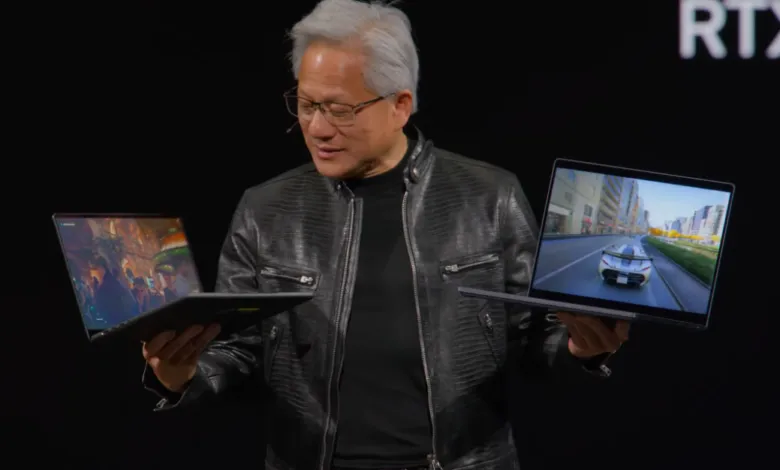
Unsurprisingly, Nvidia CEO Jensen Huang devoted most of his keynote to AI and agents, calling them the company’s “new major growth driver.” Beyond local AI compute, these laptops target creators too, with Adobe already optimizing Photoshop and Premiere for the platform.
This is Nvidia, Microsoft, and Windows laptop makers directly challenging Apple’s MacBook Pro lineup. Which exact MacBook Pro model (M5, M5 Pro, or M5 Max) remains unclear, but one thing is certain: these machines will be expensive. The fall lineup includes the Surface Laptop Ultra, Dell XPS 16, Asus ProArt P14 and P16, Lenovo Yoga Pro 9n, MSI Prestige N16 Flip AI Plus, HP OmniBook Ultra and OmniBook X 14, plus unnamed models from Acer and Gigabyte. Existing versions of these laptops typically start at $2,000 to $2,500 and up.
Given the RTX Spark’s 128GB of RAM, that price tag makes sense. Look at AMD’s Strix Halo APU, the closest x86 analog with 128GB of RAM: Asus’ ROG Flow Z13 costs $3,300, and the ProArt PX13 GoPro Edition runs $3,000. Nvidia’s own DGX Spark desktop, based on the same GB10 chip, costs around $4,700. So how much will a Spark laptop cost when you add a keyboard, trackpad, battery, and a 15-inch Mini LED touchscreen?
Microsoft’s Surface Laptop Ultra with 128GB of unified memory? For context, a fully loaded 15-inch Surface Laptop for Business with Intel Panther Lake and 64GB of RAM already hits $4,500. Nvidia promises RTX Spark chips with less RAM, but with RAMageddon driving up prices on 16GB and 32GB models too, affordability remains a concern.
When these laptops arrive this fall, Nvidia could obliterate the competition in performance. But Apple’s M1 moment succeeded because it started with the affordable Mac Mini, MacBook Air, and entry-level MacBook Pro. That put the benefits in reach of average buyers, drove early sales, and incentivized developers to support the new architecture quickly. It took nearly a year for Apple to scale up to the M1 Pro and M1 Max.
Nvidia isn’t aiming for an M1 moment. It’s trying to skip straight to an M1 Max or even M1 Ultra moment , and doing so when computers are getting pricier and consumer spending power is shrinking. There’s a reason the MacBook Neo made waves at $599. Will the same happen at $2,499?
By fall, Windows laptops will have four viable chip options: Intel, AMD, Qualcomm, and Nvidia. Having three has already been a blessing. AMD offers great performance at the cost of battery life. Qualcomm delivers exceptional battery and standby time but poor game support. Intel balances x86 compatibility with solid all-around performance.
Adding Nvidia on Arm could bring another option with strong battery life and far more graphics muscle. It might also push gaming on Arm closer to x86 parity. Microsoft and Nvidia’s work with Riot Games to port anti-cheat software for Valorant and League of Legends, and collaboration with developers using Easy Anti-Cheat, BattlEye, and Denuvo, is a major win for Windows on Arm.
I welcome more competition. The latest chips from Intel, AMD, and Qualcomm each excel in their own ways. An Nvidia-powered option that performs well, offers exceptional battery life, and doesn’t lack games like Macs do sounds fantastic. But even if the RTX Spark sparks a sea change, the rising tide of prices will leave many stranded.
(Source: The Verge)