Arduboy FX-C Review: A Pocket-Sized Time Killer You’ll Forget You’re Carrying
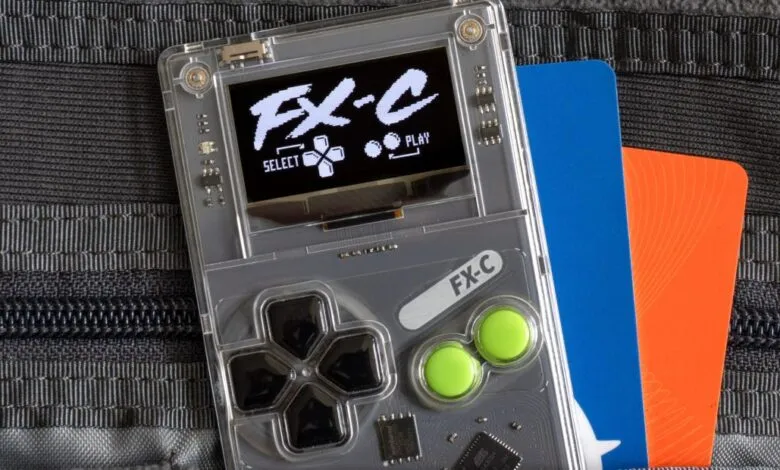
As handheld gaming devices keep ballooning in size and complexity, the Arduboy FX-C takes a sharp detour in the opposite direction. This tiny console is no bigger or thicker than a stack of credit cards, yet it manages to pack the best features of previous Arduboy models along with some meaningful upgrades. It is easily the best version of the Arduboy to date, especially for anyone who wants instant access to a growing library of games without needing to tinker or connect to a computer. However, one of its most exciting new features isn’t quite ready for the spotlight.
The Arduboy story began in 2014 when creator Kevin Bates built a Tetris-playing business card to show off his electronics skills. The concept went viral, and by 2015, he turned it into a commercial product: a tiny, open-source gaming device that doubled as a teaching tool for aspiring coders. More than a decade later, the Arduboy FX-C retains that original, no-frills design. Its controls are limited to six buttons, with four arranged as a D-pad. Despite the device being only 5mm thin, the buttons offer minimal travel but a satisfying, clicky response. The piezoelectric speaker is high-pitched yet loud enough, and the 1.3-inch, 1-bit OLED screen stays bright enough for outdoor play.
Where the original Game Boy could display four shades of greenish-gray, the Arduboy FX-C is strictly monochrome, showing only white pixels. Developers must rely on tricks like dithering or flickering to simulate grayscale. The hardware is equally spartan: an ATmega32u4 processor paired with just 2.5KB of RAM. Compared to other black-and-white handhelds like the Playdate, the FX-C feels primitive, but that limitation has become a creative catalyst. Game makers have embraced these constraints, producing surprisingly inventive and experimental titles that define the platform’s charm.
My main gripe with the original Arduboy was its tiny storage, which forced me to constantly plug it into a laptop to swap games. In 2020, Bates addressed this with the Arduboy FX, adding a flash chip capable of holding 250 games. The FX-C inherits that chip in a slightly larger capacity, boosting the pre-installed library to over 300 games, and finally upgrades the charging port from microUSB to USB-C without adding any thickness.
It would be nice to see a color screen, a proper D-pad, dedicated volume controls, an improved sound chip, Wi-Fi, Bluetooth, or even a microSD card slot. But none of those feel essential here. The FX-C is stripped down to the absolute basics of gaming, and it works beautifully.
One area that could use improvement is the sliding power switch on the top edge. It’s small and recessed, making it tricky to operate if you have short fingernails. Once you manage to slide it, the device boots almost instantly to a simple homescreen. The menu system sorts bundled games into categories like Action, Adventure, Arcade, Runner, Puzzle, and Racing. You scroll horizontally through categories and vertically within each one. It’s straightforward, though I wish there were an alphabetical list of all games for easier browsing.
Despite its modest specs, developers have found clever ways to push the FX-C’s capabilities, even bringing first-person shooters to the tiny screen. You won’t find recognizable classics like Super Mario Bros. or Castlevania, since all Arduboy games are distributed for free and Nintendo still sells those. But you will find excellent doppelgängers that scratch the nostalgic itch while staying legally distinct. The library goes far beyond side-scrollers and falling-block puzzles, offering dungeon crawlers, racing games, and FPS titles with impressive frame rates.
The Arduboy FX-C is built for short bursts of fun, not marathon gaming sessions. It’s a perfect companion for killing a few minutes here and there.
Unfortunately, the feature that convinced me to buy two units isn’t ready for prime time. Multiplayer over USB remains a work in progress. The concept is clever: it uses the extra conductors in modern USB cables to pass game data back and forth, as Bates explains in a forum post. But it requires a USB 3.0 or Thunderbolt cable to function. After testing several USB 3.0 cables from Amazon, I’ve had zero success. Some users on the Arduboy community forums have managed to get it working, but Bates acknowledges the feature is still in development. If multiplayer is your main reason for buying a pair of FX-Cs, hold off for now.
Even without that feature, the Arduboy FX-C is a solid upgrade. The original was one of the last devices I kept a microUSB cable around for, but the huge collection of pre-installed games from the Arduboy development community is the real draw. I’ve barely scratched 10 percent of the library, and while quality varies, it’s hard to complain when the games are free. A console is only as good as its game library, and over the past decade, the Arduboy has built a devoted community that has created hundreds of titles. If you come in with an open mind and don’t dwell on what’s missing, you’ll have a great time with this handheld.
(Source: The Verge)