Pope Leo XIV orders Vatican to disarm AI in first encyclical
▼ Summary
– Pope Leo XIV’s encyclical *Magnifica humanitas* calls for breaking up monopolistic control of AI and rules out algorithmic warfare.
– The document argues AI has begun to dominate humanity and seeks to restore the moral primacy of humans over algorithms.
– It explicitly states that no algorithm can make war morally acceptable, as AI only makes conflict quicker and more impersonal.
– Anthropic co-founder Christopher Olah presented alongside cardinals at the launch, highlighting the company’s clashes with the Trump administration over AI use in war.
– The encyclical frames AI disarmament as preventing technology from dominating humanity, placing human dignity and social justice at the center of future regulation.
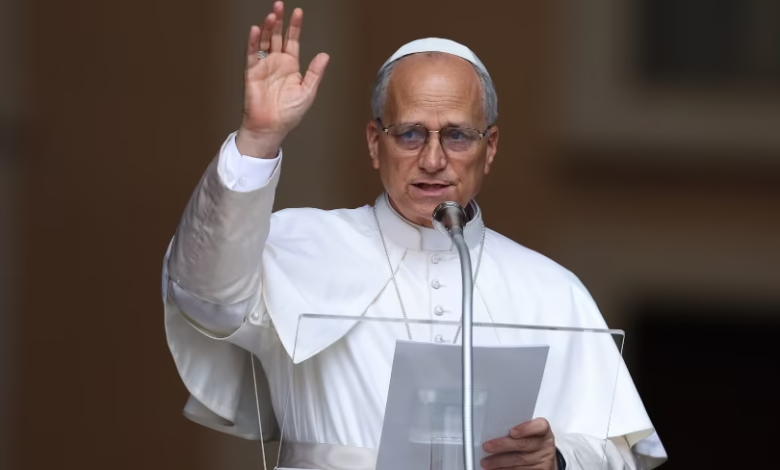
Pope Leo XIV used the first encyclical of his pontificate, released in Rome on Monday, to call for the disarmament of artificial intelligence, framing the technology as a force that has begun to dominate the very people it was designed to serve. The 245-paragraph document, titled Magnifica humanitas, argues that disarming AI means restoring the moral primacy of the human over the algorithm.
“To disarm means discrediting the assumption that technical power automatically confers the right to govern,” the pope wrote. “To disarm does not mean rejecting technology, but preventing it from dominating humanity.” This encyclical represents the most consequential act of his year-old papacy and is the first time a pope has organized an entire foundational letter around an emerging technology rather than a doctrinal or social question.
Leo, the first American pope and a former Villanova mathematics major, signed the document on May 15, the 135th anniversary of Leo XIII’s Rerum novarum, which established Catholic social teaching for the industrial age. The framing is deliberate: this encyclical is offered as its successor for the AI age.
The central targets are concentration and warfare. The pope called for AI to be made more “human-friendly” and freed from “monopolistic control,” language that directly challenges the half-dozen US firms that now define the technology’s frontier. On war, he was sharper. “No algorithm can make war morally acceptable,” he wrote. “AI does not remove the intrinsic inhumanity of conflict, indeed it can only bring about conflict more quickly and render it more impersonal.”
The choice of speaker for the launch underlined this line. Christopher Olah, Anthropic’s co-founder and head of interpretability research, presented alongside cardinals at the Vatican Synod Hall on Monday morning. Anthropic has spent the past two months at the center of a separate global debate over the security implications of Mythos, its autonomous vulnerability-discovery model that has found thousands of zero-days across every major operating system. The company has clashed with the Trump administration over the use of its technology in war and surveillance.
On that last point, the encyclical now sits directly across from the White House. Vice President JD Vance, a Catholic convert close to early OpenAI investor Peter Thiel, was asked about the document at a press briefing on May 19. “When the leader of the world’s largest Christian denomination speaks on an issue like that, it’s certainly going to have some influence,” he said. “And I’m sure it’ll contain a lot of insights, some of which I’ll probably agree with, some of which I may not.” In the same briefing, he restated that President Donald Trump “wants us to win the AI race against all other countries in the world.”
The proximate tension is older than this week. Thiel spent part of March in Rome delivering closed-door lectures at Palazzo Taverna on the figure of the Antichrist, drawing on a thesis that a one-world technocratic government would emerge under the pretext of averting AI, nuclear, or climate-driven catastrophe. Father Paolo Benanti, the Vatican’s adviser on AI, responded in an op-ed describing the lectures as “a sustained act of heresy” against the liberal consensus. Leo and Trump have separately sparred over the war in Iran.
An encyclical, by design, is not a policy document but a moral framing under which subsequent policy gets argued. Magnifica humanitas places “human dignity” and “shared standards of social justice” at the center of any future regulatory architecture and rules algorithmic warfare out of it. Pope Leo XIV presented it personally rather than delegating it to cardinals, a break with tradition. He addressed the world’s 1.4 billion Catholics. The wider audience was understood.
(Source: The Next Web)