De novo design of quasisymmetric two-component protein cages
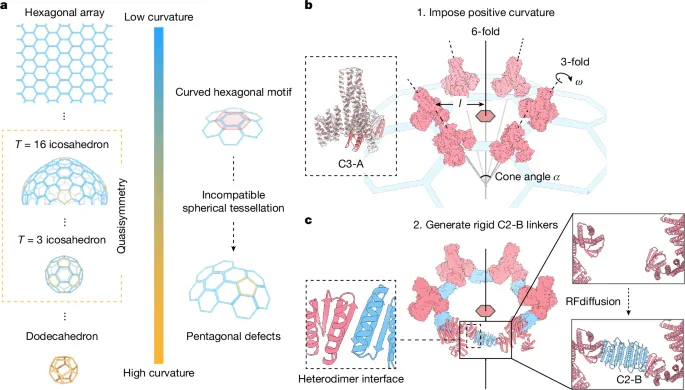
▼ Summary
– The authors acknowledge contributions from multiple individuals for computational design, protein purification, molecular dynamics simulations, and electron microscopy.
– UC San Francisco ChimeraX was used to generate molecular graphics and cage models.
– Funding was provided by the Defense Threat Reduction Agency, Burroughs Wellcome Fund, The Audacious Project, Microsoft, the National Science Foundation, and the Human Frontiers Science Program.
– Additional support came from the Bill and Melinda Gates Foundation, Howard Hughes Medical Institute, the National Institutes of Health, Spark Therapeutics, and The Nordstrom Barrier Institute.
– Crystallographic work was performed at the National Synchrotron Light Source II, with funding from NIH, DOE, and other sources, and L.J.H. was funded by multiple NIH grants and awards.
We extend our gratitude to D. Juergens for their assistance with computational design and scripting; F. Praetorius and D. Sahtoe for providing the de novo designed LHD heterodimer building blocks; Q. Dowling and W. Sheffler for insightful discussions; S. Gerben for help with protein purification; N. Bethel for support with molecular dynamics simulations; Y. Hsia for assistance with field flow fractionation; and S. Dickinson and J. Quipse for maintaining and operating the electron microscopes. Molecular visualizations and cage models were created using UCSF ChimeraX.
This research was funded by the Defense Threat Reduction Agency (grant no. HDTRA1-19-1-0003 to S. W.) and the Burroughs Wellcome Fund (S. W.); The Audacious Project at the Institute for Protein Design (S. W., A. F., A. J. B., A. B., J. D., A. K., D. B.); a gift from Microsoft (D. C.); the National Science Foundation (grant no. CHE-2226466 to F. D.); the Human Frontiers Science Program (grant no. RGP0061/2019 to F. D.); the Bill and Melinda Gates Foundation (grant nos. INV-043758 to C. W., J. D., A. K., A. B., and OPP1156262 to A. J. B.); the Howard Hughes Medical Institute (C. W., A. B., A. J. B., D. B.); the National Institutes of Health’s National Institute on Aging (grant no. R01AG063845 to A. B., A. F., A. J. B., and B. H.); Spark Therapeutics/Computational Design of a Half Size Functional (grant no. ABCA4 to K. W.); and The Nordstrom Barrier Institute for Protein Design Directors Fund (B. H.).
Crystallographic data were collected at the National Synchrotron Light Source II on beamline FMX (17-ID-2). The Center for Bio-Molecular Structure (CBMS) is supported primarily by the NIH-NIGMS through a Center Core P30 Grant (grant no. P30GM133893) and by the DOE Office of Biological and Environmental Research (grant no. KP1607011). NSLS-II is a US DOE Office of Science User Facility (operated under contract no. DE-SC0012704). This publication includes data collected using beamtime obtained through NECAT BAG proposal no. 311950. L. J. H. received funding from the NIH (grant nos. R01 GM132447 and R37 CA240765), the NIH Director’s Transformative Research Award (no. TR01 NS127186), a Hypothesis Fund Award, and a Research Grant from HFSP (grant no. RGP0016/2022).
(Source: Nature.com)