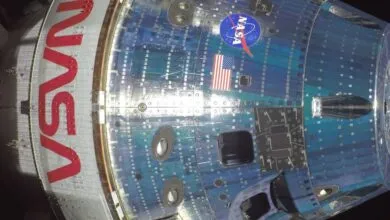
NASA Beams 484 GB From Moon, Redefining Deep Space Communication

▼ Summary
– NASA’s Artemis II mission successfully demonstrated the Orion Artemis II Optical Communications System (O2O), transmitting 484 gigabytes of data, including high-definition video and scientific measurements, from lunar distance using infrared laser light.
– The O2O system consistently delivered downlinks at 260 megabits per second, vastly exceeding the single-digit megabit speeds of traditional radio systems used for baseline communications.
– A network of ground stations at JPL, White Sands, and Mount Stromlo Observatory captured the data, with the Australian station showing that cost-effective, commercially built components can support high-performance optical links.
– Near real-time transmission of high-resolution imagery allowed scientists to analyze data during mission phases like the lunar flyby, improving decision-making and creating a more integrated science presence.
– The successful deployment signals a turning point, as optical systems can support the higher data demands of future lunar and Mars missions, potentially forming the backbone of an interplanetary communication network.
NASA has achieved a major milestone in deep space communications during the Artemis II mission, successfully demonstrating a laser-based system that transmitted 484 gigabytes of data from lunar distance. This breakthrough in laser communication technology could fundamentally transform how future missions share information, conduct science, and connect with audiences on Earth.
The core of this achievement is the Orion Artemis II Optical Communications System (O2O), engineered by MIT Lincoln Laboratory and mounted on the Orion spacecraft. Instead of relying on traditional radio frequencies, this system uses invisible infrared light to achieve vastly greater bandwidth and efficiency. Across the mission’s roughly ten-day journey, it transferred 484 gigabytes of data, the equivalent of streaming about 100 high-definition movies. This included crisp video feeds, detailed scientific measurements, engineering telemetry, and voice communications between the crew and mission control.
While radio systems remained in use for baseline communications, they typically operated at speeds limited to single-digit megabits per second at lunar distances. By contrast, the optical system consistently delivered multiple downlinks at 260 megabits per second, exceeding expectations and proving its operational readiness. This leap in data capability enables richer science, faster decision-making, and a far more immersive connection between Earth and spacecraft.
To capture these record-breaking data streams, NASA relied on a carefully coordinated network of advanced ground stations. Facilities at the Jet Propulsion Laboratory in Southern California and the White Sands Complex in New Mexico were selected for their high-altitude locations and dry atmospheric conditions, which minimize signal distortion. These stations handled the bulk of incoming transmissions, at one point receiving 26 gigabytes of data in under an hour, a rate comparable to or exceeding many terrestrial internet connections.
A third site at the Australian National University’s Mount Stromlo Observatory expanded the system’s global reach. Built with commercially available components, this station demonstrated that high-performance optical communication infrastructure can be deployed more cost-effectively and rapidly than previously thought. Over more than 15.5 hours, it supported dual-stream video transmissions, contributing to NASA’s live broadcast coverage and ensuring continuity when other stations were out of view. This distributed architecture highlights the scalability of laser communications and their potential to support continuous, high-speed links for future missions.
The impact of this technology extended well beyond raw transmission speeds. Near real-time delivery of high-resolution imagery allowed scientists on Earth to analyze data almost immediately, improving responsiveness during key mission phases such as the lunar flyby. Dr. Kelsey Young, Artemis II lunar science lead, described it as a game changer. “Access to high-resolution imagery and other scientific data during dynamic science mission phases is a game changer,” she said. “It means faster insights, better science decision-making to support the crew as they’re completing science exploration, and a mission with a more integrated science presence. It felt like we were right there with the crew, and it maximized the lunar science impact of the mission as it allowed for a more productive crew science conference the morning after the flyby.”
For the public, the difference was equally striking. Millions followed the journey through sharp, fluid video streams, capturing iconic moments like Earthrise and the spacecraft’s passage behind the Moon. Greg Heckler, SCaN’s deputy program manager for capability development, emphasized the human element. “Space communications isn’t just about moving bytes, it’s about delivering the images, the video, and the voices of the crew that bring a mission to life,” he said. “With the optical payload, we were able to watch astronauts embark on their journey in near real-time. Those moments gave us a breathtaking new view of Earth and revealed the crew isn’t just a team, but a family.”
This level of immediacy has begun to erase the psychological distance between Earth and deep space, making exploration more tangible than ever before.
The successful deployment of laser communications during Artemis II signals a turning point for the architecture of future missions. As NASA advances toward sustained lunar exploration and eventual crewed journeys to Mars, the volume and complexity of data will increase dramatically. Optical systems offer a clear path forward, capable of supporting high-definition video, advanced scientific payloads, and continuous operational data streams without the limitations of radio frequency bandwidth.
Their scalability also opens the door to a broader ecosystem involving international partners and commercial providers, particularly as demonstrated by the success of cost-effective ground stations. In the long term, this technology could form the backbone of an interplanetary communication network, linking Earth, lunar infrastructure, and deep-space missions into a unified system. The Artemis II demonstration is not just a technical success, it is an early glimpse of a future where space exploration is faster, more connected, and far more immersive for everyone involved.
(Source: The Daily Galaxy –Great Discoveries Channel)