Dex secures $5.3M to build an AI talent agent for engineers
▼ Summary
– Dex, an AI talent agent for technical hiring, charges employers a success fee of 20–30% of first-year salary, only earning money on successful hires.
– Founded by former Atomico talent adviser Paddy Lambros, Dex has grown from $0 to $1.8 million ARR in under six months of charging.
– Dex focuses exclusively on technical talent like AI researchers and engineers, with over 50 paying clients and 15,000 engineers on its platform.
– The AI agent conducts conversational interviews using models from Google, Anthropic, and OpenAI, then matches candidates to roles via a proprietary machine learning engine.
– Dex raised a $5.3 million seed round led by Notion Capital, bringing total funding to $8.4 million, which will fund expansion into New York and San Francisco.
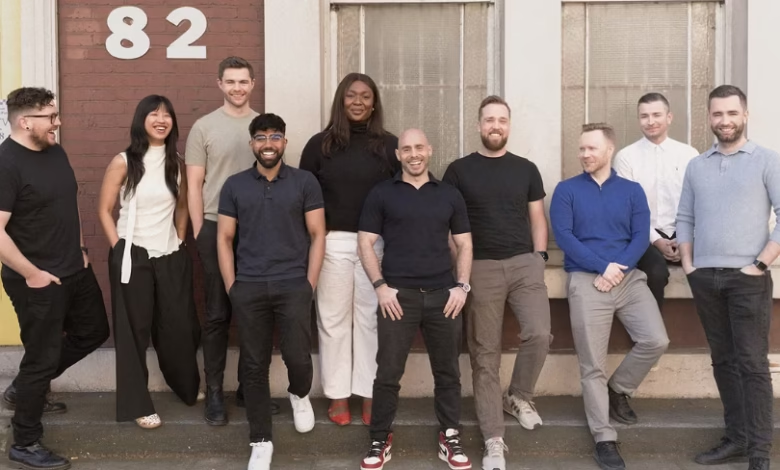
Dex, an AI-powered talent agent built specifically for technical hiring, has secured $5.3 million in seed funding to accelerate its growth and expand into the U.S. market. Founded by former Atomico talent adviser Paddy Lambros, the London-based startup charges employers a success fee only when a hire is made, a model that has already propelled it from zero to $1.8 million in annualized recurring revenue within six months of launching its paid service.
Lambros spent two and a half years advising roughly 100 European startups on hiring at Atomico, one of Europe’s largest venture capital firms. The recurring lesson was simple: nearly every serious problem at an early-stage company was downstream of a hiring decision. The wrong person in the role, or the right role left unfilled too long, and otherwise promising companies would stall. That observation became Dex, which Lambros founded in early 2025.
The seed round was led by Notion Capital, with participation from a16z Speedrun, Concept Ventures, and angel investors from OpenAI and other firms. The new funding brings total capital raised to $8.4 million, following a $3.1 million pre-seed last year.
Dex has deliberately narrowed its focus to a single slice of the technical talent market: AI researchers, software developers, and machine learning and quantitative engineers. More than 15,000 engineers have signed up to the platform, and over 50 technology companies, including Lovable, ElevenLabs, Synthesia, Granola, and Fyxer, are paying for the service. Since beginning to charge in late 2025, Dex has grown from zero to approximately $1.8 million in annualized recurring revenue. Lambros described profitability by year-end as “conceivable.”
The product works in two stages. A candidate begins with a conversation, either voice or text, with Dex’s AI agent, which asks open-ended questions about their experience, motivations, and ambitions. The agent, built on a combination of models from Google, Anthropic, and OpenAI, then surfaces relevant roles from a curated set of openings, helps the candidate research companies, benchmarks compensation, and prepares them for interviews. On the matching side, Dex uses what Lambros describes as “old-school machine learning,” a proprietary engine built from the richer, more detailed profiles the conversational AI assembles, to surface candidates to employers. When both sides indicate mutual interest, Dex introduces the candidate directly to the hiring manager.
The business model is deliberately agency-shaped rather than SaaS-shaped. Dex does not sell software to recruiters or integrate with applicant tracking systems. It charges employers a success fee of 20–30% of a hired candidate’s first-year salary, the same fee structure as a traditional executive search firm. “We only earn money if we do a good job,” Lambros said. The fee model is both a strategic choice and a pitch to employers who have grown wary of software subscriptions that promise to improve hiring without accountability for outcomes.
Lambros’ argument is that AI capable of sustained, contextually-rich back-and-forth conversation has, for the first time, made the core agency function genuinely automatable, and potentially better than the human version at scale. A human recruiter knows a few hundred candidates; an AI agent can hold detailed conversations with hundreds of thousands. A human recruiter works with a handful of clients at once; an AI agent can serve thousands simultaneously. The depth of data that candidates share privately with a conversational agent is also, Lambros argues, meaningfully richer than what they would put on a public LinkedIn profile or CV. That data asymmetry is Dex’s core product thesis: the quality of the match is only as good as the quality of the candidate model, and most existing tools, LinkedIn’s recruiter products, cold-outreach scrapers, job boards, are working with shallow, public information.
The seed funding will go towards opening offices in New York and San Francisco later in 2026, taking the company into the most competitive market for AI engineering talent. Lambros’ background, talent at Improbable when it grew from 50 to 650 people, people and talent at construction-tech startup Sensat, and then advisory work across Atomico’s portfolio, gives him credibility on both sides of the hire. If a London-founded, vertically-focused AI talent agent can hold its positioning against better-capitalized generalists as both scale into the US market is the question the next twelve months will answer.
(Source: The Next Web)