Metasurface Lens Enables Switchable 2D–3D Display
▼ Summary
– The MLL’s signal intensity is measured indirectly by subtracting DC noise from the total incident light power.
– Quasi-collimated light is created by turning on only a few pixels and collimating rays with a CCD lens.
– A linear polarizer and quarter-wave plate modulate incident light into the right-circularly polarized state.
– Efficiency is measured for different incident angles, with polarization aberrations minimized by positioning optics perpendicular to the light path.
– For normal incidence, measured efficiencies are 26.6% at 620 nm, 46.4% at 535 nm, and 54.8% at 460 nm.
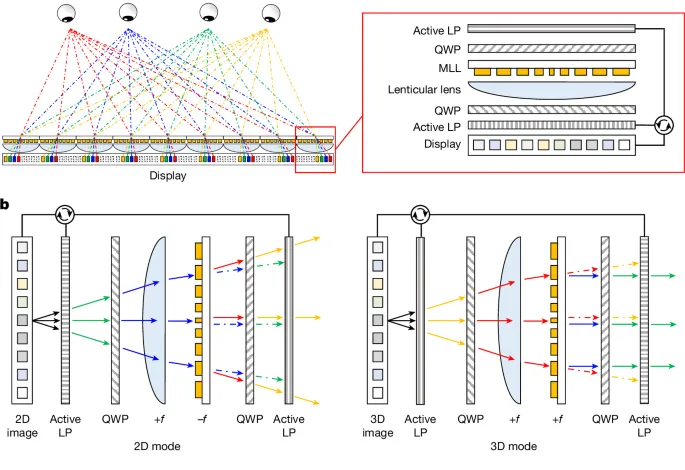
A newly developed metasurface lens is making waves in display technology by enabling a switchable 2D–3D viewing experience without the need for bulky mechanical components. This innovation relies on controlling light at the nanoscale to shift between flat and depth-perceived imagery.
To accurately measure the efficiency of the metasurface-based liquid lens (MLL) , researchers faced a unique challenge. Because the lens either diverges or converges light depending on the input polarization state, direct measurement proved difficult. Instead, the team measured the intensity of the DC noise and derived the signal intensity by subtracting it from the total power of incident light when the MLL was absent.
In the experimental setup, only a few pixels were activated to create quasi-collimated light. These rays were then collimated using a CCD lens. A linear polarizer (LP) and a quarter-wave plate (QWP) modulated the incoming light into the right-circular polarization (RCP) state. After the light passed through the MLL, a second QWP and LP blocked the signal. Efficiency was then measured across various incident angles. To minimize polarization aberrations, both sets of LPs and QWPs were aligned perpendicular to the light’s propagation direction. The output DC component was captured using an illuminance meter (model CA-210, Konica Minolta).
The results are compelling. For normal incidence, the fabricated MLL achieved measured efficiencies of 26.6% at 620 nm, 46.4% at 535 nm, and 54.8% at 460 nm. These figures demonstrate the lens’s ability to handle multi-wavelength operation effectively, paving the way for more versatile and compact display systems that can seamlessly toggle between 2D and 3D modes.
(Source: Nature.com)