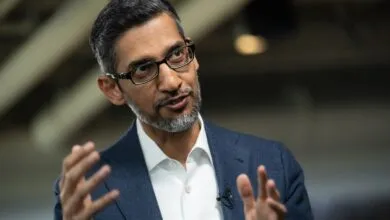
Google CEO: AI Agents Will Manage Future Search

▼ Summary
– Google’s CEO Sundar Pichai states that many information-seeking queries will shift to being handled by agentic AI systems that complete tasks.
– He envisions the future of search evolving into an orchestration layer that manages multiple AI agents performing actions for users.
– Pichai emphasizes that search will not be replaced but will expand by absorbing new capabilities like AI and adapting to shifting user expectations.
– He declines to predict the exact form of search in ten years, focusing instead on rapid yearly innovation due to fast-changing technology and user behavior.
– Notably, the CEO’s discussion of search’s future did not mention the role of websites or web pages as primary results.
The evolution of search is accelerating, driven by artificial intelligence that promises to fundamentally reshape how we find information and complete tasks. In a recent discussion, Google CEO Sundar Pichai outlined a vision where the traditional search box becomes a sophisticated AI agent manager. He suggests that many simple information queries will transition into agentic search, where AI systems handle multi-step tasks on a user’s behalf. This shift represents not a replacement for search, but a significant expansion of its capabilities as user expectations evolve with new technology.
Pichai described a future where search acts less as a simple results page and more as an orchestration layer between users and autonomous AI agents. When asked if search will exist in a decade, he reframed the concept, stating it would function as an “agent manager” where users accomplish complex, asynchronous tasks. This model moves beyond returning ranked links, instead managing multiple processes that execute over time. The CEO avoided declaring the current search paradigm obsolete, emphasizing instead that the product must continuously absorb new capabilities, much as it adapted to the mobile revolution.
A striking aspect of the conversation was the minimal mention of websites. Pichai referenced web pages only twice, and not in the context of Google Search fetching them for a query. This omission highlights a potential strategic pivot where web content is treated as structured data for AI systems to synthesize, rather than as destinations for users to click through. The focus is shifting from serving pages to completing actions, which raises profound questions for online publishers and businesses whose visibility has traditionally depended on organic search traffic.
Pichai dismissed attempts to predict the precise interface ten years out, arguing that the pace of change in AI models and device form factors makes long-term forecasting impractical. He advised focusing on the steep innovation curve just one year ahead. Crucially, he rejected a zero-sum game mentality, asserting that value creation expands for those at the cutting edge. For Google, this means aggressively developing both its search and Gemini AI platforms, allowing them to overlap and diverge where necessary.
This strategic embrace of uncertainty and competitive agility may work for a technology giant, but it presents a stark challenge for the broader ecosystem. If the future of search involves AI agents that summarize information and execute tasks without directing traffic to source websites, the foundational relationship between search engines and content creators is altered. The metaphor of websites as fleas on the dog of Google search may no longer apply, in a future where the platform itself might be seen as feeding on the web’s content to fuel its agents. The imperative for businesses is clear, adapt to an environment where search is no longer just about finding, but about doing.
(Source: Search Engine Journal)