Steve Jobs’ Historic Product Innovation Streak
▼ Summary
– Steve Jobs returned to a struggling Apple in 1997 and immediately criticized its unfocused and unappealing product lineup.
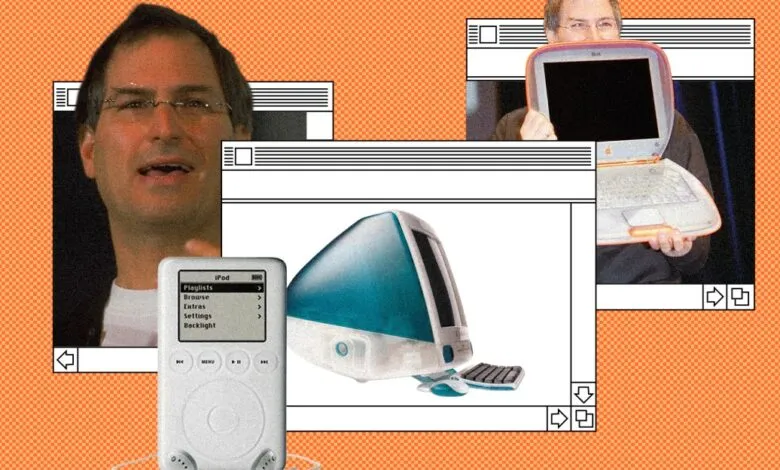
– He implemented a simplified product strategy and a design-focused culture, leading to the 1998 launch of the successful, all-in-one iMac.
– Following the iMac, Apple entered a period of rapid innovation, releasing hits like the iBook, Mac OS X, and the iPod.
– The company consistently refined its successful products, like introducing new iMac designs and iPod models with features like the click wheel.
– This product development streak culminated in the 2007 iPhone, which transformed Apple from a computer maker into a global tech giant.
In May of 1998, roughly ten months after his dramatic return to the company he co-founded, Steve Jobs stood before a Macworld audience with a confident declaration. Apple was back on track. Dressed in his trademark dark jacket and white shirt, he unveiled a new computer designed for the internet age: the iMac. Jobs predicted it would be a major success, a forecast that would prove profoundly correct and mark the beginning of an unprecedented era of commercial and cultural influence.
The Apple Jobs returned to in 1997 was a company adrift. Its product lineup was a confusing array of devices with names like Quadra, StyleWriter, and Pippin. It dabbled in printers, business servers, and the Newton handheld, all while its core computer business struggled. Jobs was famously blunt in his assessment, reportedly stating the products had lost their appeal. Even during his years away at NeXT and Pixar, he had publicly critiqued Apple’s lack of innovation, telling Fortune in 1995 he had a perfect rescue plan, though no one at the company would listen.
While that specific 1995 blueprint remains a mystery, Jobs moved swiftly to implement his vision. He simplified the entire company strategy around a now-legendary four-quadrant grid, focusing on just four core products: consumer and professional desktops and portables. He overhauled the corporate structure, empowering the design team led by Jony Ive with unprecedented authority over a product’s form and function. The first fruit of this new direction was the iMac, a bold departure from the beige boxes of the era. Its colorful, translucent, all-in-one design was a statement of intent.
The market response was overwhelming. Apple sold 800,000 iMacs in its first five months, making it the best-selling computer in the United States. Its success came despite, or perhaps because of, its radical simplicity. It eliminated legacy ports in favor of USB and rejected modular upgrades, appealing to consumers tired of complexity. This victory was a financial lifeline for a company Jobs claimed was 90 days from insolvency, and it ignited what can only be called the iDecade, a historic streak of product innovation.
The momentum continued in 1999 with the iBook. This colorful clamshell laptop featured built-in wireless networking, a novelty so striking that marketing head Phil Schiller demonstrated it by sending a file while jumping off a stage. Apple also refreshed its professional lines, introducing the sleek Power Mac G4 and the ambitious, if flawed, Power Mac G4 Cube.
The year 2001 marked a pivotal transformation. Apple released Mac OS X, an operating system built on NeXT software that would underpin its devices for a generation. That October, Jobs introduced the iPod, promising to put 1,000 songs in your pocket. It evolved from a luxury item to a cultural staple, its iconic white headphones symbolizing a new era of portable music. Apple refused to rest, continuously iterating. The iMac was reimagined with the sunflower-inspired G4 model, and the iPod was refined through multiple generations, culminating in the intuitive click wheel.
By the mid-2000s, Apple’s focused strategy seemed unstoppable. It launched the iPod Mini, the ultra-compact iPod Shuffle, and the revolutionary iPod Nano. The company transitioned its computers to Intel chips, debuted the MacBook Pro, and solidified its reputation for design-led excellence. While not every product was a hit, the pace of reinvention was relentless.
This period of intense creativity was building toward something monumental. Prototypes for a tablet using multitouch technology were developed, while the iPod team brainstormed ideas for a phone. These parallel projects eventually converged into a single device. In January 2007, Jobs unveiled the iPhone, declaring the fusion of an iPod, a phone, and an internet communicator. This launch catapulted Apple from a successful computer maker into a global titan.
The years following the iPhone brought the iPad, Apple Watch, and AirPods. Yet, for sheer velocity and consistent breakthrough innovation, the decade following Jobs’s return remains unmatched. It was a period where a company once struggling to find its way repeatedly redefined entire categories, forcing the world to play catch-up. We inhabit a world shaped by the iPhone, but the iDecade stands as Peak Apple, an unrepeatable run of creative and commercial triumph.
(Source: The Verge)