Nvidia DLSS 5 Tested: Controversial but Visually Stunning
▼ Summary
– Nvidia’s newly announced DLSS 5 uses a “neural rendering” model to add photorealistic effects like shadows and textures, going beyond previous versions that focused on upscaling or frame generation.
– The technology has drawn criticism for potentially acting like an AI filter over developers’ original art, but Nvidia states developers will retain full artistic control to fine-tune it.
– In demos, DLSS 5 significantly enhanced visual realism in environments and characters, such as updating older game models to appear more lifelike.
– The current demo required two high-end RTX 5090 GPUs, indicating DLSS 5 is not yet optimized for standard hardware and its performance impact remains a key unknown.
– Major game studios like Bethesda and Ubisoft are preparing to support DLSS 5, which Nvidia plans to launch in the fall.
The dramatic visual leaps that once defined new console generations seemed like a relic of the past. That perception is now being challenged. Nvidia’s newly announced DLSS 5 represents a potential single-generation graphics jump of a magnitude gamers haven’t witnessed in years. It is also, predictably, courting significant controversy, prompting CEO Jensen Huang to mount an early public defense. This technology moves far beyond the upscaling and frame generation of its predecessors, aiming for something fundamentally different.
During Nvidia’s recent GTC event, I experienced several early demos. The implementation is clearly not optimized for current hardware, but the preview was nonetheless stunning. It repeatedly forced a compelling question: if Nvidia can successfully deploy this, are we looking at the definitive future of in-game visuals?
Traditionally, DLSS (Deep Learning Super Sampling) has used AI to boost frame rates, either by intelligently upscaling a lower-resolution image or generating entirely new frames. DLSS 5 introduces a paradigm shift with “neural rendering.” This new model is designed to overlay photorealistic effects directly onto a game’s visuals, adding a sophisticated layer of detail that standard rendering techniques struggle to produce. Developed over three years, the technology can inject startling depth through enhanced shadows, textures, and definition on everything from character faces to environmental objects.
However, the announcement was met with immediate skepticism. Critics have likened it to applying an Instagram-style filter to game assets, arguing it could act as an “AI slop generator” that disrespectfully overlays synthetic imagery on top of artists’ original work. These concerns were in my thoughts as I viewed the demos. Yet, seeing the technology operate firsthand made its transformative potential equally clear.
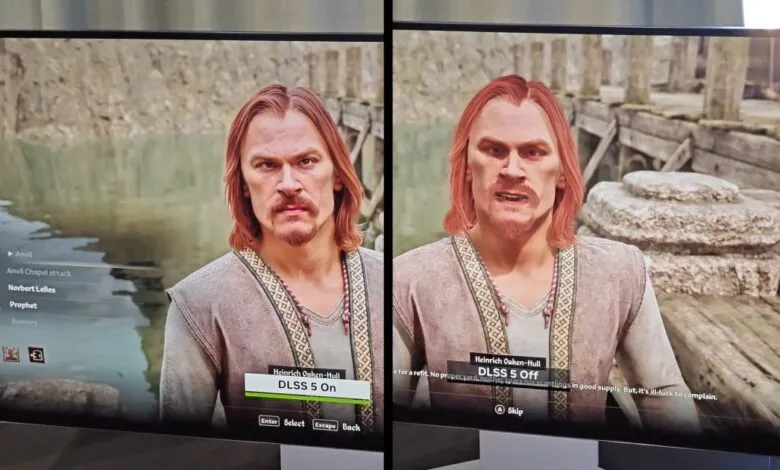
One fact became immediately apparent: this is no simple filter. In various scenes, video game rocks, trees, water, and architecture gained an uncanny resemblance to their real-world counterparts. A demo for The Elder Scrolls IV: Oblivion Remastered was particularly revealing. Characters originally modeled with the infamous “potato” faces two decades ago were instantly transformed. They exhibited photorealistic skin, hair, eyes, and clothing, trading a certain nostalgic charm for a powerful new sense of immersion.
In a preview of Assassin’s Creed Shadows, DLSS 5’s neural rendering turned lush forests into something that felt genuinely organic. The effects introduced nuanced variety in light and texture across dense foliage and rocky terrain, creating landscapes nearly indistinguishable from photography. Crucially, the enhancement never felt artificial or heavy-handed. Nvidia emphasizes that its system is designed to understand the 3D structure of characters, objects, and environments, preserving the original artistic models before enhancing them.
The major unresolved question is practical power. DLSS 5 remains a work-in-progress, demonstrated using a setup with two GeForce RTX 5090 graphics cards. One card handled traditional game rendering while the other applied the neural effects. This dual-GPU requirement highlights the significant optimization needed before it can run on a single consumer card. Nvidia aims to launch the technology this fall, but an initial limited rollout seems likely.
Other unknowns loom large. Will DLSS 5 introduce a substantial performance penalty, ironically counteracting the frame-rate mission of earlier DLSS versions? How will it perform across an entire game’s varied scenes, not just controlled walkthroughs? Broader industry issues also cast a shadow, from ethical debates over generative AI to the AI-driven memory shortage that is inflating GPU prices and could limit access to this technology.
Despite these valid concerns, the raw visual achievement is undeniable. In my demo session, DLSS 5 produced the most realistic game graphics I have ever seen. Nvidia is already addressing backlash by clarifying that game developers will retain full artistic control, able to fine-tune the model’s application. Major studios like Bethesda, Capcom, and Ubisoft are reportedly already preparing support. Once you witness the technology in action, its vast potential is hard to ignore.
(Source: PCMag.com)